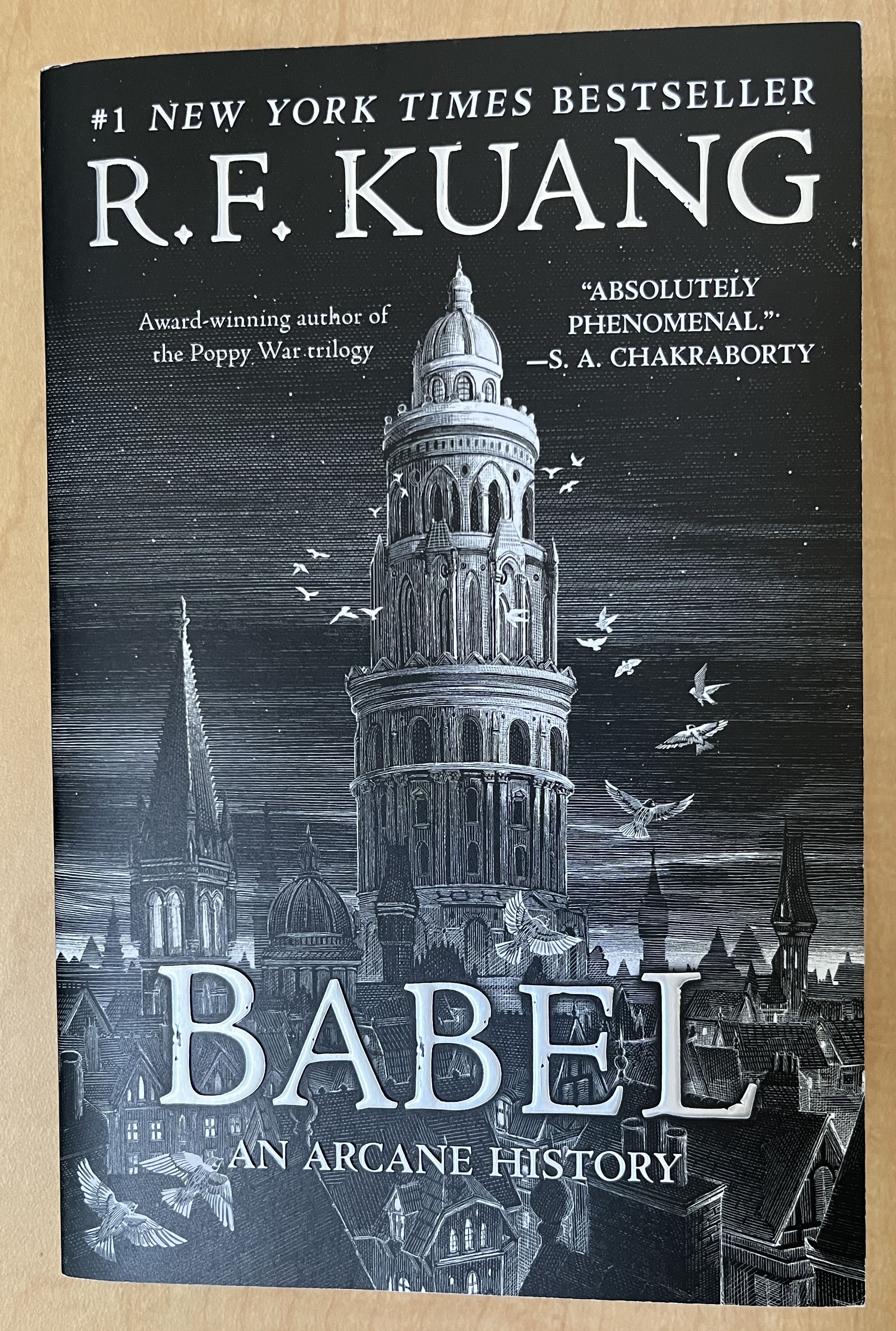
 I picked this book based on the effusive praise from a customer in the local bookshop (there will be a few more in the next few months based on her recommendations). I didn’t recognize the author’s name, but upon starting this book realized I had read her before – her debut novel, Yellowface, which was so bad I stopped reading after ~70 pages (it was truly drivel). However, I was interested in this one as an alternative history novel, so I persisted.
Set primarily at Oxford, the novel is about the fictional Royal Institute of Translation, a prestigious school at Oxford specializing in translation and the study of language as well as the creation of magical silver pieces that use multiple languages to create their spells. The spells require the engraving and incantation of pairs of words obliquely linked between two languages, and require that the spell be created by a native speaker of at least one of the languages; also, the more obscure the better for the power of the spell. Thus, we meet the protagonist, Robin Swift, a half-English half-Chinese orphan, trained for the sole purpose of entering the Institute by a shady professor, his adoptive father and benefactor. Robin’s cohort at the school becomes a close-knit group, but Robin is lured into sedition against the institute by the shadowy Hermes Group. Chaos, revelation, and revolution ensue.
This novel read like a somewhat more grown-up and convoluted Harry Potter story. The central characters are essentially children (late teens and early 20s, but not mature), and the sorcery involved with the magic silver makes this more of a fantasy novel than speculative or alternative fiction. The main character was interesting, but often petulant and quick to judgement, making him a less sympathetic hero than the story needed. As we learn through the story, Robin’s origins and entree to Oxford are not unusual, and so a few other characters may have been more worthy of being the focus. Despite being quite a long/hefty book, there are several story elements that are unsatisfyingly unfinished at the end.
There were two interesting themes that kept me engaged in the story. The first was language – the discussions and digressions about overlaps between languages and their divergent and convergent evolutions. I was reminded here of the book The Wayfinders, and the study of how languages can represent more than just words, but also the history and culture of a people and their connections to the natural world, and how, when we lose a language, we lose much more than just that way of communicating with each other. This element was also interesting for its connection with violence – how words can be violent (in the novel, quite literally through the spells they cast), and the removal of words can be violence through the silencing of voices and the othering of those we no longer understand.
The second and related theme was anticolonialism, an offshoot of the theme of language and a driving force behind the revolution that Robin and friends effect at Babel. As shown here, colonialism and its step-children – racism and unfettered free-trade – are unequivocal evils. This is where the title modifier – “or, The Necessity of Violence” – comes from. The rebels come to understand that non-violence will never defeat these forces of evil; only violence on an epic scale can undo all the bad of colonialism. This is a very strange argument, and while it is demonstrably successful in the novel, at least temporarily, it is a questionable moral for this fable, especially as the chosen violence is both catastrophic and (in the line of the story) precipitous, brought on through the impatience and caprice of the youthful freedom fighters. Their all-or-nothing approach supposes that all colonialism, industrial progress, multiculturalism, and globalization is bad and must be not only stopped but reversed, an argument that is both naïve and specious.
Two other interesting points – touched on briefly and then left behind. First was about the cost of progress and technology. “…machines of the kind William Blake dubbed ‘dark Satanic Mills’ were rapidly replacing artisanal labour, but rather than bringing prosperity to all, they had instead created an economic recession, had caused a widening of the gap between rich and poor that would soon become the stuff of novels by Disraeli and Dickens.” This could easily be said about today’s world and the emergence of AI, displacing knowledge workers of all kinds and providing benefit only to the already rich. Second was this throwaway comment about the Babel scholars’ development of an alphabet readable only by them, for the sole purpose of retaining the technology as proprietary and ensuring their rivals cannot compete: “It is astounding, in truth, how much of academia’s perceived resource scarcity is artificially constructed.” I see in this the Ouroboros of modern academia, with its tensions and torsions around being both collaborative and competitive.
As with the previous novel, the writing is not very good. The novel is longer than it needs to be, especially with the missing conclusions to several storylines, and the style is somewhat juvenile (again, Harry Potter-ish), which is strange considering the elaborate explanations needed for the study of languages so essential to the story. There is far too much narrative exposition beyond what is needed for the etymology, with characters expounding for pages and pages in a lecture-like tell-don’t-show style. I liked this novel enough to finish it, but not enough to recommend it, nor to seek out anything more from Kuang. She is popular in her niche – it’s just not a niche I want to be part of.
Fate: little book library.
1 – a murder
5 – about language
8 – a female author
17 – a place name
20 – one word

