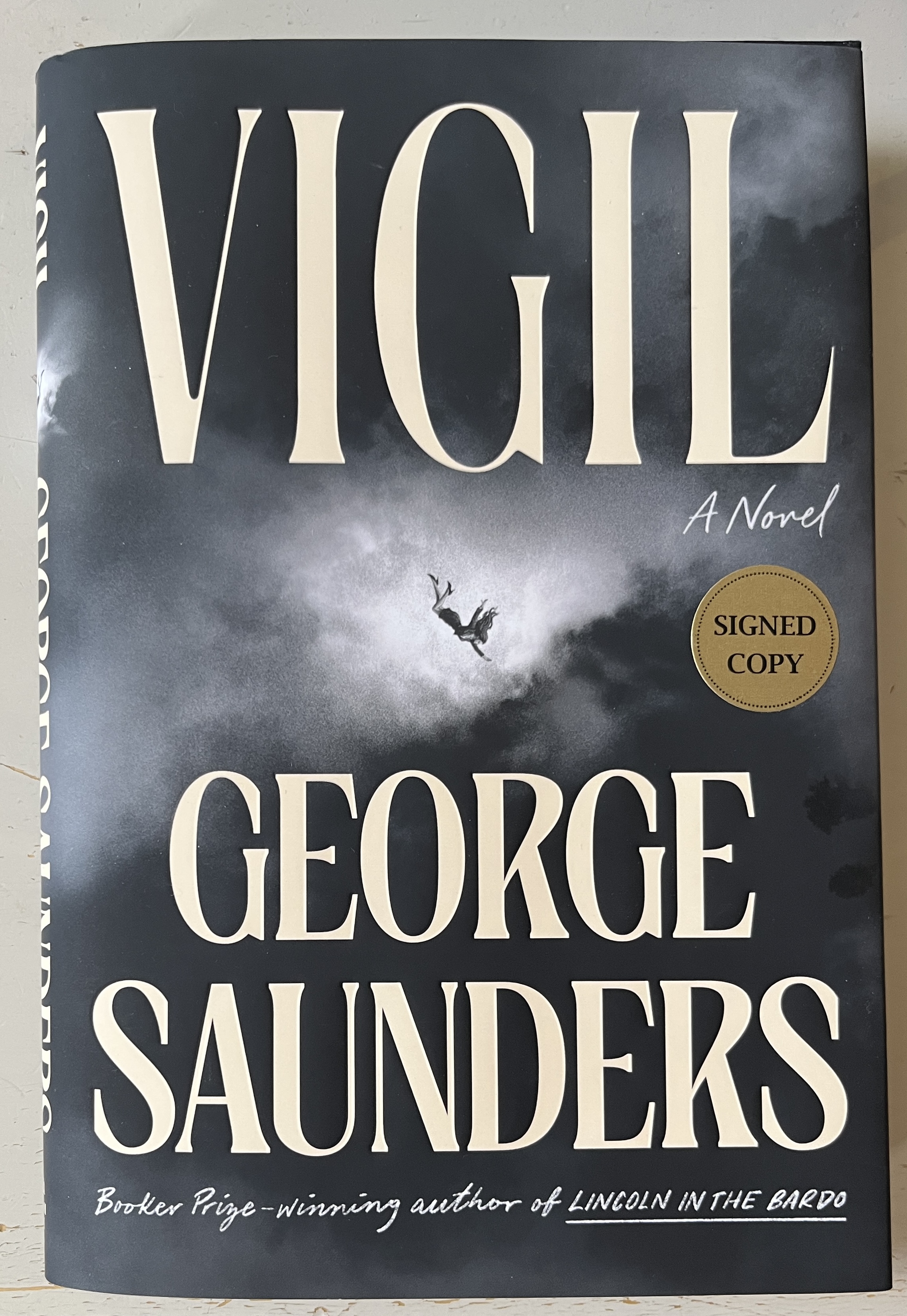
I was excited to read this, as George Saunders is a favourite short story writer, and his excellent previous novel (Lincoln in the Bardo) was a favourite in recent years. A friend recommended this book earlier in the year, and after a recent coffee chat where I was praising Saunders’ stories, it seemed timely to get into this one.
Set in a similar Bardo-like environment as the earlier novel, here we meet Jill, a kind of ghost whose role is to visit the dying and offer them an opportunity to recognize their failings and atone for (or at least own up to) them in their last moments. She encourages the dying person to revisit their past – the familiar ‘life passing before one’s eyes’ – and seek revelations about their gifts and sins before passing into the afterlife. Her latest charge is a self-made man, rich on the bounty of the oil business and infamous for his self-serving denouncements of climate change science. As he nears death, he has the opportunity to admit he lied out of self-interest and to acknowledge his complicity in the environmental damage wrought by his industry – a kind of last rite of confession, although it’s not clear absolution will follow.
A series of other ghosts appear to bear witness to the devastation caused by this man, but to little avail – he is steadfast in his claims and defiant in his defence of industry. While Jill’s role is to provide comfort and guidance, she comes to dislike her charge, often having to step away and clear her head, a tricky thing for a non-corporeal being. In these breaks from her bedside duties, we learn of her own life and death stories, and a bit more about the “rules” of the Bardo, including: remembering your past life affects the power you have in this realm. As the man crosses the veil into death, he tries to repent but learns too late the fate of those who deny anthropic climate change (here the seemingly ultimate sin) – a set of nasty ghosts drag him away for eternal tortures unknown. Jill has one last burst of power to free him, saying a better fate for him is to wander in the Bardo and face all of those to whom he owes apology, and to play a role in visiting others – all his fellow oil barons on their deathbeds – to encourage their enlightenment.
While the Bardo-like world was still fascinating, I found this story disappointing in its heavy-handed social commentary. Described cleverly elsewhere as a ‘climate change Christmas carol‘, I didn’t feel the urgency or cogency of the arguments being made by the ghosts to entice the man to change his mind and repent. Like so much of the human-caused damage to the Earth and humanity, to focus the blame on a single person is both myopic and narrow-minded. While there certainly are individuals who make decisions, take action, and wield power to the detriment of society, no one of them could be the sole cause of the damage – such effects require the complicity of many and the apathy of many more. I was reminded of my earlier read (the novel, Babel), and the characterization of some elements of history as unequivocal evils, not considering the blend of good and bad in those larger concepts. In Vigil, we’re asked to look on the oil industry, and its progenitors back to the Industrial Revolution and the invention of the internal combustion engine, as entirely and unequivocally bad. While there is plenty of bad to go around, much progress and advancement came from those phases of social and technological progress, up and including the tools enabling the printing and distribution of the book itself and the computer and systems supporting this review. When complex issues are made polemic, I start to tune out; I prefer a bit more compassion and humility in my arguments, and acknowledgement of the nuance of reality.
In the Bardo of the previous book, ghosts remain by choice rather than by design and confine their society to each other, doing very little other than talk amongst themselves while leaving the living to get on with their lives; each has a chance to tell their life and death story, and eventually gets the opportunity to move on from the Bardo to somewhere else. While ghostly, the Bardo is somewhat clearly realized and understood; the reader knows what the ghosts can and cannot do, why they are all there, and where they go next. In Vigil, the world of this Bardo (or whatever this dimension is called) was interesting but less clear, perhaps because of the greater role played by living characters in this story but more due to lack of development of any character other than Jill and the man (who remains the more inscrutable despite being a living person and not a ghost). The ghosts seem to have roles to play and some objectives in their interactions with the living, but without any motive. It is never clear why Jill, who led an innocent and blameless life before her accidental death at a young age more than 50 years earlier, is in this world, or why she has this duty to provide comfort and guidance to those dying with unresolved issues. It’s not a pleasant place to be, so either she’s here because she must be or because she chooses to be, but neither explanation makes sense, and this applies to all the others. (At one point, Jill encounters the ghosts of some animals, further confusing the rules of this place – do animals have ghosts?) If not everyone who has died is here (which would be incredibly crowded and noisy), then where are they? And why are these particular spirits stuck here? There are suggestions of a God and of some kind of order to the levels, but nothing of sufficient detail to make it make sense. While we don’t need a full dissertation on the rules of this world, the reader gets insufficient information to even make their own determination.
The non-ghost characters here are poorly defined, mostly caricatures of a nouveau-riche oil baron and family – the malevolent but beloved dad and self-made CEO, the doting (and almost certainly blond and plastic) wife with no other role in life, the ditzy and spoiled child with a strong conservative worldview shared with her father. It is clear from this shallow portrayal the author does not like or care about these people and despises their lifestyles and opinions, but doesn’t give them any depth, just a single lens (his own) through which to view them. As one of the ghost characters is identifiable as an historical figure (one Étienne Lenoir, the inventor of the internal combustion engine), I was expecting to recognize the oil executive character in one of the current mainstream villains but he seems to be an pastiche of the greedy, selfish magnate, which is perhaps why his character is not fully realized.
With neither the corporeal nor spectral characters having much depth, it is hard to like or engage with any of them. We’re not supposed to like the man, but it’s hard to feel anything with such little character provided for him, and his refutations of climate change are more persuasive in some places than the case being made against him personally, which further undermines the dislike we’re supposed to feel towards him. Indeed, Saunders might be guilty of the same thing as the man in the story – creating “facts” and telling only part of a story in order to convince a broader audience they are right – as some of the “evidence” produced against the man reads more like conspiracy theory than ground truth, especially as presented by ghosts with a tenuous grip on reality. (I felt a similar challenge with Fire Weather, in that the arguments purported to make the case for anthropic climate change fell short due to loss of nuance and tendency to hector rather than persuade.)
The book is quite short, which is perhaps part of the issue. With some additional depth given to the ghostly characters or the explanations of the limbo they exist in, the story might have flowed a bit better and ended with more clarity. However, such extension might have resulted only in more climate commentary and conservative bashing, and there’s quite enough already here.
In the end, this was not great, so a disappointing effort from an otherwise excellent writer. Hopefully Saunders will return to the realm of short stories, where the social commentary is much more subtle and effective, and the narratives stand on their own a bit better.
Fate: TBD. It’s a valuable hard copy, so I’m loathe to let it moulder in a little book library.
4 – published 2026
13 – somewhere I’ve never been (Dallas)
20 – one word title


Leave a comment