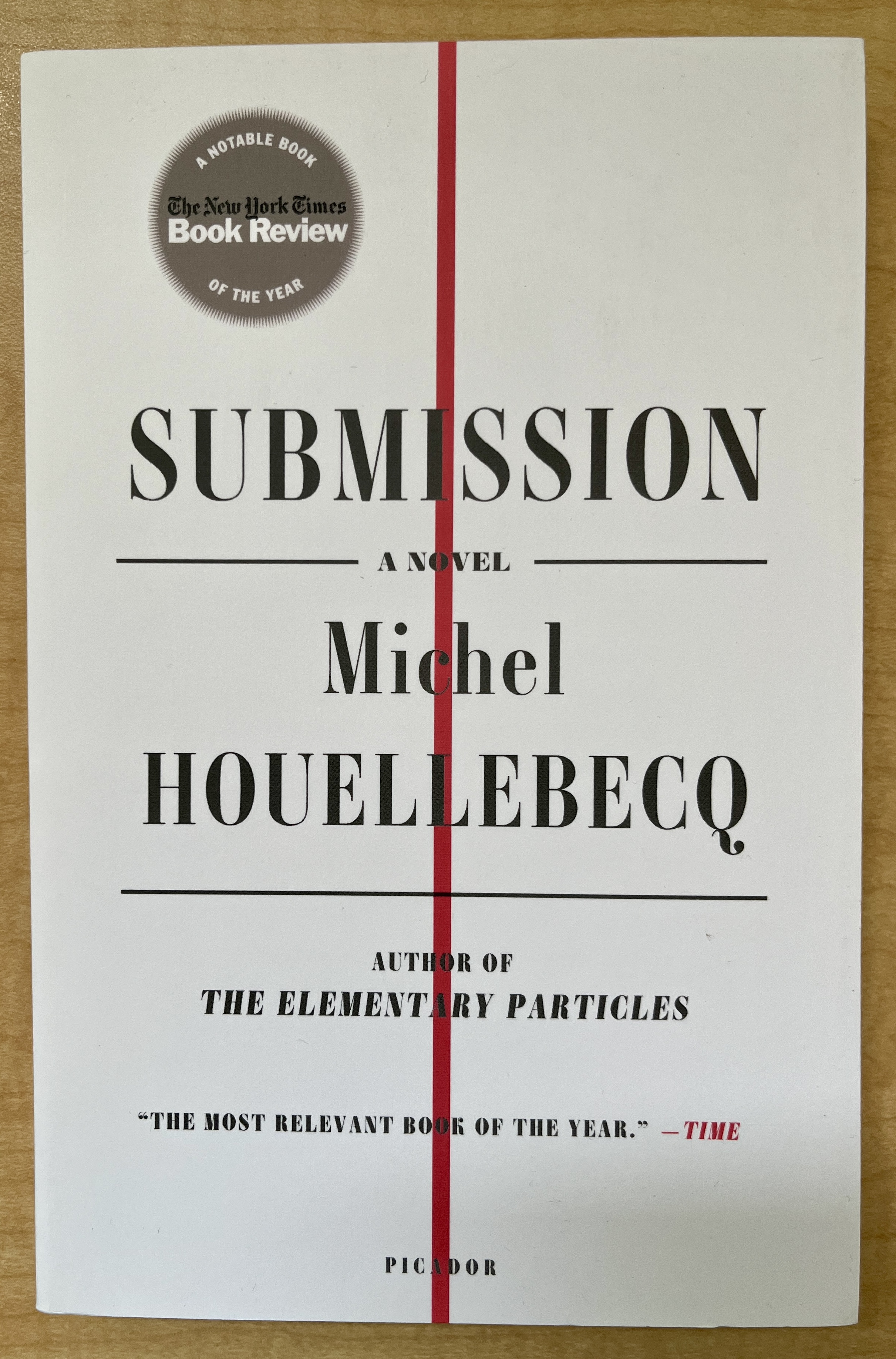
 I have no idea why this book ended up on my shelves. I must have read something about it, or perhaps I confused it with a different French novel. Regardless, I must have had some reason to get. Now that I’ve read it, I’m truly at a loss. Ugh. Just ugh.
This is a satire, which is not my type of novel. The blurbs I read suggested that it was an “important” and though-provoking story. Briefly, the protagonist (François) is a literature professor at the Sorbonne, with a specialty in an early 20th c. Decadent writer named Huysmans. François is also a decadent – he aims to put in the minimal effort needed to keep his job; he eats microwave meals and drinks to excess often; he has an annual affair with one of his students, treating the student list like a sexual menu. The novel is set in 2022 – it was jarring to read about life in that year without the shadow cast by Covid – and civil unrest in France reaches a flashpoint in the presidential elections that year. The result is the election of the Muslim Brotherhood to the presidency, and the immediate and sweeping changes to French society. As described here, these are based on the most superficial understanding of Islamic regimes, with all the hot-button items absent any theocratic understanding. In the end, François, always game to do the bare minimum with no integrity or commitment to anything, realizes that he can maintain and even enhance his lifestyle by meeting the minimum criteria to be part of this new society: he converts to Islam. The novel attempts to portray this new world as nihilistic, but François has insufficient belief in even that philosophy for it to apply here.
There was potential to really explore such a counterfactual political future, but the novel ruins any pretence of serious consideration, satirical or otherwise, with the blatantly racist depictions of almost every segment of society and the farcical situations François encounters. After the first 2/3 of the book, I was tempted to set it aside, but I held out hope that there would be some kind of point. Alas, the last 1/3 was even worse, with long expositions by grasping cynics embracing the new system solely for its individual benefits (for men, not for the women). Every character is one-dimensional, and the women shallower than a mere smear on a page. François is cartoonish, buffoonish, and distasteful. Described by some critics as dystopic and cautionary, perhaps I just don’t get satire, but I did not see the point of this poorly told tale.
Fate: little book library where I hope it gets moldy and eventually disintegrates.
20 – one-word title
21 – translation
25 – new author to me
38 – drivel


Leave a comment