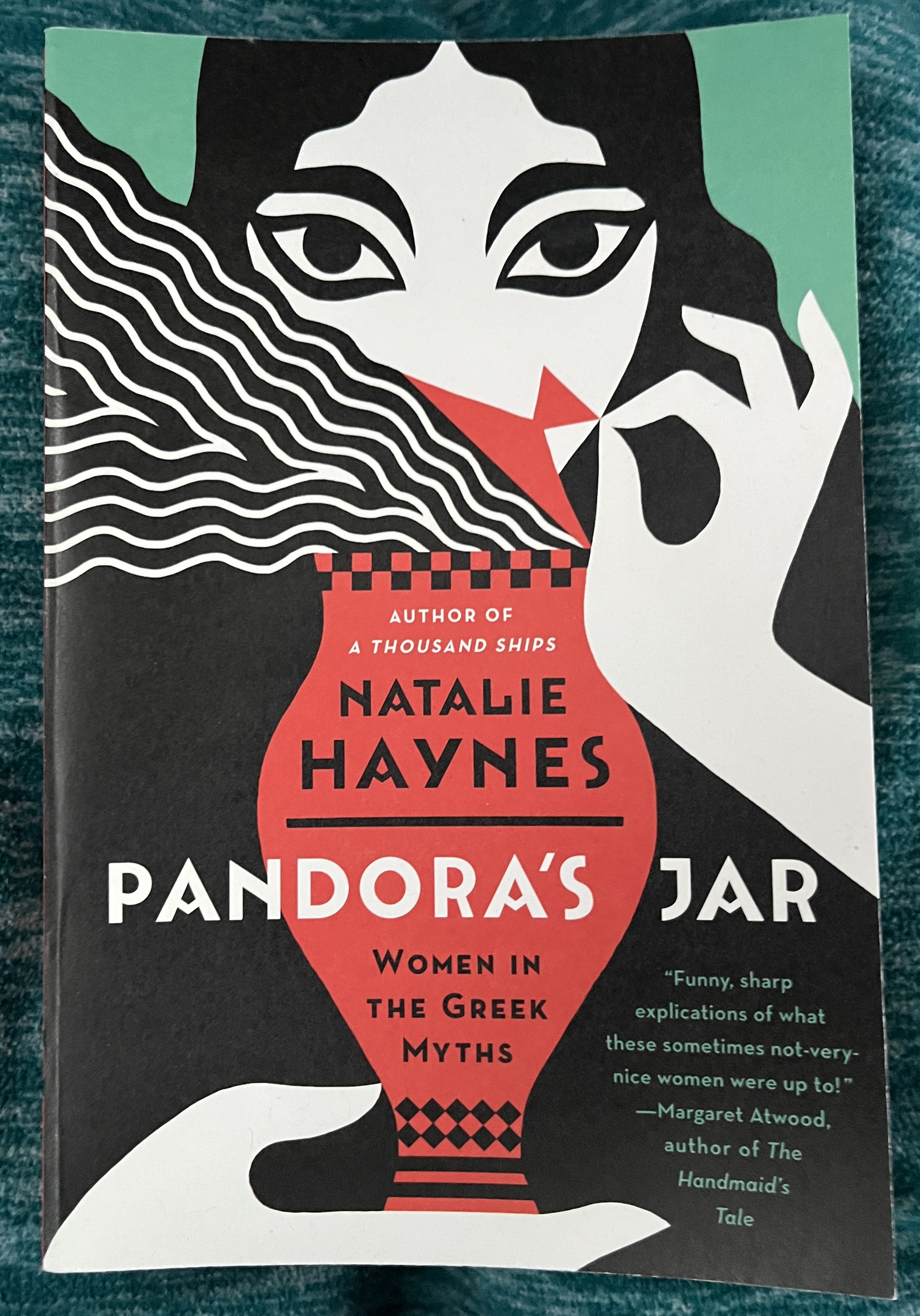
 I took this book on a recent bus trip under the mistaken impression it was a novel. While I was initially disappointed to have no fiction in my travel book selection (the other being a non-fiction maths book), I stuck with it and found it enjoyable and enlightening.
I’ve read two novels by Haynes (both excellent) and am a big fan of her podcast (Natalie Haynes Stands Up for the Classics). She is an erudite and witty storyteller who (I recently learned) considers Julian Barnes’ style (making me want to reread Talking It Over) as a significant influence on her writing, which only increased my admiration for her. She specializes in telling the stories of women largely ignored, marginalized, or misrepresented in classical literature, and her novels are engaging and realistic portrayals of little-known or only slightly familiar characters. Here, she takes a more direct approach to dispelling myths and giving voices to those woman.
In this essay collection, Haynes does a deep dive on ten famous females from the classics to provide a critical reassessment of many of the tropes often associated with each, starting with Pandora. Things I learned from this essay: Pandora had a jar, not a box; Pandora was the first woman (a kind of an Eve), created by the gods and deposited amongst men as a double-whammy curse (first, to disrupt life with her female-ness, and then to unleash the contents of the jar); the contents of the jar and the cause and consequences of its opening are much debated by scholars. Haynes explores Pandora and her jar in detail, revealing the complexity and nuance of a story often delivered more cartoonishly: a woman’s curiosity unleashes all the evils on the world. In fact, it was Prometheus who was the cause, as it is in retribution for his disobedience Pandora and the jar are created in the first place (the gods not being content with the whole daily-eagle-liver-eating thing). Pandora’s story has nuance and complexity lost through the various writings, translations, and interpretations over time, and not least by the imposition of stereotype by male artists on female characters and of the influence of culture on the one-dimensionality of how women are portrayed in most literature prior to the last 200 years.
Haynes gives similar analysis and discussion to other classic (and classically misunderstood) women from antiquity and myth, including Helen, Clytemnestra, Medea, and Penelope. She does not deny any character their agency to be heroine, victim, or villain; rather, she portrays most as a melange of all three and dismantles much of the mythology around these mostly tragic women. For example, rather than merely a haughty, insipid, and mostly silent blonde, bombshell, Helen is a woman whose life was made tragedy from a young age by the very blessing that would make her infamous: her beauty. Treated by men as prey (not as a trophy, since they do not value her once they have her) and by women as malevolent competition, Helen is isolated by a world that despises her even while telling her she is adored. (This book was written in 2020, so I wonder what Haynes would make of the Barbie movie.)
Haynes relies on familiar ancient authors, including Homer, Euripides, and Ovid among many others, as well as representations in art and architecture; the essays come with references but are not laden with quotes and citations so remain highly readable. I found it interesting the best sources of these histories are literature, especially poems and plays from 5th-8th century BCE, all telling and retelling stories from the previous period of oral history and tradition. The stories comprise a strange blend of history, mythology, culture, and politics, and Haynes dissects the various sources for her essays to try to find the essence of each character and how the authors and periods adjust and influence these and their places in modern thinking.
Haynes’ experience in stand-up (especially her podcast) is very much in evidence, with sidebar stories and the occasional quip elevating these essays from dry literature reviews to stories all on their own. Knowing her voice, it was easy to read these and hear her speech and cadence, adding a liveliness and wry commentary within the analysis. Example: when talking about Perseus murdering hundreds at his own wedding, “That’s certainly one way to make sure you have enough cake to go around.” Another: when discussing women in literature and in Greek society in 5th c. BCE, “Thankfully the hypocrisy of censuring women’s behaviour in general while maintaining an entirely different set of standards for the actual women you know has now died out.” Her sarcasm is perfectly timed and targeted but used sparingly enough that her more serious messages are retained.
I enjoyed this book more than I expected and am glad I made the mistake of bringing it on the bus. I have a richer understanding of these characters and stories, and a twinge of interest in reading sources I would previously have avoided, including Homer and Euripides. (I was also delighted to learn in my background reading that Haynes has a new novel out; I can it add to this year’s birthday and Christmas wish lists :-).
Fate: I might send this to an emerging young actor I know, as the backgrounds about these essential and often misunderstood characters in classic plays might be of interest to them, especially as this collection is so very readable and often quite funny.
1 – murder
8 – female author
10 – essays
13 – place I’ve never been
14 – name in the title
32 – about art


Leave a comment