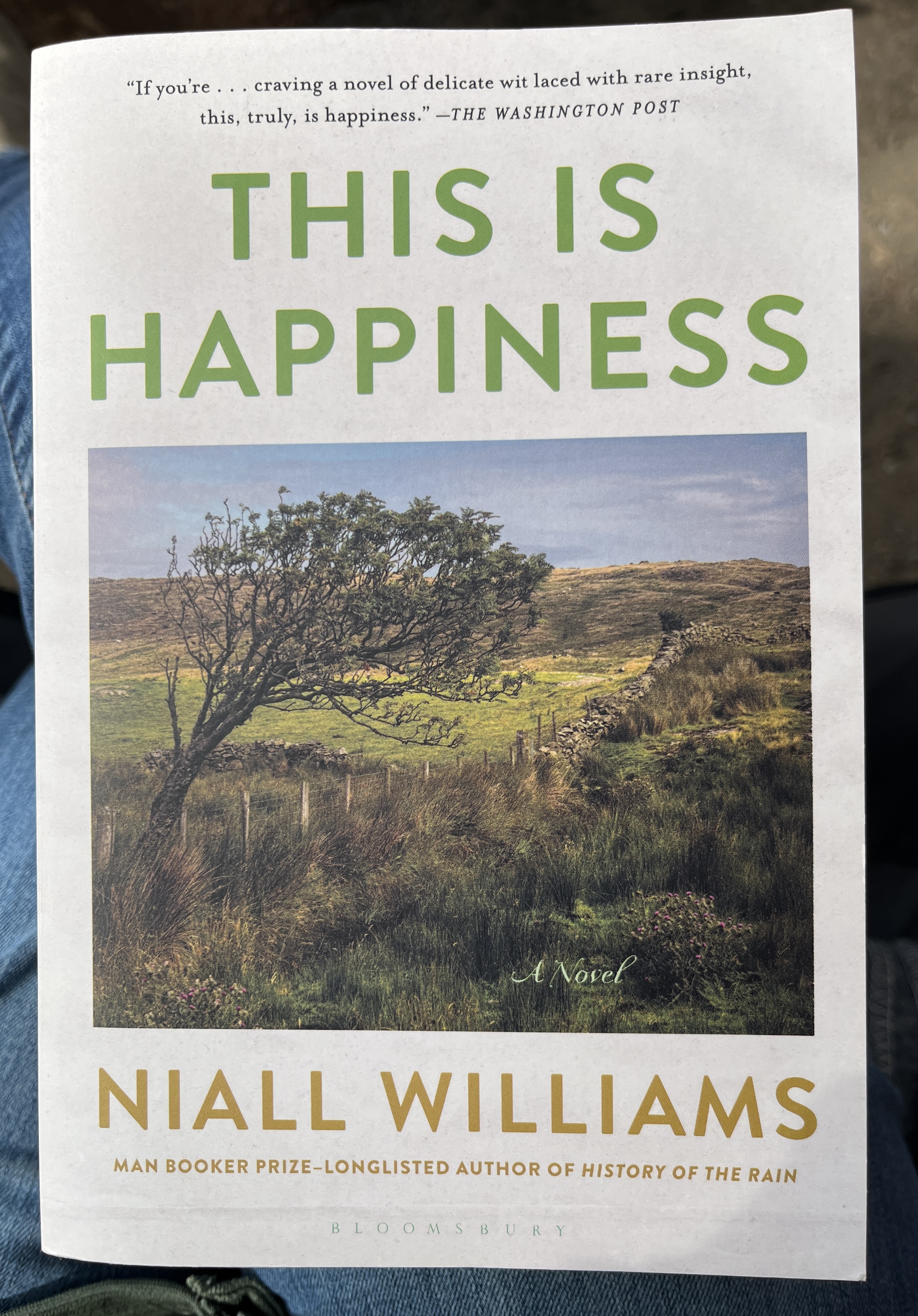
 This has been on my shelf for a while, moving up and down the tsundoku depending on when and from whom I heard it mentioned. It was on the top at last just before vacation. Described by critics as “unhurried” and “elegiac”, it requires slow and savoury reading, perfect for a holiday.
The novel is about a place and time – Faha, a fictional small town in Western Ireland, in 1958. Electricity is coming to the town (as part of Ireland’s Rural Electrification Scheme) and with it the beginning – and the end – of many ways of life. The narrator is Noel Crowe, looking back sixty years to the spring when he was 17 and living with his grandparents in Faha after leaving (without completing) seminary school. Noel is confronting and/or avoiding his grief at the death of his mother (something he feels responsible for), the pressures to return to the seminary, and the awakening of romantic love. The Crowe’s are joined for the summer by a lodger named Christy McMahon, the representative of the electricity board, charged with reinforcing the years-old commitments by the town’s residents to have power poles installed on their properties and their houses connected to the grid. Christy has a secret and more romantic reason for being in Faha: seeking forgiveness from his own lost love from fifty years before.
This is a novel of details. Despite taking place over just 10 weeks between Easter week and early June, the story ranges backwards years and decades to tell of each characters’ past and present. It feels like a delightfully Irish way of telling a story, where every step forward in the present requires several branching steps backward and sideways to ensure you know all about the people and places. This accounts for the unhurried feeling of the novel – a story of those 10 weeks could likely have been a short story, but it is enchantingly enhanced by the rich details of the lives of Fahaeans. “And because in Faha, like all country places, time was the only thing people could afford, all stories were long, all storytellers took their, and your, and anyone else’s time, and all gave it up willingly…”
Williams is a terrific writer and storyteller. The novel reads like it would sound if told aloud, slow and engaging and lilting with humour and love. This adds to the slow joy of the story, as each person and place and situation is given sufficient attention and depth for the reader to really know them, without losing the thread of where the story is and is going. The book is rife with evocative descriptions like this:
“Father Coffey, the curate, was young then, and in vocational love with his new parish. Pale and thin as a Communion wafer, he was addicted to the Wilkinson Sword and shaved to the blood vessels.”
Ultimately a story of many kinds of love, the novel is an ode to a simpler time, when the advent of modern technology was both a blessing and a curse, a relief of hardship and the end of simplicity and happiness realized through living rather than acquiring. When Noel’s grandfather ultimately rejects the installation of electricity, he challenges his family with, “Aren’t we happy as we are?”, a question they can’t argue with. This is expressed more elaborately by Christy, giving the novel its title:
“…you could stop at, not all, but most of the moments of your life, stop for one heartbeat and, no matter what the state of your head or heart, say This is happiness, because of the simple truth that you were alive to say it.”
The novel took a long time to read, not because it is long but because it deserves to be savoured, to be enjoyed like an old country story with all its diversions and digressions. It is a loving portrait of a time long past and only faintly remembered today.
Fate: staying on my overcrowded shelves.
13 – set somewhere I’ve never been
25 – new author to me


Leave a comment