“…history, by reason of human nature, will follow a similar course.” Thucydides
The mainstream media has recently been revisiting the Covid times with revelations from Anthony Fauci’s diaries, his subsequent appearance in the US Congress, and his eventual charge of contempt of congress. While several participants in that process advocate for leaving the past alone, looking forward instead of back, I subscribe to the notion that we must explore and understand our past to learn from it, and for my own reasons I am keen to learn more about what went on in the Covid times.
The diary revelations included one that struck close to home for me – in June 2021, Anthony Fauci experienced pulmonary infarction, likely as a result of an embolism. This was a few months after his initial Covid vaccinations. This news was a catalyst of sorts for me, an inspiration to look back at the last several years with a sort of righteousness and vindication.
Why would learning about an elderly American celebrity’s health issues matter to me? To understand, we need to go back to a time before Covid.
Pre-Covid health scare
My own story starts in February 2017. Early one morning, I experienced acute chest pains and ended up in hospital. After some testing and scanning and consultations, I was diagnosed with a sub-massive saddle pulmonary embolism (aka a PE). I was hospitalized and successfully treated and, despite much testing (an undiagnosed cancer was suspected, leading to biopsies and scans which thankfully found nothing), the cause of my PE remains unknown, and I am on medication for the rest of my life to forestall a recurrence.
The experience was existential for me. When the doctors delivered my diagnosis, they told me if I’d done what I thought of doing that morning – going back to bed and hoping to feel better later – I would likely not have woken up. While my time in the hospital ended up being somewhat benign – other than the initial scary hours, the experience was filled with boredom blended with scary revelations about the dilapidated state of Canada’s health care systems and infrastructure and a healthy respect for the people who nonetheless deliver compassionate care in that environment – the anxiety from that experience remains today. And not just for me – those who love me and feared losing me remain afraid. Our fear: without knowing why it happened before, we’re afraid it could happen again.
This was and is part of my mental health state – a low-level but constant anxiety that a serious and sudden health emergency due to an unexplained blood clot could occur, creating a life-threatening situation for me and a distressing situation for those around me. This fear doesn’t change my daily behaviour, but it does colour my everyday with varying shades of blue and grey. And it has influenced other decisions in my life, including plans for the future; I want to remain living near to health facilities that can treat me quickly should I need them, so bye-bye dreams of living in the middle of nowhere.
Covid times
The Pandemic Period (March 2020-Septmber 2021)
For everyone in this period, there was a general fear of the unknown, an upending of social norms, a sense of incipient cataclysm. Huge swaths of society were closed or restricted. Toilet paper became a high-value commodity. On the news, an omnipresent ticker gave the grisly live count of the sick and the dead. At work, people were sent home to establish and navigate a new normal of working from their dining rooms and spending high volumes of time with their families or (worse) alone.
Through that period, I participated in it all. I maintained physical distances, cancelled trips and visits, banged pots, and washed my hands with vigour and virtue. Like so many, this meant missing connections with friends and family and being careful in enclosed spaces, standing on the dots on the floor in the grocery stores and enjoying jokes about how to measure 6-feet in TimBits.
My job was a leadership role at a research laboratory. There, I became the main onsite leader for those employees who could not work from home, primarily our lab staff. Much of the lab’s research and clinical work did not stop, but there was also a large pivot into public heath with the development of testing approaches and other research into Covid. As other senior leaders moved to work from home – some for convenience, others due to their own fear of Covid – I continued to be present at work, becoming a caretaker for the site and the people there during those weeks and months. While I occasionally worked from home, I tried to be present onsite to provide a sense of normalcy, order, and stability for the staff.
Throughout this time, I not only followed but encouraged and supported all the myriad and evolving rules and recommendations. I espoused and repeated all the slogans: “two weeks to flatten the curve”, “not forever, just for now”, “be kind, be calm, be safe.” My daily email updates included bitmojis such as these to encourage all these good practices:

At work, I led and supported efforts to create spaces for staff to be and feel safe. When masking emerged, I wore masks and encouraged others to do so. I implemented a monthly draw with prizes such as gift cards for online orders (so essential in this time) or designer masks, and organized communal playlists to keep us energized through the difficult times. I wrote about the lessons learned throughout that time, and the importance of self-care and gratitude. I consistently delivered the best information I could, so people felt informed and supported and did my best to sustain the camaraderie and community at our workplace, including fighting for recognition of our lab personnel as essential healthcare workers and therefore eligible for pandemic pay. I lost that fight, but later felt the ironic sting when a broader definition of “healthcare workers” was eventually implemented.
At home, like everyone else, I navigated the ever-changing rules and recommendations, avoiding indoor public spaces, giving a wide berth to others in stores and on the street, stocking up on essentials when I could, and, other than going to work, staying home. This wasn’t difficult for me. Work and home were pretty closely located, and being a big reader, tv-watcher, and general homebody suited me well. I missed vacations – several planned camping trips became “staycations” – and the cancellation of dinner and theatre dates with friends (especially my sister) took much of the colour from my life. But overall, I was content to stay at home and do my part as the world tried to figure out what to do next.
The Vaccine Period (December 2020-September)
“…moving cautiously and slowly, its insights checked by continued self-testing and experimentation…only science, aided by human decency, common sense, farsightedness, and concern for the unfortunate and the poor, offers the world any hope in its present morass.” From Everything in its Place, by Oliver Sacks
The mRNA Covid shots given emergency use authorization in late 2020, and distributed globally (though not equitably) starting in early 2021, including in BC where an age-based roll-out was initially planned to manage supply and ensure a prioritized distribution to the most vulnerable; my eligibility would have been in mid-May. But as news from elsewhere told of serious adverse events from the shots, especially blood clotting and cardiac issues, scarily similar to my own previous experience, I hesitated. I decided I would hold off getting the shots until there was more information and evidence about their risks and benefits. I figured I had time to learn more and then choose.
I was not vocal about my decision; indeed, only those closest to me knew my concerns and status, and I was buoyed by the love and support of those few. I continued my vigorous support of pandemic responses, maintaining the flow of information at work and encouragement of masking, distancing, and choosing to be vaccinated. At the same time, I was vocal about how someone’s vaccination status was personal and private, in the same way any medical information is, and I included reminders of all these points in my regular communications to staff.
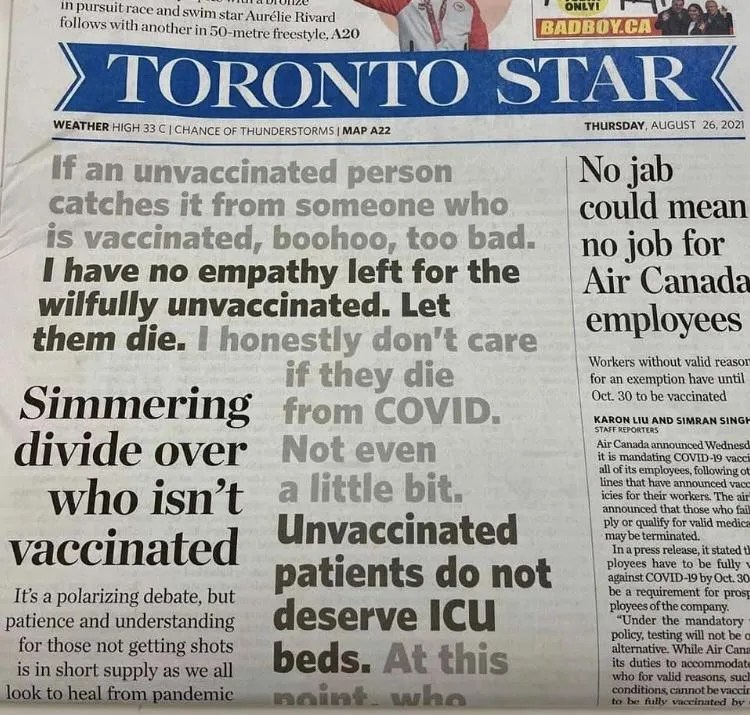
I was growing concerned about the emerging social divide between the vaccinated and unvaccinated, especially the condescension bordering on hostility I heard and observed, and even felt from time to time, including from some of my friends (the eventual demise of Midnight Blue , a jazz group I’d been part of for nearly 15 years, is rooted in my exclusion from rehearsal spaces by my fellow musicians). In the spring of 2021, I had to remind other leaders it was wrong to require their staff to get vaccinated in order to come to work, and unethical to encourage them to “jump the queue” ahead of their eligible time; at this point, the designation of “essential” and “healthcare worker” was still not applicable to those of us in research.
The Mandate Period (September 2021-July 2024)
Returning from a vacation in September 2021, we found new rules in place about vaccine passports and healthcare workplace policies. In a matter of weeks, I went from someone who supported and enabled people to understand the challenging world we were living through and continue to work safely and effectively, to one who was about to lose their freedom to move in society and their job because of a personal health decision.
On 14 October, an Order from the Provincial Health Officer was issued, requiring all healthcare workers – a designation now including me – to be “fully vaccinated” by 26 October. Those who did not demonstrate compliance would be suspended for at least three weeks, and then terminated on 15 November.
I had not seen any evidence that allayed my concerns about the Covid shots. As such, I remained circumspect and reticent, keeping my own concerns and status to myself while trying to navigate the arcane and disorganized roll-out of the mandate at my workplace. I asked provocative questions: why was the Covid vaccination being treated differently than the influenza vaccination (which allowed employees to use alternative measures such as masks and distances if they chose not be vaccinated)? Why was the mandate being applied so broadly as to include non-healthcare workers – employees with no patient contact, many of whom could easily perform their jobs remotely, as had been demonstrated clearly over the previous 18 months? I got no direct answers, but several direct and indirect messages: stop causing trouble and do as you’re told. By 14 October, the die was cast and employees were notified of the deadline of 25 October to show proof of vaccination.
Throughout those last 10 days of employment, I had the responsibility to plan for my own departure and the departure of one other member of my team, while trying to continue business as usual (Covid style) and, as much as possible, maintain my own dignity and privacy. In the midst of this, one close colleague (without knowing my situation) characterized all those who remained unvaccinated as either “lazy, stupid, or nutters.” This was stinging, but worse was that others on the call, aware of my status, said nothing to mitigate the characterization.
In my final days at work, I told my team members about my own status and what would be happening. Those final meetings were among the most difficult of my career, with many tears from me and others; one colleague expressed anger and frustration with the organization – after all I had done to keep everyone safe and together through the pandemic, no one was lifting a finger to me. Again, those other leaders said nothing; indeed, they kept emphasizing that my absence would be temporary, suggesting that I might still come to my senses in time to return to work.
I did try to push back. In the warning letter I received on 20 October, there was a provision that, if I took the first dose of the shot, I could “return to work with preventative measures (wearing a medical mask)…” I asked why I couldn’t just stay at work and follow preventative measures in the workplace. I felt this was a reasonable accommodation based on my genuine fear for my health and on previous workplace practice to manage communicable disease. But there was no room for accommodation or consideration.
None of it mattered. Despite all my compliance and cheerleading and camaraderie throughout the pandemic and the vaccine roll-out, despite masking and distancing and remote working and isolation, despite all the loss already experienced – none of that mattered. I was now considered a healthcare worker required to comply with the mandate. On 01 November, Bonnie Henry said: “If people in our health-care system are not recognizing the importance of vaccination, then that’s probably not the right profession for them.” With that statement, my nearly 20 years of work and contribution at the agency was characterized as a mistake. I had never considered myself a hero, but I was now very clearly a zero.
In my last weeks of employment – at work and then on suspension – very few people asked about or tried to understand my position. Those who did speak to me put their efforts into trying to change my mind, even after I explained my fears. I received anecdotes, personal opinions, publications, news articles, suggestions, and gentle-to-mildly-hostile cajoling to just get vaccinated. The dogmatism of those who believed in vaccination was absolute. While I was always fine to discuss my situation and choice and hear new relevant information, I became weary of defending myself or being challenged to reconsider, or to explain how I could be so obstinately uncooperative or unscientific. I withdrew from engaging in discussion and became truly socially distanced.
Of course, I did think about it – how could I think about anything but? I was losing a job so important to me it was practically my identity. The preponderance of messaging was all about the benefits and importance and responsibility of taking the shot – “do it for the we, not the me.” “100% safe and effective.” “When you are vaccinated, the virus stops with you.” “You’re not going to get COVID if you have these vaccinations.” The pressure was relentless, but the coercive tactics around vaccination, to overcome my “ideological bullshit” had the opposite of the intended effect: I felt even more strongly it was unfair and started to see it as less a personal medical choice and more a required act of faith – in medicine, in science, in society – with the penalty of excommunication for anyone who questioned or resisted it.
Despite having expressed my concerns and reasons – my anxiety – to my employer, not once was I encouraged to seek any mental health support or explore medical exemption (not that that would have worked). There were just two options: take the shot or get fired. In the final days of my suspension, I was offered the Johnson-and-Johnson shot (a one-and-done approach I could complete in the remaining days), and when I again refused, I was treated as obdurate and non-sensical, my questions and objections seen as the stuff of misinformation, i.e., I was a stupid nutter. 3 weeks later, when it became more widely known the J&J shot was associated with rare but serious blood clotting adverse events, the very thing I was fearful of, no one acknowledged my concerns had been well founded.
On 15 November, I was fired for failure to comply with mandatory Covid vaccination.
Post-firing
We’re living in a fast age, and all of us are rather impatient, and, more important, we’re rather intolerant of the opinions of our fellow man and his judgements and his conduct and his traditions and his way of life. Lyndon Johnson
2021 through 2022
The remainder of 2021 and most of 2022 was a difficult and intense period, filled with questioning and resolution and anger and sadness and revelation.
That latter item was the most interesting, teaching me much about those I counted as colleagues and close friends. Some remained (and remain) close and supportive, and I’m eternally grateful for their camaraderie then and now, for their continued presence in my life. Others emerged as new friends, comrades in a crazy time. Sadly, most colleagues from that workplace, either immediately or in a short time, dropped me like a hot potato. There are many with whom I had (so I thought) strong relationships extending beyond the workplace. We got together on weekends, attended birthdays and weddings and parties, and supported each other through life changes. I met their partners and held their babies, even becoming “auntie Robyn” to some. And with so many of those, I have not exchanged a single word in nearly 5 years, despite my own attempts to connect and be present in their lives. In the first few months, it was incredibly hurtful and disappointing to be ostracized by people who previously claimed friendship. I get it: I was a pariah; the social contagion of contact with me being perceived as dangerous as Covid, maintaining social distance was deemed prudent. But it didn’t need to be so extreme and permanent. In the subsequent months and years, it has become a lesson for me about acceptance and trust.
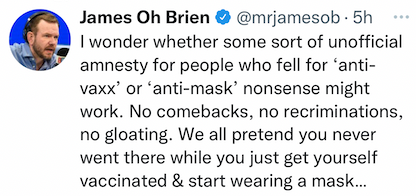
Such responses were not limited to work colleagues. A few close and long-term friends expressed fear for and frustration with me. Fear about Covid: the prevailing wisdom of the time was Covid was definitely life-threatening while the adverse reactions with the shot were only maybes and seen to manageable. Frustration about my choice: why was I so entrenched about something that (for them) was not a big deal (indeed, for some it was a privilege to have been vaxed and boosted), so much so I was willing to be fired?
With a few of these friends, I was made to understand they felt I was due the consequences of my choice. More than once I heard how “choices have consequences,” a phrase that disturbed me as a perversion of older ideas about the right to choose, and a sentiment that reflected the very coercion I was increasingly concerned about. These friendships have been sustained, but not without a few months of tense conversations and a persistence of Covid as a no-go topic.
My fear of repeating my life-threatening experience is real, as real as someone’s fear of heights or water or enclosed spaces. It is not debilitating, but that doesn’t mean it is inconsequential. Yet in this age where mental health is allegedly valued – where compassion and latitude extends to the point of allowing people to do repeated actual physical harm to themselves in the name of respecting their autonomy and not judging them for choices made under the influence of a disorder, even when others are hurt or at risk – many of those around me disdained my fear as at best ill-informed and dismissed it as a superficial excuse to stand by a bad decision. A few others expressed concern about possible undue influences on me, as if I were being prevented from making the right choice by others in my life. It was insulting and infuriating that people thought I was so malleable, naïve, and without agency, and that others in my life were so domineering and malevolent.
2022 to the present
“When an uninstructed multitude attempts to see with its eyes, it is exceedingly apt to be deceived.” From The Scarlet Letter, by Nathaniel Hawthorne.
In the years since, so much that was deemed disinformation has been revealed to be correct and so much that was taken as gospel has been shown to be false, including social distancing, masks, the origin of the virus, its deadliness, and vaccine efficacy.
I resist probing around the edges of people’s understanding of Covid and the vaccine. People wearing a mask to protect themselves from Covid – I resist saying, “That’s not the purpose of masking.” Vaccinated people avoiding unvaccinated people over fears of catching Covid: unless the other person HAS Covid, they are not a risk to you (and isn’t the vaccine protecting you FROM Covid?). The damage to relationships and social connections with these misunderstandings of “the science” is rampant, and affected several key relationships in my life. Indeed, my exclusion from the world of music was justified with exactly these twists of science, the fears stoked by the media, and the othering of those who made different choices that, in saner times, would have been seen to have no impact on anyone else.
Those who were once strident about the importance of staying current with vaccination now rarely mention it, and vaccine hesitancy (as it is so delicately called now) is no longer the province of “nutters” – by late 2023, just two years after the mandates, less than 15% of Canadians took the then-latest booster shot. In July 2024, despite the sustained presence of Covid as an ongoing illness, the emergency was declared over and the healthcare vaccination mandate lifted.
One of the saddest lessons for me from this experience was the loss of trust in science and medicine, as well as the mainstream media. Since early 2022, when I lifted my head above the parapet to survey the information landscape, I have tried to explore and inquire about all manner of things. As more and more came to light showing my fears were justified and my questions legitimate, it caused me to question more and resist more. To some extent, I had been “red-pilled,” seeing the “harsh, concealed truth of reality rather than remaining in comfortable ignorance.” And once you’re there, there’s no going back.
Fauci revelation
So, back to Fauci. Why am so upset about his diary revelation? To me, it appears he experienced exactly what I had feared for myself, something that became quietly but clearly documented in literature – a serious blood-clotting event, occurring in the period when vaccinations were being encouraged and any discussion of side effects was verboten. It took four years, an internal investigation, and a senate hearing to bring this to light. Whether or not his own condition was brought about by the Covid vaccination or Covid itself, or was completely unrelated, that he did not disclose it in the summer of 2021 when it happened suggests there was – and is – some truth to the concern about the shots.
I know how it sounds: QAnon conspiracy theory, red-pill exaggeration, nutter. But given all the other revelations in recent years – the “six foot” rule was made up, face masks make little difference in interrupting the spread of Covid, overall vaccine effectiveness against infection is much less than 100% and wanes almost entirely after 6 months, vaccinated people can transmit the virus to others, prior Covid infection does confer immunity – why isn’t it reasonable to at least consider the risk of serious adverse events from the Covid shot are greater than previously disclosed, and so someone’s fear of such events is not unfounded but grounded in truth, not stupidity, laziness, or nuttiness.
In more recent years, when I have broached this subject with vaccinated others, the defence is usually, “but we didn’t know at the time!” My response is to point out how we didn’t know either way: there was insufficient information to know whether the shots were safe OR NOT, whether Covid was of greater concern than the vaccine side effects OR NOT. All I asked for back in 2021 (and now) was the benefit of that doubt – to be allowed to make my own choice about something affecting no one but me and which, in more normal times, would have been a private decision about my own medical treatment.
Back in 2021, I resisted taking the Covid shot, rejecting the potential benefits of a medical intervention I feared and did not want, which purported to protect me from something I did not fear and was unlikely to contract based on my behaviour (distancing, masks, avoiding those with Covid) and circumstances (especially once fired, I was even less in contact with people than ever). As of mid-2026, I have still yet to contract Covid, despite the relaxation of restrictions and never being vaccinated. At the same time, most people I know are a) vaccinated and b) have had Covid at least once in the past 5 years.
Choices do have consequences. If I had chosen to get vaccinated in 2021, the consequence might have been insignificant or catastrophic, even fatal. If my fears had been realized, no amount of apology or acknowledgement would have made me feel better. My choice did have consequences, which I considered – then and now – to be disproportionate, unfair, and entirely avoidable. If the powers-that-were (including Anthony Fauci but also Bonnie Henry, Bonnie Tam, Rochelle Walensky, and Deborah Birx) had had the humility to acknowledge the uncertainties inherent in science and the decency to consider the humans affected by their draconian rules and catchy slogans, not just my own experience but the state of society’s trust in science and the media, and of people in each other, could have been preserved or enhanced. Instead, lines were drawn and people pushed to either side of it, creating social divisions unlikely to be bridged for years or decades.
Mea culpa
In the past, I vigorously admonished and publicly castigated those who refused vaccines. I was among the condescending and vitriolic righteous who painted others with the “nutter” brush, who took it for granted that I was right and they were wrong, never leaving the moral judgement out of the argument or allowing individuals to make their own choices. I was mean and judgemental, relying on “the science” that I now see as flawed at best and specious at worst, and I wish dearly I could erase those comments and conversations from history. I cannot undo any of that.
For all of that, I unreservedly repudiate my previous comments and humbly apologize.
What I can do now is acknowledge and change. I now know this is not about right and wrong, it’s about individual and informed choice, and in the absence of the latter, the former can be flawed. I am now a strong believer in social freedoms – choice, speech, movement – and responsibilities – engagement, humility, knowledge. That I had to learn the importance of these when they were taken from me is why I’m telling this story, so others can learn from my experience, and we can avoid repeating the mistakes of our individual and collective past.
Moving on
I take heart in and solace from those around me who cared enough to listen to and respect my decision and am grateful for the new and stronger relationships I have in my post Covid life. While I still believe in and benefit from modern medicine (indeed, I’m still alive because of it), I also take forward a wariness and mistrust of any situation where someone claims the science is settled, where “everyone knows,” and where “experts say” things probably, maybe, could be the worst ever if everyone doesn’t comply or change. Beyond death and taxes, there are few “always” or “nevers” in life, and we would be wise to consider with skepticism any claims otherwise.
I grieve the loss of relationships from before Covid, those gone entirely and those altered irrevocably. I grieve the loss of identities – leader, musician, friend. I grieve the loss of innocence or naïveté, or perhaps ignorance, for knowledge is a dangerous thing. I “…was blind, but now I see.” I remain primarily a critical realist – a trait for which I was and am known and valued by many – but where I used to feel primarily optimism and trust, I’m now much more a hesitant skeptic.
I also grieve the loss of my job, my place within that world of research, and my identity as a leader to people who meant so much to me. I went through the full spectrum of grief’s phases, and have made it to acceptance, but the loss remains – not with sadness or a desire to return to that time, but with a wistfulness and fond remembrance of things past. While the loss is still painful (and likely always will be), I can look back at what it meant, and all I accomplished, with fondness for the people I knew, the lessons I learned, and the legacy I created there. I bring all of that forward into new work and relationships, with the knowledge I can survive and thrive, not despite the experience but because of it.
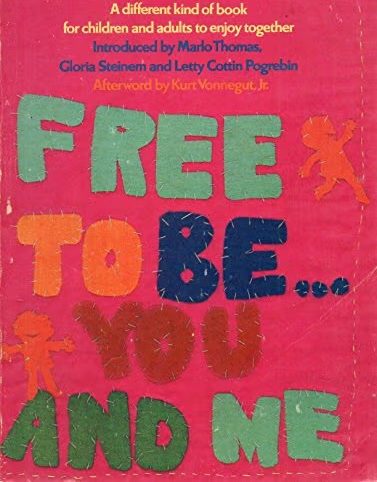
I don’t claim my views or choices are right for anyone other than myself, and I neither judge nor begrudge anyone else their choices or opinions. I wish everyone joy and love and peace along whatever path they choose, and that they are allowed to take it. I pray those dear to me remain unscathed by the rare but real events that haunt me, and that we can take all the lessons of Covid forward into any future catastrophe, especially that we can and should treat each other with the very compassion we want to receive. I hope I can live up to that the next time I’m confronted with a challenge to my own beliefs – that they will be loosely held no matter how strongly felt.


Leave a Reply