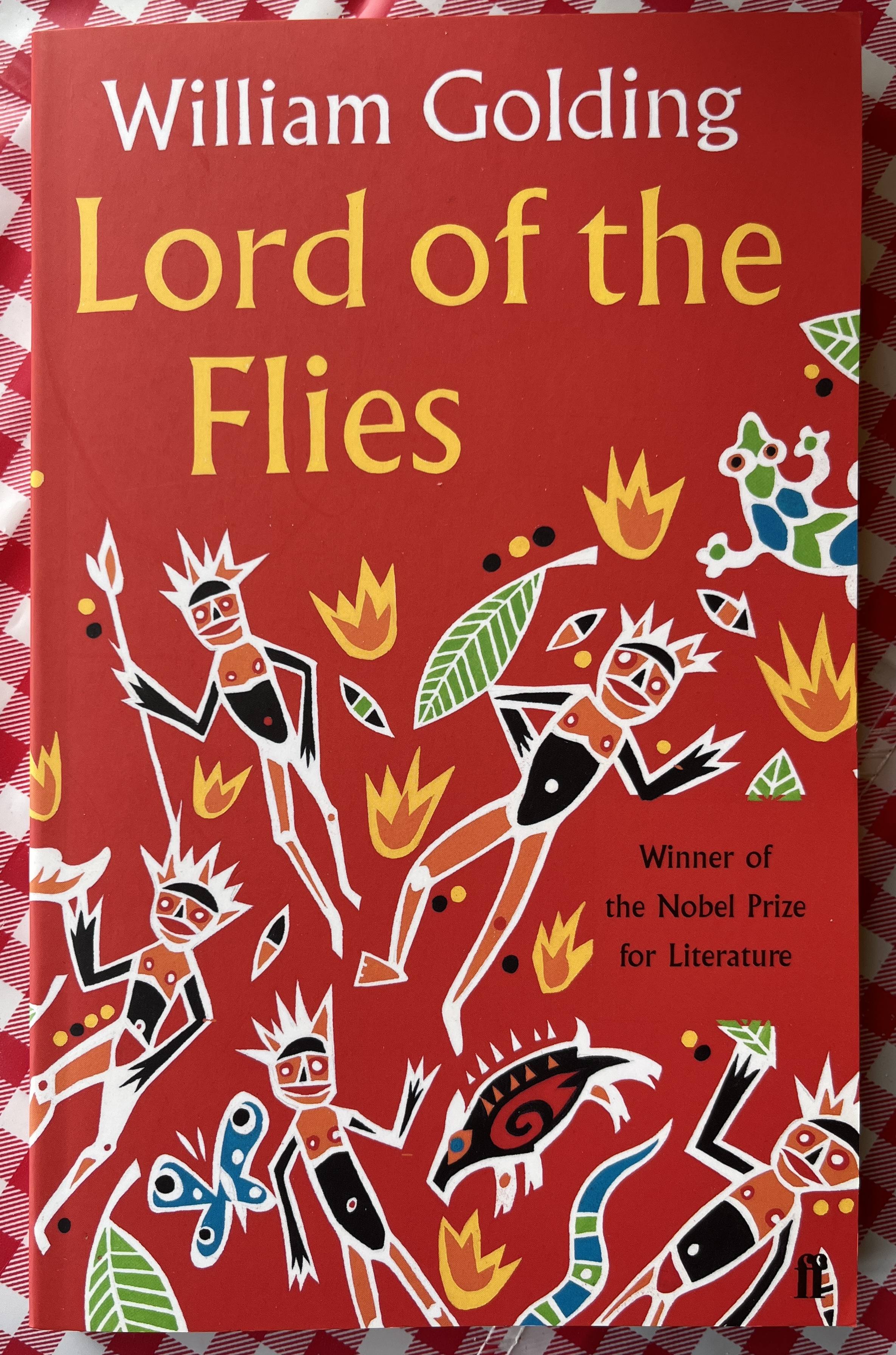
 I was inspired to read this by The Book Club podcast, as it is on their upcoming reading list. I recall I had to read this in Grade 9, and also saw the 1963 film at about the same time. However, my memory was quite vague about the story details, so this rereading was like new, full of surprises and fresh horror.
Briefly, following their evacuation in a new world war (amidst the threat of nuclear attack), a group of English school boys is marooned when their plane crashes on a tropical island. After some initial gambolling in the surf and on the beach, they attempt to organize themselves for survival. The initial leader, Ralph, is an early teenager whose father is a Navy officer, and he tries to focus the group on order, cleanliness, and rescue; he insists creating and sustaining a signal fire is imperative to their being found. Jack, a similarly aged boy and former choir leader, is initially the second in command, taking charge of securing food for the group by hunting in the jungle. Piggy (we never do learn his real name) is a boy from a different school and class, and while he is sensible and wants to contribute and be heard, he is marginalized by the others due to his background and his physical difficulties; he is overweight, wears glasses, and has asthma, so is limited in contributing to the work of the group. There is also Simon, a calm and dreamy boy (he may also be epileptic) who indulges in periods communing with nature, and Roger, an even more violent boy than Jack who becomes a true terror.
Over a period of several weeks or months, the group gradually divides into Ralph’s and Jack’s separate group. Jack’s hunters descend into savagery, with face-painting, violence, and blood rituals. While they try to present brave faces to each other, they are still at heart boys, afraid of the dark and imaginary beasts, and concerned more about fun and adventure than order and survival.
Golding set out to write a truer version of The Coral Island tale, focusing on the likelihood the boys, without adult supervision and social controls, would revert to a savage, or at least undisciplined, state. There is also an allegorical angle, with Jack and gang as the fascists – violent, sectarian – and Ralph and Piggy as the democratic appeasers, quickly losing control of the situation and failing to fulfill their promises of fun and rescue. Simon is a kind of doomed prophet, Cassandra-like, able to see the truth of things but unable to share it with the others.
Despite being about children, this is not a story for children. Several scenes are genuinely savage and creepy, and the violence, meanness, and death make this a sad and disturbing tale. I found the vivid description of the boys’ killing of the sow, as well as the murder of Simon, to be especially nightmarish. At the end, I was left wondering about the fate of these boys when they return to their lives after rescue. What will they tell others – and themselves – about what went on there? How could they possibly return to “normal” life unscathed by their experience?
I’ve read many other novels where the rule of law and society are suspended or removed and people descend rapidly into savagery (e.g., Into That Darkness, Moon of the Crusted Snow), which I found to be unrealistic – I didn’t believe order would break down and violence ensue so quickly. In Lord of the Flies, it feels more believable and rawer but also more terrifying because it is children, suggesting the capacity for violence and bloodshed may be inherent, lurking beneath the surface, tamed only by the constraints of morality and social order.
I’m glad I read this book, as I can now understand why it is so often on greatest-novels lists, and can also see how it provides a truer and darker view of isolation stories. Its influence on so many other stories and writers ever since is clear, including the creators of reality shows such as Survivor. The story will haunt me for a while.
Fate: little book library
1 – a murder
7 – debut
9 – made into a film
12 – a book I should read
13 – set somewhere I’ve never been (some tropical coral island)


Leave a Reply