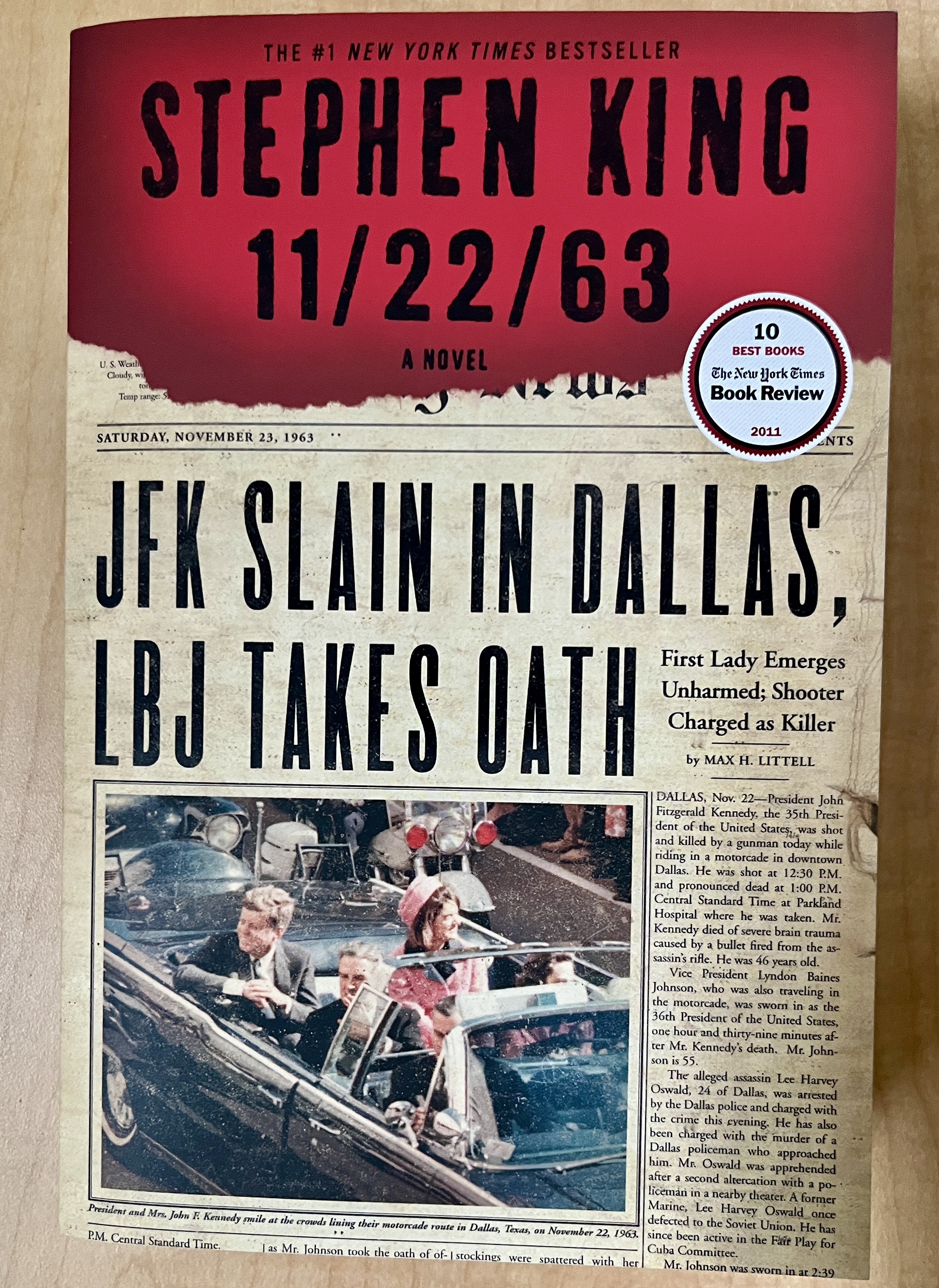
 This monster of a book was a recommendation from a fellow book shopper a few months ago. I was intrigued by the concept – a man travels back in time to stop the assassination of JFK – but that is only a sidebar in this lengthy mess of a story.
Briefly, in a diner in a small town in Maine, a man discovers a time portal in the storage room that takes him back to September 1958. For years, the man uses the portal to go back in time to…buy cheap supplies for his diner. At some point, he realizes he could use the portal for something more significant, like stopping the assassination, so he tries that but fails. When he returns, he is deathly ill so he recruits a regular customer (Jake) to take on this quest. He arms Jake with a fake ID (so he’s now George) and some 50’s era cash, as well as some rudimentary guidance about how the portal works (such as: no matter how long you’re gone, when you return only 2 minutes will have passed) and living in that bygone era. He also gives him a notebook with all his “research” about Lee Harvey Oswald, and warns him about the irascible drunkard known as Yellow Card Man, a denizen of 1958 who happens to be nearby the portal whenever someone travels back there. The plan: go back in time, hang around for a few years, try to determine if Oswald acted alone, and if yes, kill him before he kills JFK.
Sounds interesting, but Jake is far from interesting, and neither is what he gets up to in the five years he spends in the past. He alters the past for a few people he knows, and then spends some time lounging around in Florida before heading to Texas to find and investigate Oswald. But then he meets and falls in love with Sadie, and his life and decisions get even more complicated. Havoc ensues. After finishing his quest, he returns to the present to find the world in dire straits. Turns out, JFK was not the linchpin saviour of history the diner owner thought. He goes back in time again to reset things and decides not to mess with history anymore. He tracks down Sadie (now in her 80s) and creepily crashes a party to dance with her one last time.
While several segments of the book were good, especially the edge-of-your-seat race-against-time assassination attempt, much of it was frustrating and lame. The lengthy sidebar stories and Easter eggs were needless things, reading more like story ideas leftover from other writing shoehorned in here so as not to be wasted.
Worse was Jake/George as the time travelling hero. He decides to set-out on this mission to the past without doing the barest of research about Oswald, Dallas, or history in general, so other than some well-known happenings in that time, he’s almost as naïve as the rest of the population in the early 60s. His plan for making money is to bet on long-shots with his knowledge of who will win, but he does this so infrequently and ineptly that he barely makes a dent in his cashflow and calls enough attention to himself – by going back to the same betting shops over and over – eventually getting beat up by the bookies who are suspicious at his luck on high risk bets. There are several times where he does something rash or notices something strange…and just dismisses it, while the reader is practically screaming, “look again, you idiot!” For someone with this incredible opportunity to see the world from a unique perspective, he is remarkably boring in his choices and uninterested in learning or exploring.
Worst was Jake/George’s utter disregard for the “butterfly effect” – something he and diner man discuss before he makes his first trip to the past. The whole point of the exercise was to “correct” an event so that the future would be better – capitalizing on said butterfly effect. That assumption – that it would for sure be better – is remarkably flawed. But to also disregard how his very presence and even his smallest actions would change the past in irrevocable and unintended ways is just plain dumb. He thinks his presence is no big deal, so much so that he becomes part of a community, teaches high school for a few years, and changes the lives of almost everyone he meets. He’s a one-man wrecking ball of the past.
And still, with a 5-year head start and the basic knowledge of the future, he comes to within seconds of Oswald succeeding. Jake/George blames the obduracy of the past for the disruption of his plans. In fact, it is primarily his own incompetence that causes him to almost fail in his mission. That “the past” might be sentient enough to resist efforts to change it is an interesting and original concept, but King never explores why the past would be so protective, and why it would care about certain events and ignore others. It’s truly a lost opportunity.
The final nail in this large coffin: the ending. How lame and frustrating. Apparently Jake/George is not the only time traveller and his portal is one of many in the US. Yellow Card Man is not a drunk bystander but an arbiter of the time bubbles who admonishes Jake for messing with time. It seems that all these people coming and going in time are creating so many strands of that history is confused (again, an interesting time travel angle that King devotes very little time to, unfortunately; I’d be interested to know more about how these threads get tangled up and how Yellow Card Man and his mysterious crew plan to untangle them). But no matter: if Jake returns to his own time, all will be fine. What!? After 850 pages, basically the past is reset, we all go back to normal, the time bubble bursts, and the threads are no longer a worry? How lazy and unsatisfying. Was the bubble still there in the diner? After that adventure, how did Jake stay sane for the rest of his life? I came up with my own theory about how the book would end – that Jake IS the Yellow Card Man, another version of himself from a previous travel in time that was stuck in 1958 but AWARE of the reset and unable to go back. I still think it is a better resolution than what King came up with.
One last complaint: the writing. John Irving and Stephen King should pool their considerable resources and go half-sies on an editor. Get rid of the sidebar stories that add nothing to the plot or characters. And cut out at least a quarter of nearly every sentence. This book did not need to be so long.
While written well enough with an engaging enough story to keep me going, the frustrating main character, the pointless sidebar stories, and the ridiculous ending leave me feeling like I wasted so much valuable reading time. Sadly, I can’t go back in time and read something else instead.
Fate: little book library. This book almost made the drivel category…
1 – a murder
2 – about time
13 – place I’ve never been
15 – a number
 rclr
rclr 
Leave a comment