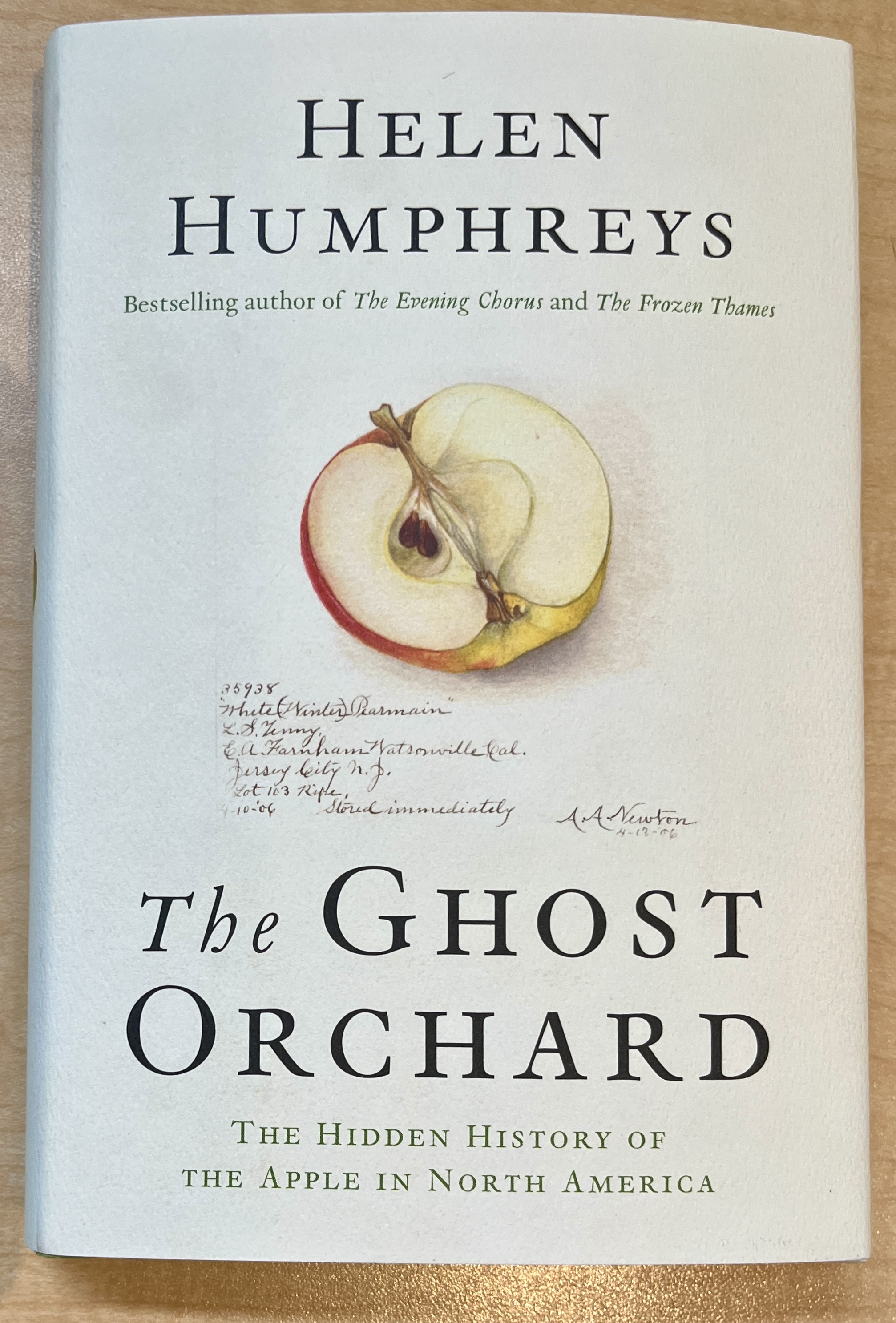
 Helen Humphreys is a writer beloved by me for her poetic descriptions, lyrical narratives, and unusual blending of fiction and non-fiction (see Machine Without Horses for a great example). I have read almost her entire oeuvre, but this one (a Christmas gift) had been lingering on my shelves for a few years until recently. On a weekend trip with a friend, I was reminded of our mutual desire to attend (one day) the UBC Annual Apple Festival and thus of this book. I dusted it off for an early summer read, finding the bookmark where I’d previously left it. While not Humphreys best book IMHO, it is still a great addition to her growing collection of historical books.
Humphreys’ descent into the apple barrel began like the original search for knowledge – with the bite of an apple. She came across an old and abandoned tree near her home and the taste of the apples (the White Winter Pearmain, allegedly one of the tastiest varieties) inspired her study of the apple as a fruit, a symbol of scientific and agricultural experiments, the rugged and exploitative nature of pioneering and colonialism, the connections formed through this humble fruit, and the loss of diversity of the Malus domestica species to capitalism. Humphreys starts with the history of the apple in North America – its importation from Europe, its vast propagation by settlers and Indigenous peoples, and its role in sustaining (and then undermining) those populations through the 18th and 19th centuries. In this sense, the apple was both a tool and a weapon in the USA’s manifest destiny. She also tells the story of a true apple champion, not the oft-cited Johnny Appleseed, but one Ann Jessop; true to form for Humphreys, she finds a woman hidden in history. A Quaker minister and pioneer from the mid-1700s. Jessop’s life blended travel, ministry, and pomology to create a legacy that lives on in the orchards and history throughout the northeastern US.
On the literary side, Humphreys explores the role of the apples in the life of Robert Frost, including his unique and close friendship with an English poet that was both short-lived and essential to his own life, centred around apples. In the end, she tells a fable about the origins of the White Winter Pearmain, and concludes with a lengthy list of apple varieties that are no more – a compilation of varietal descriptions from old seed catalogues and historical records that tell of a tasty legacy worth mourning.
A parallel inspiration is the death of a longtime friend, Joanne Page, a Canadian poet and painter who died in 2015. While not the overt impetus for Humphreys’ exploration of apples, with all the loss she encounters in her studies – of orchards, varieties, biographies of others – there is an undercurrent of grief throughout the book. Many of the locations that she visits during her investigations are no longer around, or at least no longer orchards producing apples of the historical varieties, and she mourns both losses equally.
I would have liked to learn a bit more about the ‘how’ of apple propagation and varietal development, but this would likely have been too much of a digression from the more lyrical explorations that Humphreys takes. It was sufficient to pique my interest in that, so a future book may be required, inspired by the history learned here and the delicious-sounding taste of the pearmain.
Fate: being added to my Humphreys collection.
8 – female author
27 – a gift
28 – old favourites
29 – leftover
31 – history
33 – Canadian
37 – non-mainstream


Leave a Reply