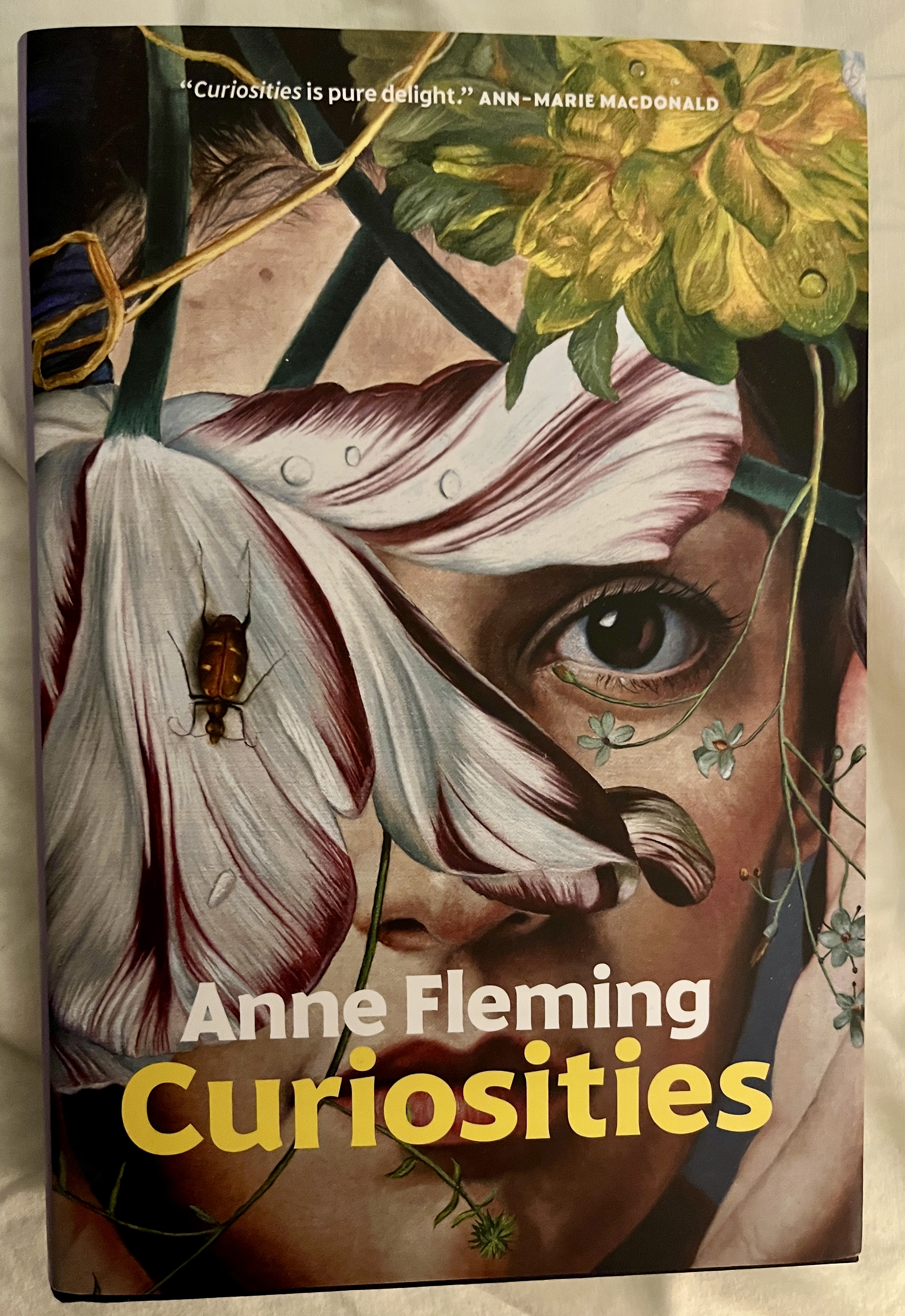
 This was a Christmas gift from my sister, who heard an interview with the author and thought it sounded interesting. She was oh-so right. This book was terrific – engaging, surprising, well-written, and lives up to its name. This is historical fiction at its finest, with a few kernels of real history enveloped in an intense fictional tale. As the narrator says, the minor figures in history can be the most interesting, if only because we recognize ourselves in them: “…aren’t most of us minor characters?” While there was some similarity to the use of the character from the Franklin expedition in The Ministry of Time, I found this novel to be more comparable to the works of Madeline Miller and Natalie Haynes, whose alternative perspectives and refreshed minor characters from Greek mythology are similarly engaging and realistic. However, Fleming’s work is truly original, creating characters and situations within a historic context that are believable and empathetic.
The novel begins with the set-up: while seeking information about a real historical figure (one John Aubrey), the narrator encounters some (fictional) misfiled papers that lead to the novel’s early 17th century story. These papers are journal entries and letters related to one Lady Margaret Long (modelled on another real person, Mary Sidney) and by extension to the story of Joan Palmer and Thomasina (or Tom) Barrows. Joan and Tom are survivors of a plague in their village. After a few years, Tom’s father returns to take her on his planned emigration to Virginia. Joan goes into service with a local family, and eventually moves to being Lady Long’s assistant and companion; Lady Long is eccentric for her time, a widow who spends much time on nature and astronomy.
It is while on the journey to Virginia, after the deaths of his own father and family, Tom truly becomes Tom, changing identities with a boy who dies on route. After figuring out the physical disguises necessary, Tom successfully joins the ranks of the men onboard ship and in society. Eventually returning to England, Tom completes an education and training to be a doctor.
After re-encountering Joan at Lady Long’s home, Tom realizes his love for her and the complicated situation they now find themselves in. After a discovery, Tom chooses to flee for a time, while Joan returns to Lady Long’s, only to be embroiled in a scandal of witchcraft. The ending is uncertain, reflecting the reality that, for minor characters, the story is often like that: incomplete, murky, and perplexing.
The other real historical figure in the novel is Thomas James, the captain of the 1630s expedition through Hudson’s Bay and into James Bay. It is this ill-fated voyage to which Tom signs-on after rediscovering and then fleeing from Joan, and his unsent letters to her, part of the fictional historian’s research findings, comprise several sections of the novel.
Fleming’s stated aim was to deemphasize Tom’s gender identity, which I think was highly successful. Most of the time, I forgot Tom was female; her camouflage was so effective in her world that even the reader was convinced. When revelations happen, the reader’s response is, “so what?”, and disappointment that it matters to others. And that’s the point: what does it matter? Tom is able to live, work, learn, and contribute at many levels regardless of sex or gender, emphasizing the irrelevance of these for whether someone can or should be able to do or try things.
Fleming was asked about how common “Toms” were in that period. she has said that because most of the few revelations in the historical record come from those who were “discovered”, there were likely many more people who lived undiscovered for their entire lives. Probably the most common would have been females-living-as-males, as the main benefits being sought were the social freedoms – education, mobility, career, money, and relationships (i.e., living with another woman).
The novel tests the reader’s tolerance for believing things that are true and things that are fictional. By incorporating real people and events, for me this made the story of Margaret, Joan, and Tom more believable, as they fit in perfectly with the context and times. I was reminded of last year’s read, The Maniac, and came to a similar conclusion: what’s true and what isn’t doesn’t really matter when the story and the writing are this good.
I look forward to more from Fleming in the future, and may seek out her poetry some time.
Fate: I’m not sure that I’ll read this again, but I’m reluctant to let it go. Perhaps I’ll loan it out.
4 – published in 2024
8 – female author
20 – one word title
25 – new author to me
27 – a gift
33 – Canadian
 rclr
rclr 
Leave a comment