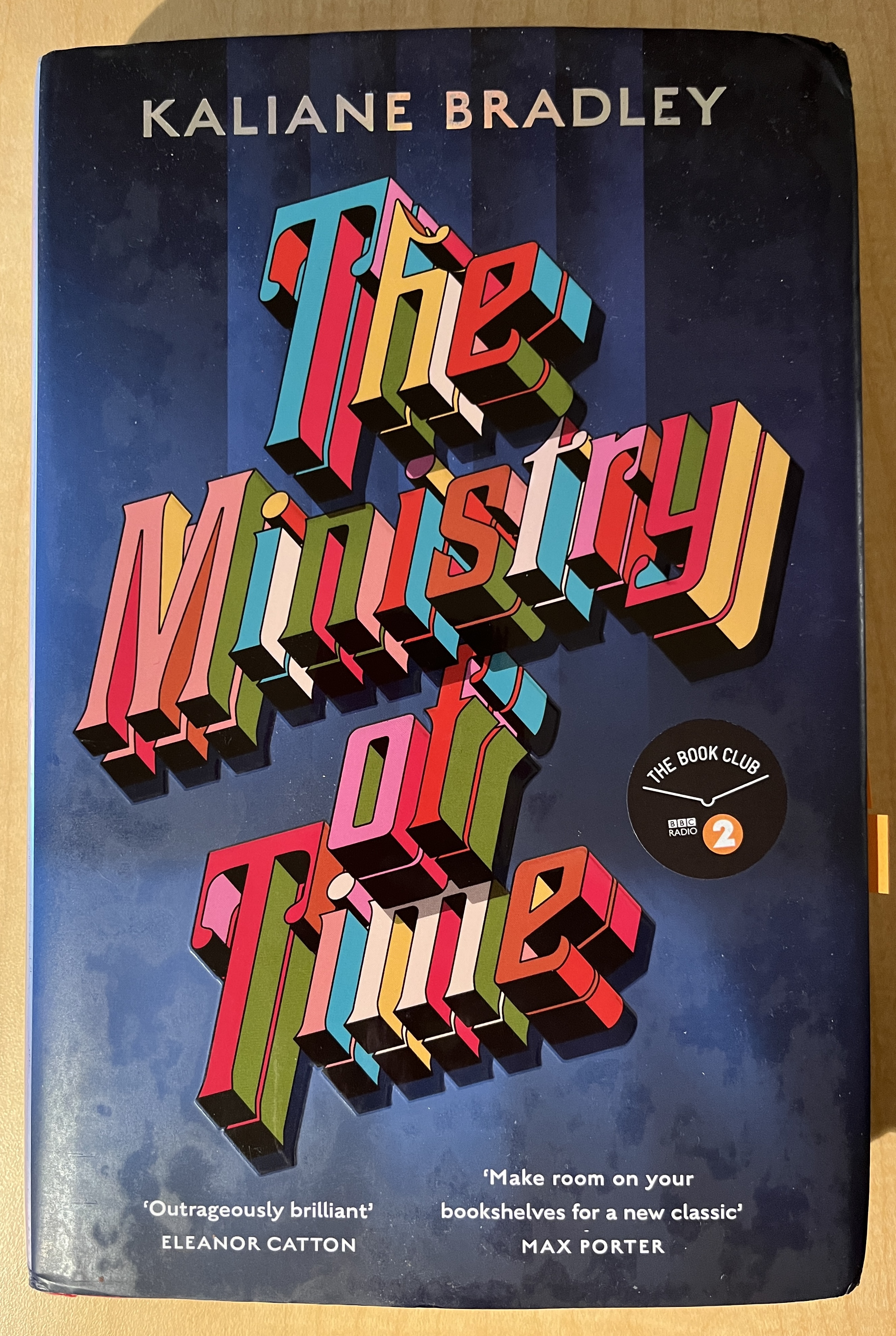
 I had high hopes for this book. A Christmas gift from a fellow bookclubber, this time-travel romance seemed very promising. However, after pushing to the half-way point, I gave up in frustration, then skimmed through the remainder of the book. Perhaps I missed out, but I was too worn out from rolling my eyes to care.
Briefly, in the near-present, a mechanism of time travel has been created that allows agents to travel back to a specific date and place, and bring someone forward to the present. A considerable amount of planning is required to get to exactly the right place and time, and to extract only a person who was about to die in their own time, so their disappearance ought not to disrupt history or the future. Each expat (as the extracted persons are called) is assigned a bridge – an agent trained to help the expat communicate and adapt to their new world. Among the expats are a WWI soldier, a rebel from the French Revolution, and Graham Gore, an officer from the ill-fated Franklin expedition. The bridges are chosen primarily for their expertise in language – someone from 18th century France is likely going to have a hard time understanding modern language. Among the bridges is a British-Cambodian woman (the unnamed narrator) who becomes Gore’s bridge. Naturally, they begin a relationship and fall in love. After realizing the nefarious how-and-why of the time-travel, they attempt an escape and are separated. He goes into hiding, and she loses her job at the evil Ministry of Time.
While we learn later in the story that people are moving back and forth in time for less-than-noble purposes, it is not made clear what the purpose is of bringing the expats forward in time, as the observation and experimentation with them is very loose and there does not seem to be a mission for them. The assignment of bridge-to-expat also seems very random and ill-considered – while modern sensibilities would see no issue with a female agent for a male subject, Gore’s early 19th century culture would have a hard time relating to, taking orders from, and living with an unmarried and younger woman. Similarly, the various sexualities of the expats is more easily adapted and accepted by them than is realistic for their background cultures. The cultural and technological adaptations are mostly glossed over so, like the mysterious time-travel device, we’re just supposed accept that the expats figure out television, computers, social media, and driving with little difficulty, and similarly take modern gender roles and sexuality with little to no pause.
The one clever device was the interweaving of stories reflecting Gore’s experiences within his own time. These counterpoints throughout the novel help to explain his despair at being a survivor, but also suggest a flaw in his extraction: he was extracted too early. He was an expert hunter, supplying food for the crews, and his extraction may actually have doomed the rest of the expeditions to death. Thus, even this attempt to leave history unmolested had some unforeseen and tragic consequences.
Worse than the story was the language. While I’m a fan of an advanced vocabulary, the author seems to have consulted a thesaurus for the most obscure words available, and then used them somewhat randomly. Describing a fellow agent: “snide and etiolated”. Mean and pale? “Movement was anathema.” (That’s the whole sentence.). The similes are similarly bad: “the air hung like an executed corpse”; “He filled the room like a horizon.”
The author is British-Cambodian like the protagonist/narrator. Neither does a good job of telling what might have been an interesting story. The romantic relationship is unconvincing, and there is so little detail given about the time travel stuff that it seems almost farcical at times. While I like sci-fi to tell a story with science as the backdrop, here the science is nearly non-existent. A missed opportunity was making more of a link between the discombobulation of the expats and the narrator’s own sense of “hereness” and “thereness” with her strained immigrant background. That would have been interesting.
Perhaps I’ve just read too much superior sci-fi last year that this one suffers by comparison. But even on its own merits, it is drivel.
Fate: little book library with a note of apology to the unwitting next reader.
1 – book with a murder
2 – time in the title
4 – pub in 2024
7 – debut
8 – female author
25 – new author to me
27 – a gift
38 – drivel

