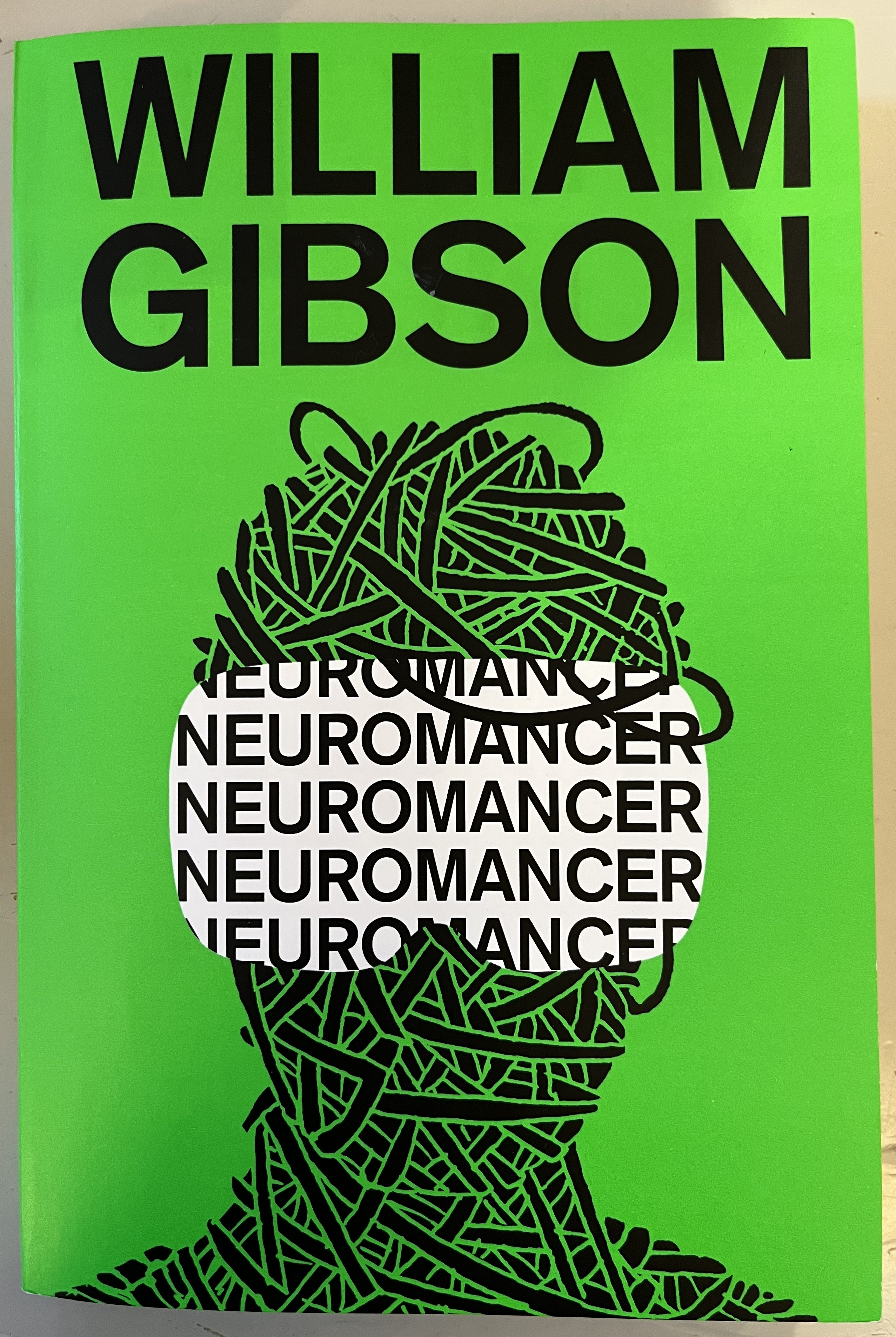
 This is one of those books: when I say I haven’t read it, people who have and loved it are SHOCKED. “How can you not? Oh, you must!” The latest was my brother, and so to enable a conversation with him about it, I finally read it.
Neuromancer is revered in modern sci-fi circles as THE essential book. Gibson is renowned as (one of) the father(s) of cyberpunk (a variant of steampunk), merging the hulking steel and analog systems of mid- to late-20th century with the sleek, digital world of the then-future. Gibson’s worlds include cyberspace, microsofts, virtual reality, lab-grown food, human augmentation, and AI, all within a gritty and dark world of criminals and murky geopolitics.
In this novel, we follow Case, a cyber cowboy with a reputation for being able to infiltrate even the most secure and obscure sites and systems. After being down on his luck for a while, Case is recruited to join a strange band of specialists to hack one of the most secure systems ever. No one is really who they seem, and as the tight bonds of technology over each of the team start to break down, Case has to be both real and cyber hero to complete the job.
I confess to not understanding much of the tech-speak in the book, but it wasn’t essential to follow the story. More interesting to me were the characters, how they come to be who they are, why they are involved, and what happens to each of them. Gibson does an excellent job with these, creating characters that are not likeable but engaging and, in most cases, empathetic. By the end of the novel, we’re rooting for Case and some of his partners, and are happy to see the comeuppance for the less desirable ones. The novel’s ending is satisfactory, although clearly a set-up for a sequel (ultimately, this novel became the first of a trilogy, albeit with mostly different characters).
The AI “characters” were especially interesting in our current age. The AI systems in the novel have developed a level of sentience that is fascinating and disturbing. They have personalities, moralities, and yearnings that are decidedly human, and their awareness of such was intriguing. Given the current fascination with AI and the rapid integration of these “tools” into everyday systems, this novel gives some warnings about over-dependence on and reduced vigilance of such systems. In the novel, the fate of the AI characters leads to the creation of something called the matrix, and there is clear and obvious influence from this to the Matrix franchise.
I look forward to talking about this novel with my bro’ and other sci-fi friends who have been bugging me to read it. My own enthusiasm for it is likely less than theirs, but I can appreciate the early genius and influence of this story for much of the good sci-fi of today.
Fate: I’m not likely to read this again, and it is widely available if do want to, so this copy will go to the little book library.
1 – book with a murder
12 – book I should read
13 – set where I’ve never been (Japan, Atlanta, Istanbul)
14 – a name in the title
20 – one-word title
33 – Canadian
34 – prize
36 – part of a series
 rclr
rclr 
Cyberpunk predates steampunk by a number of years.