It was the summer of 1982. I was 15ish and, while waiting for the bus at the corner of Portage Avenue and Vaughan Street in Winnipeg, I saw the marquee of the theatre across the street advertising the film The World According to Garp. I think I had seen a trailer for the film earlier in the year, and was interested in seeing Robin Williams – whom I knew only as Mork from Ork and as a frenetic comedian on talk shows – in a dramatic role. The film played for only a few weeks that summer, but I managed somehow to see it twice, despite its R rating. I recall the theatre being mostly empty on both occasions – it was not a great movie – but I enjoyed the characters and the bizarre story. In retrospect, it was worthwhile seeing these early roles for Williams, John Lithgow, and Glenn Close (her big screen debut).
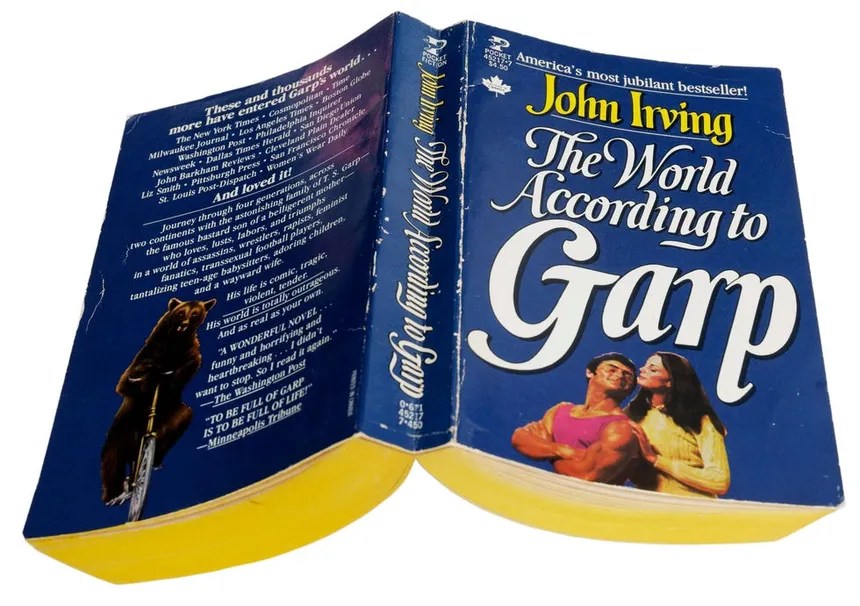
Sometime later (I’m guessing the following year, as I was still in high school), I found a copy of the novel – a paperback version – at my Grampa’s store. I may have been stocking the shelves while working a slow evening shift, tidying up the magazines and organizing the books, when I found it in one of those spinning display stands near the magazine rack. The book cover did not reflect what I recalled about the story from the film, but I was intrigued enough that I bought it .
I remember it as the first grown-up, non-school-assigned book that I chose for myself. I also remember being engrossed in reading and re-reading it several times through my teenage and early 20s years. The paperback became ragged and broken, with pages falling out and a spine that was nearly illegible; it became my first favourite novel. It was also an early instance of my both seeing the film and reading the book, and doing those in that order.
Since then, I’ve returned to Garp less frequently than I have to other favourite books. In part, I didn’t want to ruin the romance of it being of my favourite novel. In the years since, and definitely in more recent years, John Irving has falling from grace with me. While I was once a devoted fan – he used to be the answer to the login security question, “who is your favourite author?” – I feel that he reached his peak in the late 80s with A Prayer for Owen Meany; some subsequent novels were good but not great. For many years, I continued to buy and read his novels as they came out, but by the 2010s, I was done.
Recently, I decided to share Garp with my goddaughter. She is turning 16 this year, the age I was when I first read it, so I hope the novel will be one she also enjoys. In sending this gift, I decided I would re-read the novel to affirm (or not) its status as a favourite, and confirm my effusive praise was not misplaced; like people, not all novels age well.
I was pleased to enjoy it again and be reminded of so many of the elements that make it such a wonderful novel. The characters are complex and real, and Garp’s short life is remarkably full of weirdness and tragedy. The story reflects well the violent and volatile times of the 60s and 70s without dipping at all into the real political or historical events of the time, which were violent enough themselves. I think that may be part of what keeps the novel timeless – not getting distracted by the “real world” – but also keeps the Irving commentary to a minimum; it is all about the story, with minimal preachiness from the author, a balance I found increasingly skewed toward Irving’s own commentary and opinions in his later novels.
The novel includes many of what would become Irving’s quasi-autobiographical hallmarks: a writer as the protagonist (including several of Garp’s novels reflecting Irving’s own oeuvre); Vienna; wrestling; New Hampshire; single parents; death of a child; a bear; a transexual character. There are also several stories-within-the story, as Garp shares several short and bedtime stories with the world and his family; each of these is excellent on their own.
In Garp, Irving is a prolific user of the (as Garp calls it) the good old semicolon. It was from Irving that I developed my own affection for this punctuation mark, and for the careful use of fonts and symbols in the written word. The style of presentation of the novel enhances the characters and story – an element of “show, don’t tell” – which was an early exposure for me to the art of publishing.
Garp is the novel that began my affection for the epilogue. In the final chapter, Irving closes out the lives of all the main characters, and several of the minor ones, bring the whole World to a complete close; there is no possibility of a sequel to Garp. I loved this element, so much so that I am delighted when other authors do it, and often disappointed when they don’t.
Garp is also the novel that introduced me to Marcus Aurelius, the stoic philosopher whose way with words is poetic as well as wise. I’ve remembered this passage since I first read it decades ago:
In the life of a man, his time is but a moment, his being an incessant flux, his sense a dim rushlight, his body a prey of worms, his soul an unquiet eddy, his fortune dark, his fame doubtful. In short, all that is body is as coursing waters, all that is of the soul as dreams and vapors.
I am very happy to have found the novel as funny and moving as I remembered it. It remains a toss-up between Garp and Owen Meany as to which would become a desert island book; perhaps one day they’ll be issued in a compendium so they can both come. I remain hopeful that my goddaughter may eventually enjoy the novel as well.
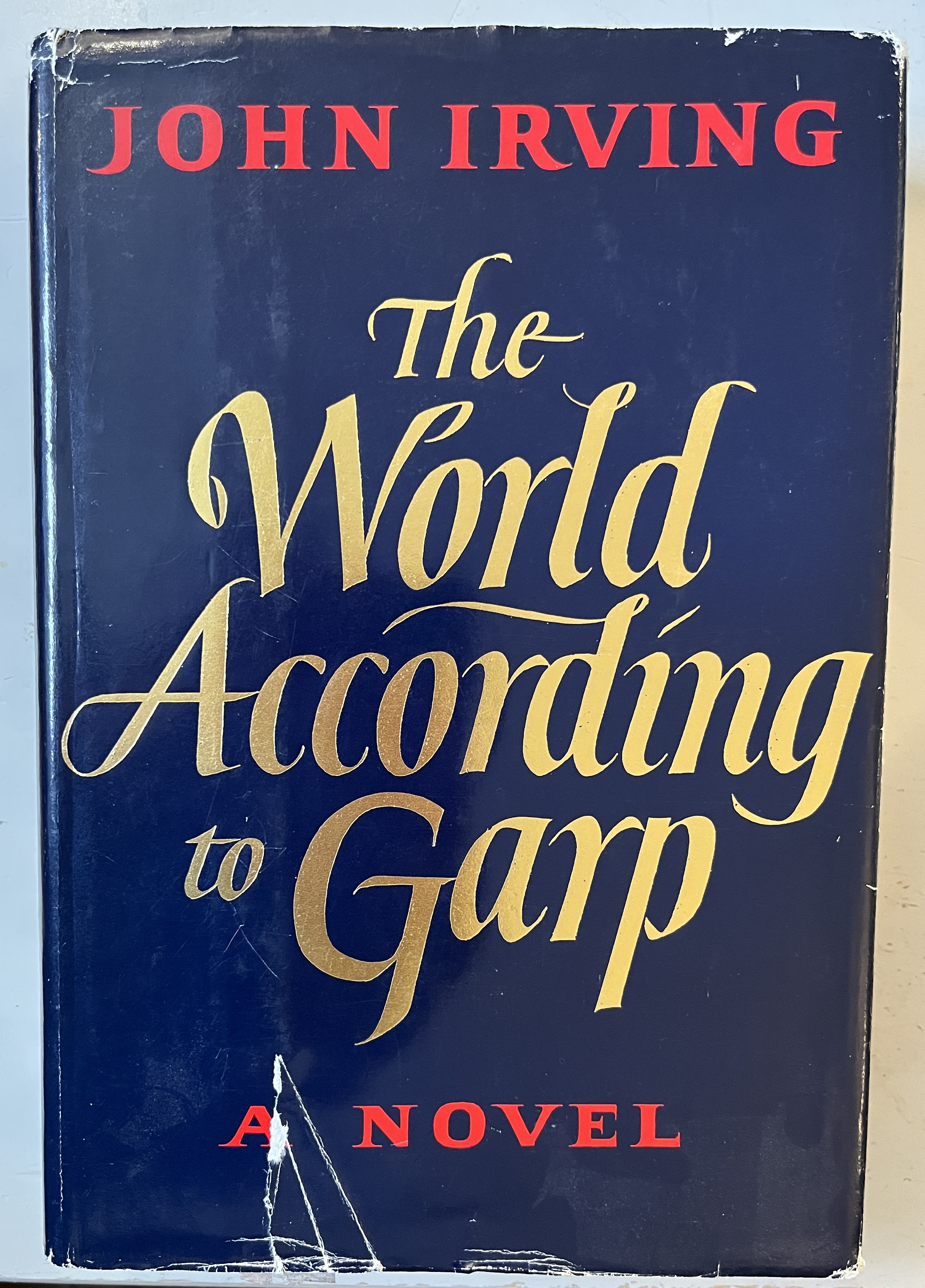 Fate: My original paperback copy must have eventually broken into too many pieces to be retained and was lost in the late 80s before I moved away from Winnipeg. My current copy is a hard-cover edition from 1978, neither rare nor valuable, but will remain in place with my curated collection of favourite novels.
1 – book with a murder
9 – made into a film
13 – set somewhere I’ve never been (New Hampshire, Vienna)
14 – name in the title
28 – an old favourite
 rclr
rclr 
As with Garp containing stories-within-the-story, I love your story-within-the review. I can picture you at 15 strolling into a Restricted show. I don’t particularly remember your well read, well loved, well worn paperback but I can picture the scene at Grampa’s store. You, wearing a uniform smock and duty shoes, doing your bit to keep the establishment tidy and welcoming. Art Murphy’s cherished ambassador! We’ve watched the Garp movie together multiple times and always talked and laughed and analyzed. Thanks for this review and disclosing the genesis of your passion for the semi-colon; a passion we share.