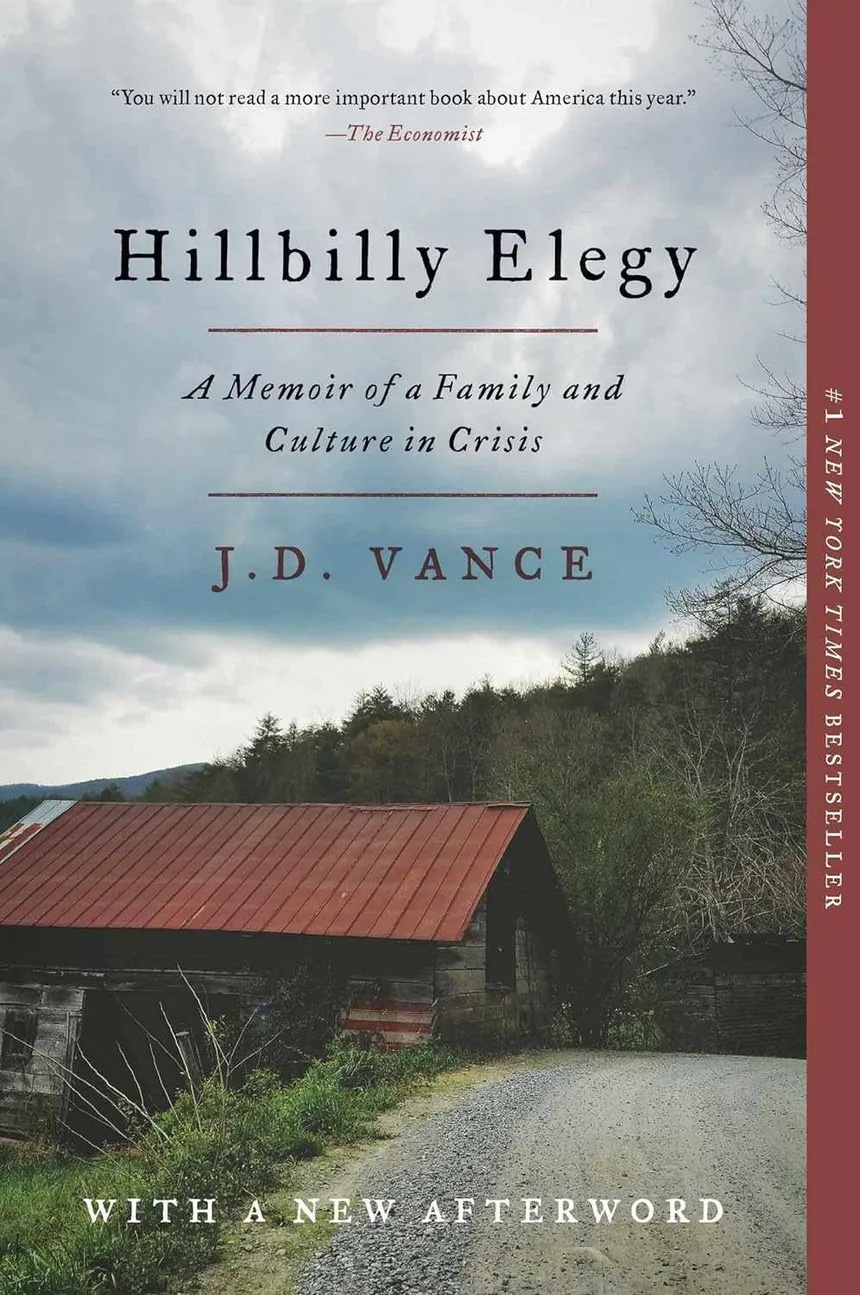
 This book was an unlikely addition to my list this year. My fellow book-clubber had read and reviewed it back in 2017, and did not love it. But not long ago, the author rose to prominence in the 2024 US election, and it seemed like one way to learn more about this new face.
In Hillbilly Elegy, Vance describes his life from early childhood through to his early 30s. Coming from a low-income household and family in southwestern Ohio, Vance’s childhood and teenage years were certainly difficult – lots of moving, family schisms, and multiple upheavals due to drugs and violence, these all made for troubling early years . He found some comfort and stability with his grandmother (known as Mamaw), but overall, he was displaced more than he was stable. After high school, he finds a measure of stability and success in the Marine Corps, a path that leads him to university and then to a prestigious law school, along the way meeting his wife and eventually starting a family. It’s very much an American Dream story, with the disadvantaged youth making good through success.
Except, amid all the strife in his young life, Vance almost makes light of some of the disruptions he experienced while attempting to sell the notion of the hillbilly as a mythic and admirable culture. He refers time and again to hillbillies as people of faith and family, living a hardscrabble existence, misunderstood and mistreated by a more (so called) sophisticated outside world. If his life story is truly representative of hillbilly culture, then that notion is a lie.
For a culture allegedly rooted in faith and family, Vance has little positive influence in either of these. There are vast networks of step- and half-siblings, reflecting the almost casual attitude to marriage and family. And there seems to be little in the way of faith (as in, religious faith); few of the characters attend church or suggest beliefs of any kind, despite waving the bible when it’s convenient to do so. The notion of getting pregnant as a teenager and running away from one’s family to start a new family in even greater poverty is rhapsodized as a strangely beautiful way of life rather than the tragic downward spiral that it represents.
Vance fails to reconcile the dichotomy between his idealized version of the folksy hillbilly and the reality of his own experience: able-bodied people who don’t work and proudly take advantage of social systems to the point of abuse and dependence (almost like an addiction); people who complain and bemoan the lack of support and understanding from authorities and society who then close ranks and lie about what’s happening when someone does try to intervene; who commit property and violent crimes against each other almost constantly while talking about the strength of their community.
His experiences as a child and teenager are terrible, and his parental influences are shockingly bad, including the beloved Mamaw with her foul mouth and penchant for guns but especially his mother who married five times and moved even more frequently before he was 15. However, by his own description, JD was also a terrible child and teenager – I found him completely unlikeable. Despite all those difficult situations, he has much more agency in his life than he acknowledges, often demanding and deciding where he was going to live and with whom and frequently getting his way, only to change his mind a few weeks later. He comes across as both underprivileged and spoiled at the same time, often taking for granted the good will of those around him and taking advantage of difficult situations for both sympathy and gain. It is this plasticity – being whatever it takes to get what he wants – that is the most troubling about him in the current context. How can he be trusted when he’s so good at saying what someone wants to hear?
I also think he gives insufficient credit to the Marine Corps for providing him both the discipline and the structure that allowed him to pursue a path that was previously clearly out of his reach, and to the bursary program at Yale (which I find hard to believe he was as naive about as he suggests). As a lazy high school student – something he can blame on no one but himself – he was not getting anywhere near a college let alone Yale; while he does ultimately achieve those things, it is less due to his own hard work or overcoming adversity than to other people or systems doing things for him, almost despite his shortcomings rather than because he’s anything special. Plus, a huge dose of good luck and timing, things that help anyone regardless of background or upbringing.
He hasn’t been a politician (or even a grown-up) long enough for there to be a coherent link between his experiences and his policies, and he was mostly inconsequential as a senator for the year or so that he was there before being vaulted into his current spotlight role. I gather from this book that his policy positions are not so much about ending social supports as to reforming them: acknowledging where they don’t work and removing elements that are open to abuse or misuse.
Overall, Vance’s story reflects a cognitive dissonance between the notion that “hillbilly” is a modest and admirable culture that thrives on faith, family, and community, and the reality that it has as its hallmarks disrupted and violent family lives and communities rife with crime, drugs, and poverty. It’s hard to see how preserving that culture does anybody any good.
I will say that I found reading this book an interesting parallel with Demon Copperhead, which also looks at hillbilly culture, painting a similarly bleak but more compelling picture of the violence, drugs, indigence, poverty, and hopelessness that characterize the modern hillbilly. I learned a lot more about the plight of this geographic and cultural region from Kingsolver than from Vance. Also, I found the fictional character more sympathetic than the real one, and I have higher hopes and greater wishes for success for Demon than for JD.
This book has the ignominy of being my Drivel choice for the year. It’s been a while since I’ve read something so poorly written, and while I know it is a memoir and so less subject to the requirements of grammar in order to reflect the author’s true voice, I was struck by the hyperbolic descriptions of people and situations (how many times can you refer to someone as a “lunatic”? Doesn’t he have a thesaurus?), the unnecessary repetition of stories and details, and the wild and disjointed swings from personal history to (mostly undeveloped and biased) social commentary. While much of the story is from his childhood, he was a grown-up when he wrote this (and allegedly a talented enough writer to edit the Yale Law Review and write for The Atlantic). If I were one of the many people he acknowledged for reading drafts and providing editing support, I would be embarrassed.
Fate: almost immediately to the little book library.
7 – author’s debut (please let it be his last)
9 – made into a film (why in the world would Glenn Close agree to be in this?)
13 – set somewhere I’ve never been (Kentucky, Ohio)
23 – a memoir
25 – new author to me
38 – drivel
 rclr
rclr 
Thanks for the great review and for taking the time to read a predictable book I’d never read myself. JD Vance’s backstory is totally consistent with his backward views. His “plasticity” makes him a well-suited companion for The Self-Centred Donald. I’m now questioning the vetting process for Yale bursaries, Yale Law Review and the Atlantic. Perhaps he was a DEI selection?