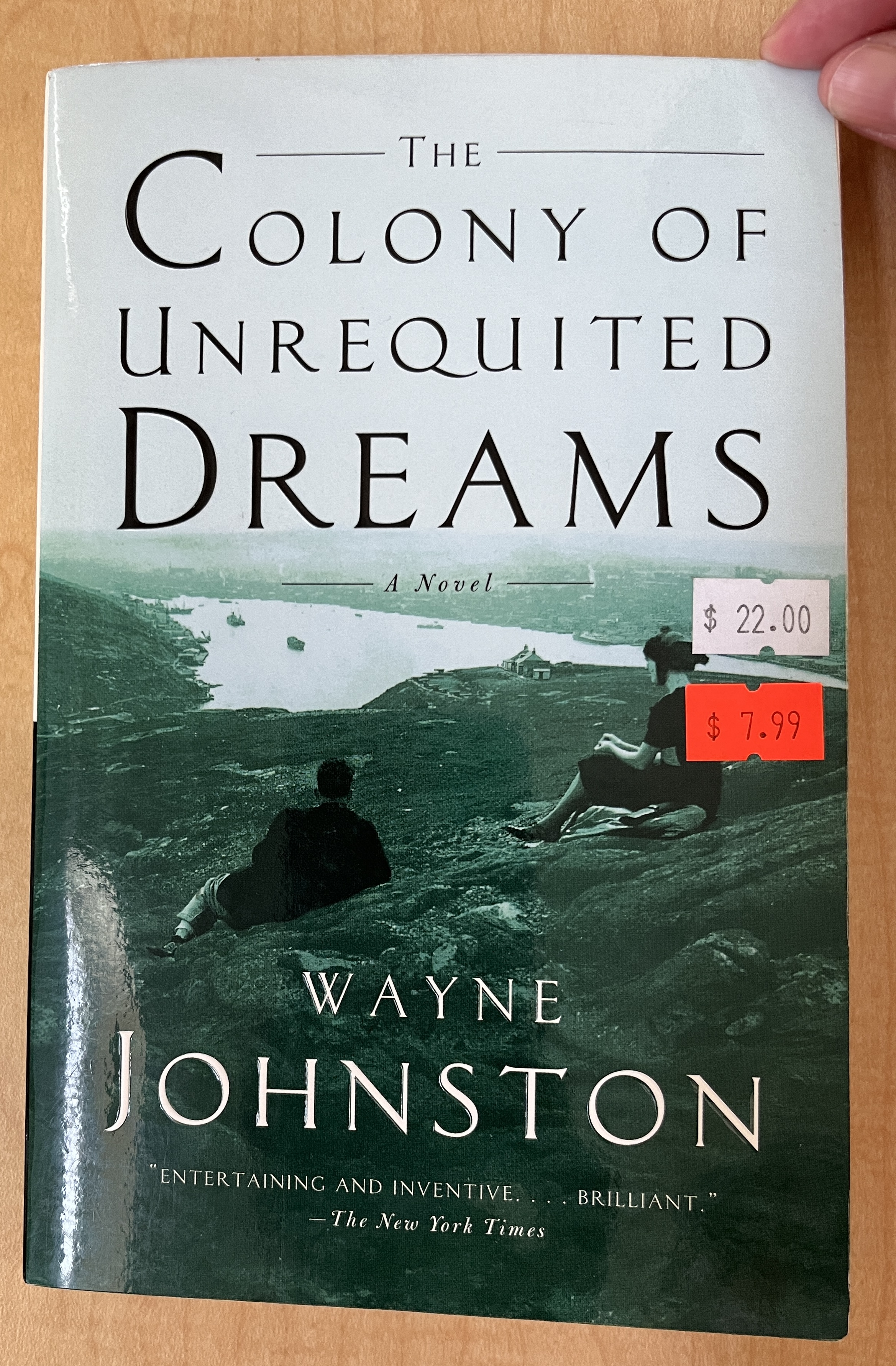
 I recall buying this book >10 years ago at a favourite used book shop in Victoria. I had previously read The Custodian of Paradise, and while I enjoyed it, I realized too late that it would have been enhanced by having read this book first. While I made a start on Colony back then, it drifted on to the bookshelves and was lost to the mists of time until now.
In this book, Johnston tells an imagined version of the life of Joey Smallwood, champion of Newfoundland joining Canada through confederation and the first premier of that new province. Building on the framework of facts from Smallwood’s life, Johnston provides a portrait of a man of considerable vanity, with limited means and confidence, with big dreams of fame and glory. He is described early in his political life by a much more experienced and successful politician:
“Power is what you want, though I’ll never get you to admit it. You picked socialism because you thought it was the best way of getting ahead…Nothing terrifies you more than the thought of dying without having made your mark.”
This sums Smallwood up well, a man vaingloriously pursuing whatever cause will get him to be remembered, to overcome his meagre start in life and show up his earliest detractors. However, he has the worst sense of intuition about situations or people, so he is constantly and consistently making bad decisions, and he lacks any true convictions or morality. His hesitation at key moments and his persistent ruminations and regrets presents a very flawed individual who is the architect of his own disappointments and missteps. As someone who has a legendary reputation, he comes across as largely unlikeable and even more unadmirable. He fails often to stick to his alleged convictions and does seem to have taken on the mission of Confederation only as a contrarian, perhaps being more surprised than anyone at his mid-life success on that path.
The land of Newfoundland is a prominent character in the novel, with the land, the towns, and the sea all playing defining roles for the characters, while also providing the unique settings for this story. The land has a powerful influence over the characters and their choices, and provides settings for key scenes that could not work anywhere else.
Johnston seems to want us to see Smallwood as the personification of Newfoundland, flaws and all. When the colony is put into what is essentially receivership by the British in 1932, there is a strange sense of pride among Newfoundlanders at having failed so spectacularly at managing their own affairs.
“Whether our distinguishing national trait was resourcefulness or laziness, ineptitude or competence, honesty or corruptibility, did not seem to matter as long as we were famous for it, as long as we were acknowledged as being unmatched in the world for something.”
This sums up Smallwood’s own strange ambitions nicely. He does occasionally acknowledge his missteps, describing an an abandoned outport community:
“The day would come when, because of me, there would be hundreds of such places…ghost ports whose populations had been forcibly transferred to employment centres.”
He acknowledges, but never apologizes, which adds to the reader’s lack of sympathy for him.
On the cusp of his great success with confederation, when he finds himself doing deals with people and making bad decisions left and right, he tells himself:
“A politician should believe that the welfare of his people depends on his success. Everything I do for me I do for them. And so the day may arrive when to tell the difference between selfishness and selflessness becomes impossible.”
I found this to be a sad portent of today’s political climate, where everything is about the personality of the leader, where there are no principles or positions or policies, just a person who is the face and mouth of the party, and who can justify any statement or action as long as it is the opposite of the other side. Smallwood’s amorality would have been right at home in the 21st century.
Johnston employs a unique plot device to tell this story – he creates an entirely fictitious character in the form of Sheilagh Fielding, with whom Smallwood has a tempestuous and antagonistic friendship throughout the story. Both are journalists, a vocation that she maintains while Smallwood only uses it as a means for his political aims. While the love story between them is tragically never resolved, their connection provides the venue for exploring and revealing Smallwood’s character. Fielding is revealed more through her journals and letters, as well as her newspaper columns. She is an acidly witty writer whose ironic turns of phrase make her writing an unreliable representation of herself, so she is ultimately inscrutable, but is overall the more sympathetic and engaging of the pair. She’s ultimately the truth-teller: when describing an earlier effort at confederation, she refers to Canadians as, “Concession-happy, compassion-prone, suckers for a sob story…”, a description that is prescient even today. She’s also a much better writer than Smallwood; I love this from her journal: “The kind of silence that follows the slamming of a door persisted in the house for years.”
And yet the people of Newfoundland outside of St. John’s are presented as being as kindly and hospitable as today’s tourism ads convey. When Smallwood is touring the outport communities – the very ones he will decimate in the future – while trying to start a fisherman’s union, he is often saved by the very people that he will come to destroy:
“…they regarded me as something of a crackpot…convinced that my mere presence among them would somehow improve their lot. Yet if I had told the head of any household that from now on, I would live with him, he would have assured me that I was welcome.”
I was struck in this section of the parallels to any colonization, where the newcomer purports to make things better for people who were just fine before, but whose lives are made ruin by forced “improvements”.
(Sidebar – a previous read was the short book, “Most of what follows is true“, an exploration of how/whether writers of historical fiction must stick to the facts of the history, how much latitude they should have on the fiction side. In that book, there is a story of a woman who came forward claiming to be the basis for Fielding, even though it was an entirely invented character.)
While I enjoyed the book, I found it hard going at times, as the minutiae of the detail could be tedious. After a while, I kept hoping for the return of Fielding to the story to liven things up, and to give Smallwood the kick in the pants he so deserved. Many of the other characters have some basis in fact, either as real historical characters or clear adaptations of them. Fielding is the only one entirely made-up, so perhaps that is why she is the most human of the bunch. I am thinking of re-reading the other book, if only to have more time with Fielding, as her character is much more interesting than any other.
Fate: I’ll likely let this go to the little book library, as I won’t read it again. But I may keep it until I do re-read the other book, in case I need to check on the timeline of something across the stories.
12 – a book I should read
13 – set somewhere I’ve never been
19 – based on a true story
29 – leftover
31 – history/politics
33 – Canadian
34 – prize winner
 rclr
rclr 