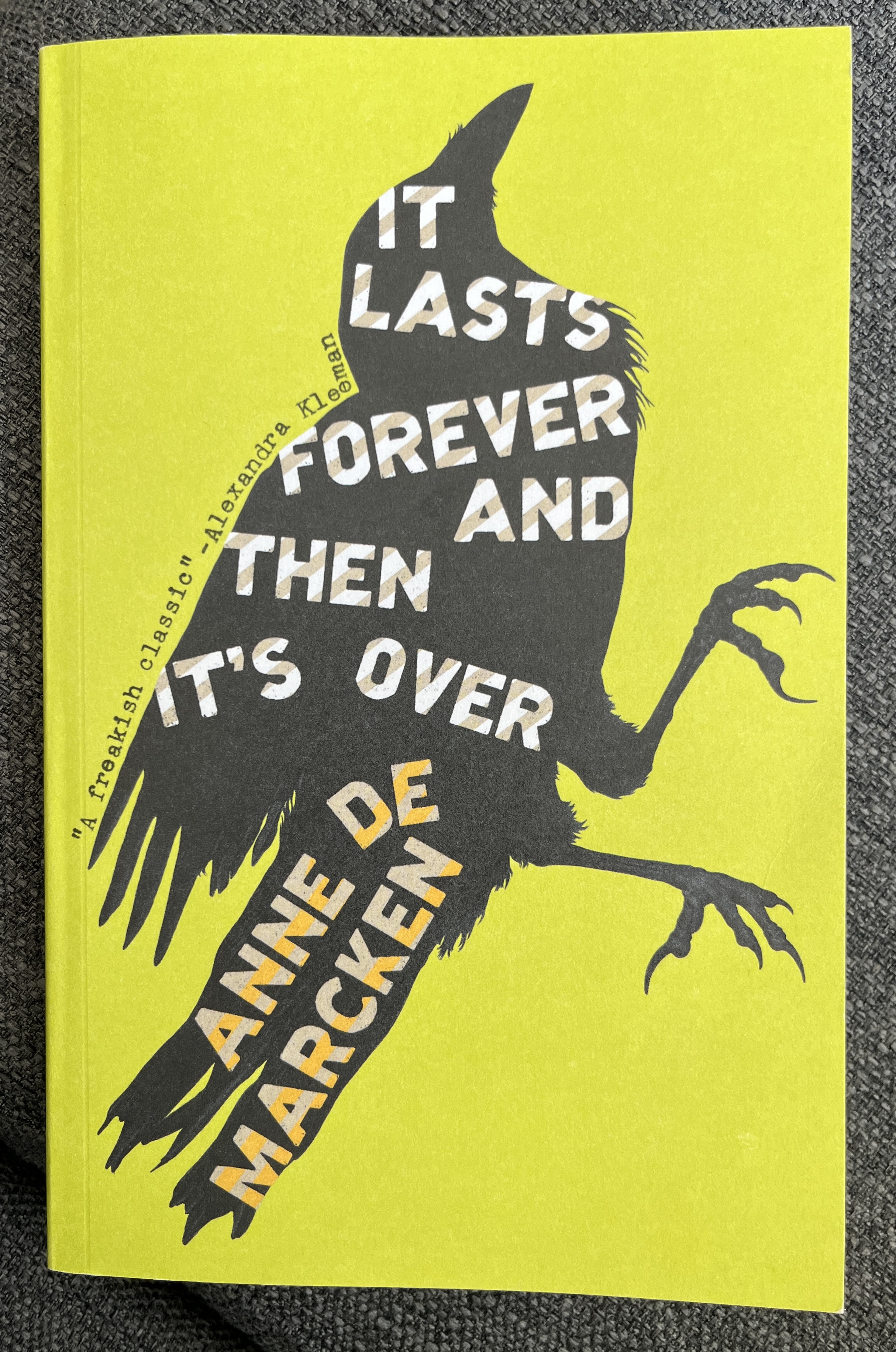
 I picked this one up last year at my favourite local bookstore. It was on the “recommended by staff” shelf, recommended by someone who has pointed me to good books before. This was another.
De Marcken creates a strange apocalyptic world, populated by zombie-like people (including the main character, who narrates the story) and those left behind to fend for themselves in makeshift communities. But as the novel progresses, it seems more like the entire world is a fantasy of the narrator’s, an allegory for their own immense grief and a story of the loss of love.
The unnamed narrator is a zombie-like creature, living communally with others of her kind. They occasionally “feed” (murder and then eat a non-zombie) and are ravenously hungry all the time. At an early point, she finds a dead crow and puts it inside her chest – to be close to her heart, or perhaps to replace her lost heart. After a kind of zombie uprising, she decides to leave and walk to the west, to the ocean, where she remembers she once spent time with her lost love. And she makes the conscious choice to no longer feed her hunger; she finds that, after ignoring it for a while, the hunger abates and then disappears entirely. Eventually making it to the ocean shore, she releases her body to the sea while her head remains alive and on the shore, watching the beach and the waves in a state of perpetual wistfulness.
A strange and lyrical, almost magical, story, I found it to be an excellent portrayal of love and grief (on par with the short film, Sea Wall), with the character’s journey through denial and bargaining, etc. through to a kind of acceptance. Her eventual arrival at the beach, with its endless watching and remembering without any further movement or action, reflects that final stage of grief – a letting go without forgetting. There’s an element of poetry here as well, with the rampant symbolism that’s not entirely explained, the dream-like descriptions and actual dreams, and the lack of concrete place or person names, all of which supports the allegorical nature of the story.
I was also reminded a bit of I Who Have Never Known Men, for the otherworldliness of the setting and the lack of resolution of the setting or the why/how of the situations.
I enjoyed this book more than I expected to, and the story will stay with me for a while.
Fate: it’s small enough that I may hang on to it for a while before passing it along.
1 – a murder
2 – time in title
7 – debut
8 – female author
25 – new author to me
34 – prize winner
37 – non-mainstream
 rclr
rclr 
Leave a comment