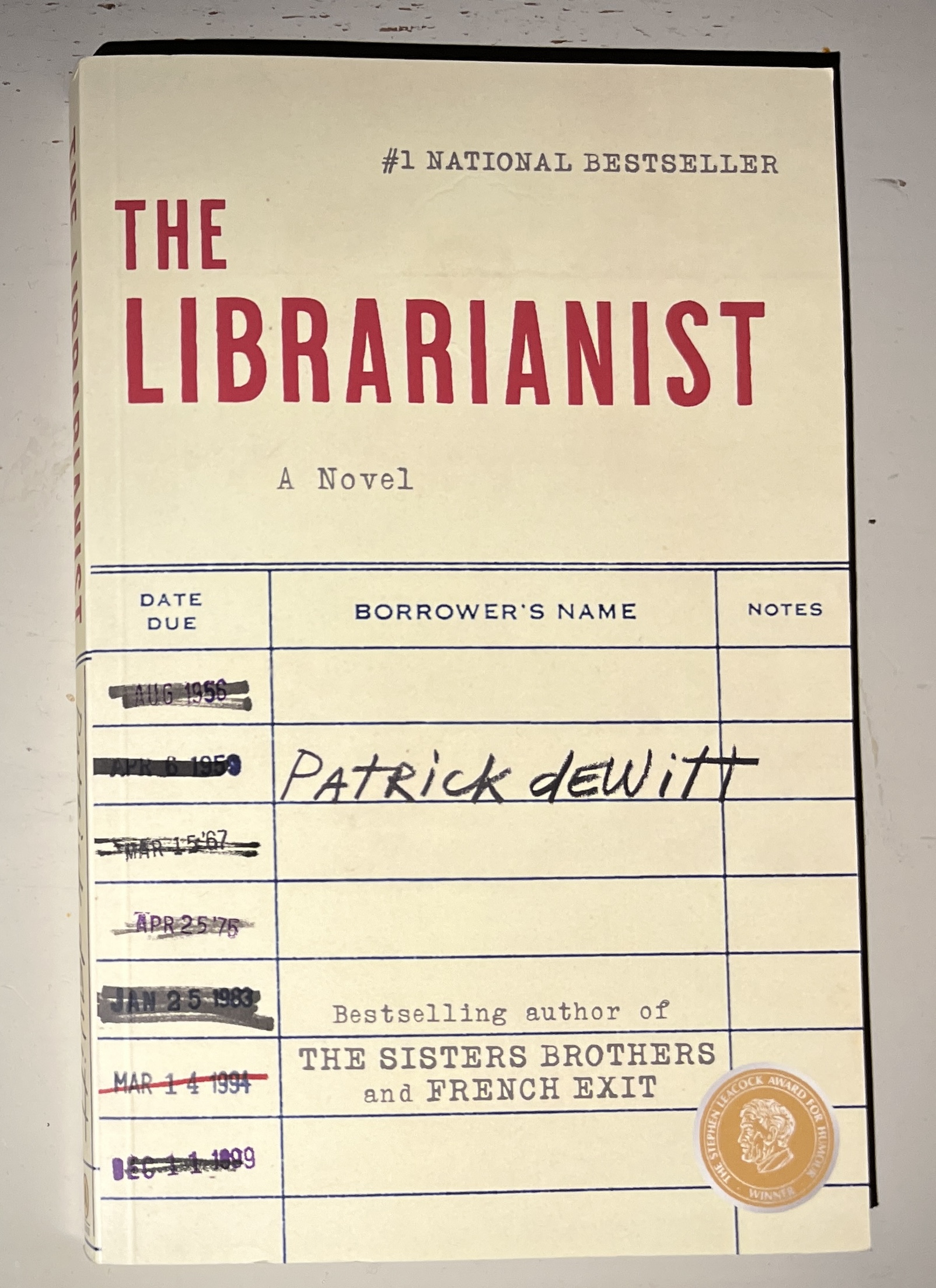
 I had high hopes for this book, as I enjoyed French Exit very much. I waited till this was in paperback before adding it to my Christmas wish list, which was duly fulfilled by Santa. While this novel is not as good as the other, it is an enjoyable, engaging, and well-written story with a few surprises, a few laughs, and a few tears.
The librarianist is Bob Comet. In his 70s, Bob lives alone in his house in Portland, OR – the house he grew up in, got married in, and from which his wife left him for his best friend nearly 50 years ago. Bob is content, with the means to stay on his own and a boundless capacity to sustain himself mentally with books and walks in his neighbourhood. It is on one of these walks that he encounters a woman from a nearby senior’s centre. Escorting her back to the building, he finds an opportunity to volunteer, and while his initial offering of reading to the group fell flat (no one was interested or had sufficient hearing or attention span for a short story), he took to hanging around with the seniors – playing cards, doing puzzles, watching tv, and generally helping to ensure no one wandered away or hurt themselves. After a chance encounter with his past, Bob takes a break from the centre, but eventually returns and moves in, opting for the camaraderie and community of these newfound quirky friends.
This story of Bob as a senior bookends two other stories of his earlier life. First, we learn of Bob’s brief marriage, culminating in the betrayal by the two people he loved and trusted most. We are entranced by the romance of Bob and Connie, and Bob’s new friendship with Ethan, and keep hoping it might turn out differently even though we already know it doesn’t. As if to wish that away, we are taken even further back to 1945 when Bob ran away from home at age 11, and spent four adventurous and almost magical days on the Oregon coast with two middle-aged actresses, Ida and June, and their pair of small dogs. June takes a liking to Bob’s pluck and daring, and so allows him to accompany them to the Hotel Elba, and even play a small part in their theatre rehearsals. Before the show, Bob is discovered by the town sheriff and returned home, and for the rest of his life he dreams of the Hotel Elba and the strange people he met and stayed with there.
This book shouldn’t work, but it really does. Even though nothing really happens, the reader is drawn in to Bob’s world and life, and roots for him in all his calmness, niceness, and passivity – not for anything to happen, but perhaps for nothing else bad to happen. Other than the actresses, who are nonetheless sympathetic, none of the characters is overdone or farcical or one-dimensional. It would have been easy to make Connie and Ethan into villains for breaking Bob’s heart, but instead we see them as complex people doing their best to navigate the messy world of human relationships, trying and failing to get it right. Perhaps that’s what’s so engaging – even in some ridiculous circumstances, the characters feel very real. That’s what I enjoyed about the previous novel – real characters. And while it’s a novel about nothing but an ordinary guy in only mildly extraordinary circumstances, it pulls the reader in and makes those circumstances and experiences tangible and vivid and compelling.
In many ways, it’s a book about nothing, a bit like the Seinfeld show, which is perhaps how this ended up as a humour prize winner. There are few laugh-out-loud moments in the book, but it is lightly humorous throughout.
Fate: passing along to another reader.
13 – never been
33 – Canadian
34 – prize (Stephen Leacock award for humour)
 rclr
rclr 
Leave a comment