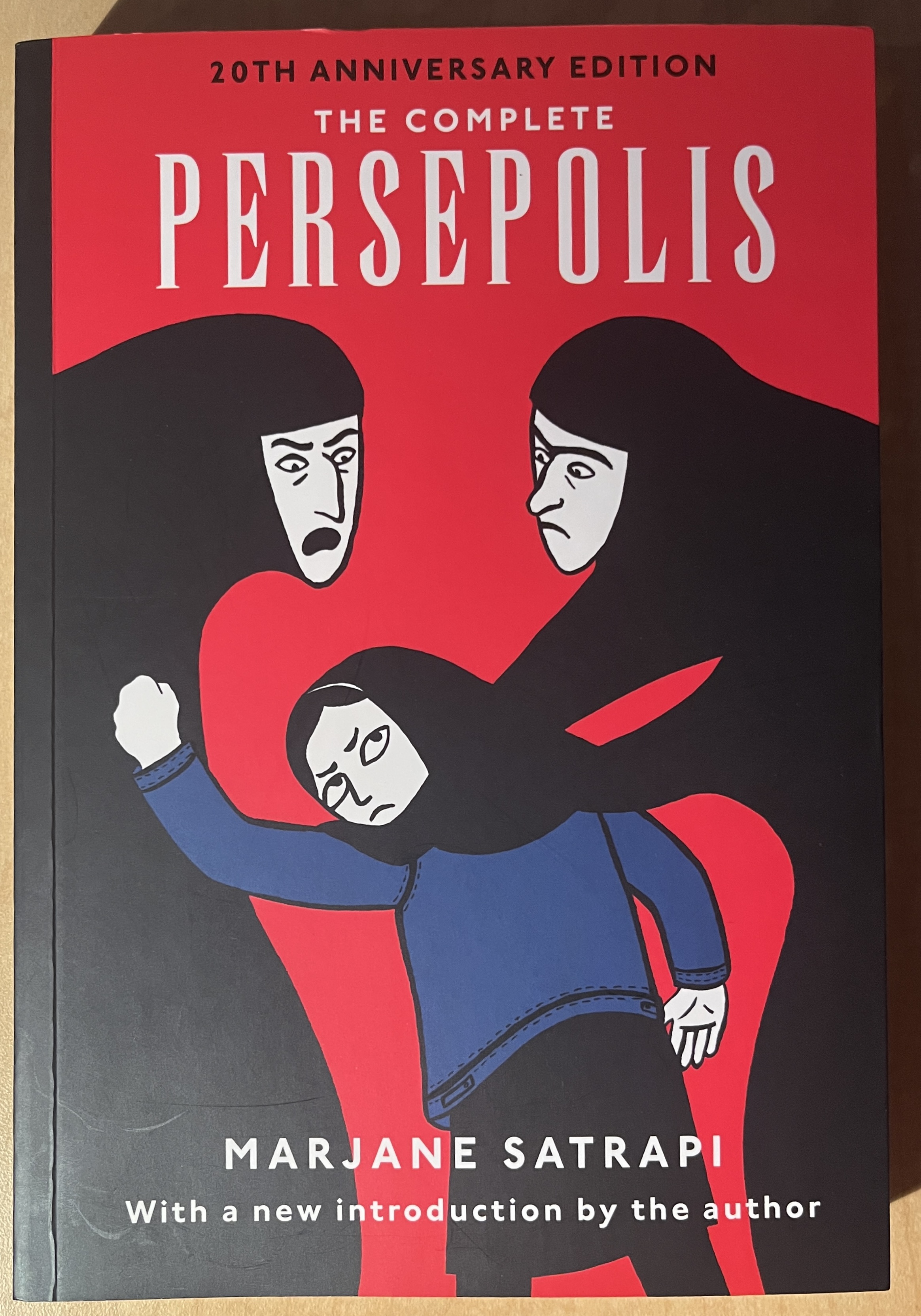
 Given the ongoing revolution on the streets in Iran, this seemed like a timely read, and one I’ve been meaning to get to for some years. While graphic novels are not usually my thing, it seemed like an interesting way to engage with the topic, and indeed it was.
Persepolis (which is actually two volumes presented here as a single book) is a memoir/autobiography of the author/artist, detailing her childhood in Iran before and during the Iranian Revolution, and her adolescence and young adulthood under the resulting Islamic Republic, up to her departure from Iran in 1994. Although Satrapi is writing as an adult, she clearly captures the child’s experiences, including the binary perspectives of what is good and what is bad (appropriately depicted in black and white). She experiences the politics of the Revolution through her parents, watching them attend rallies and joining in with their fervour and fear, and their dawning realization of what the Revolution has wrought – the fire is not better than the frying pan. Young Marjane doesn’t always understand the bigger picture, but she does get the details – her own family’s downfall under the previous regime, her uncle’s death in prison, the loss of her friends through violence and segregation, and the resulting absurdities when people are given power indiscriminately and empowered to use it the same way. As she grows up, she engages more critically with the society around her and recognizes when she has agency (rarely) and when she doesn’t (almost all the time). Her decision to finally leave Iran is difficult, and the book ends with, “Freedom had a price…” – a statement reflecting both the larger revolution and her own journey and life. The sense of guilt and regret pervade the book, as she recounts her own survival and escape against the stories of those many who did not get out.
At the same time as reading this, I’ve been listening to my favourite history podcast to learn more about the past century in Iran and the 1979 revolution, as a way of understanding the current moment there. I confess I’m no further ahead – other than being more informed about the history, I’m no closer to understanding it. Reading this story helped a bit with providing a perspective on the past, a personal story from the inside of a mysterious (to me) place and culture, but in some respects, this made understanding the present even more difficult. For example, given the history of the Shah’s regime, why would any portion of the current population advocate for its return? It’s also confusing to me how the politics and the media coverage influence the breadth or prominence of the story in the news (as well as my own mistrust of whatever I read). If news stories are correct, the numbers of people killed, injured, or arrested in the first two months of the current upheaval are staggering, greater than those in Gaza in 2023, and yet since the initial burst of headlines in January, there is little ongoing coverage. Has the world been inured to such conflict and loss? And how have we forgotten the burst of “woman, life, freedom; man, homeland, prosperity” protests just a few years ago, when men and women protested together, with women risking their lives to remove their headscarves?
All that to say, I think books like Persepolis are important stories and perspectives for those of us living so far away from such trouble, not just to appreciate our own peace and privilege but to encourage us to provide both the grace and support to those who are living through those struggles, including the difficult choices they must make for survival and freedom. While I won’t say I “know” more about the history of the region and its current struggles, I can say I know more about how fraught are the lives of those living through them, how agonizing their dilemma is, and its impact on their daily lives and longer term choices.
Fate: will pass along to another reader.
1 – a murder
8 – female author
9 – made into a film
13 – never been
17 – place name
21 – translation
23 – memoir
25 – new author
31 – history/politics
35 – banned
 rclr
rclr 

Leave a comment