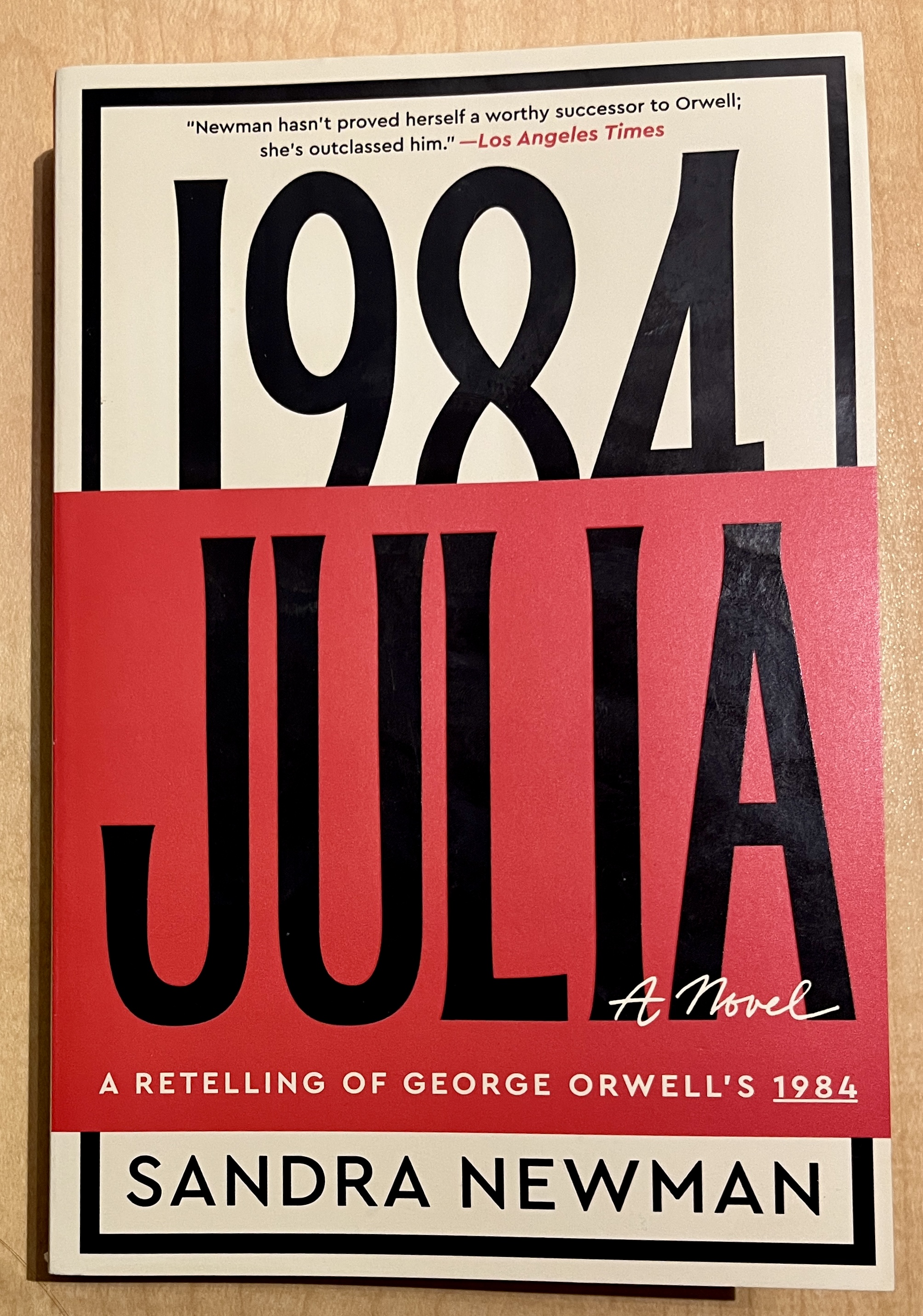
 This is billed as a retelling of George Orwell’s 1984, with the imprimatur of approval from the Orwell estate (while the original novel is in the public domain in England, it is still under copyright in the US, and the estate has further protected both the title, the phrase “Big Brother is watching you” and the name “Julia” as a guard against pretenders and cheap merchandising). This is indeed a retelling of that story, but with Julia as the main character, providing both her backstory and her post-Winston life.
In 1984, Orwell’s focus was on the totalitarian world of Oceania; Winston Smith was a tool to tell about that world, and Julia almost a NPC, a necessary plot device but nothing else. Newman provides more history and complexity to Julia than Orwell gave to Winston Smith, both to give a voice to a voiceless woman and to expand on the horrors of that world, horrors portrayed as more elaborate and intimate for women.
Spoiler alert: we first meet Julia at a time contemporaneous with the 1984 story. She knows Winston Smith casually as a Ministry co-worker. We learn about her life outside the Ministry, the hostel she shares with a few dozen other young women who work at various Outer Party apparats, and about her skill at living within but not as a part of the Party. She has grown up knowing only this world, albeit from the fringes originally, and has learned to navigate through it, taking her own pleasures through semi-subversive acts such as delaying her own shouting during a rally, dealing on the black market, and arranging and enjoying a series of trysts. Her sexcrimes (as they would have been judged) are prodigious and expertly navigated; despite her relative youth (she’s just 27), she has a mastery of moving just beneath the surface of the Party world. Enter the character of O’Brien, the duplicitous and sinister villain representing the worst of the Party. In this story, Julia is drawn into his world before Winston is, and she becomes O’Brien’s agent, luring Winston and others into sexcrimes and other treasonous acts. When truths are revealed, Julia learns of her own naïveté alongside her victims, and suffers (in excruciating detail) a similar fate. Following her torture, like Winston she is released into a kind of purgatory, to live as an unperson. But she gets a reprieve – she is pregnant, with a presumptive Big Brother heir. This gives her a smidgen more latitude in the world, and she indulges in what she can while she can. Beyond England (aka Airstrip One), the world is closing in; so-called Rebels are encircling the island and then the city of London. Julia has had a warning of this, and so, nearing the completion of her pregnancy, she decides to try to leave London, eventually being rescued by the Brotherhood of Free Men (turns out, the Brotherhood is real, not just the fantastic creation of O’Brien and the Party to tempt thought criminals into the open).
While I enjoyed this retelling for the backstory of both Julia and the Party, and the quotidian details of the lives of ordinary people in that time, I had several issues with the story. First is Julia herself. Despite her worldliness from her experiences as a young girl and then young woman, she is shockingly naive and credulous, and I found her interior life to be often insipid bordering on ridiculous. Through her credulity, she is partly the architect of her own demise; not to blame the victim, but in many situations, she really should have known better. Next, the ending was disappointing, seemingly modelled on the 1990 movie version of The Handmaid’s Tale, where, after a dramatic climax, the heroine is shown safe and pregnant, away from the dystopian world. It seemed wholly unnecessary to have Julia delivered to presumptive safety or for the portrayal of the decadence of both Big Brother and the purported Rebels (perhaps more aptly called the Revels, as they avail themselves of all the hoarded luxuries in a seemingly endless bacchanal of champagne and baths). Within this was the unnecessary and tasteless portrayal of Big Brother as a senile old man, at an age that seems unlikely in the story’s timeline; like with the overall ending, better would have been to leave his fate a mystery, or with a suggestion of a grisly or humiliating off-screen death.
This novel beats the feminist drum pretty hard (all women good, all men bad), and ultimately treats men similarly to how Orwell treated women – as caricatures, villains, and NPCs. The graphic descriptions of violence (sexual and otherwise) as being an ongoing threat for women especially, misses Orwell’s point: the objective of the Party is stratification and dominance based on class, not sex; divisions and actions based on sex are a means to the end of enforcing classes in a supposedly classless society – that’s the commentary from Orwell. And while sexual violence and subjugation based on sex is very much a part of that world, the targets are both men and women, and Julia plays her part in it, both as victim and perpetrator. She is a willing, if duped, participant, using her sexuality and desires to extract damning behaviour from the men O’Brien is targeting. She enjoys it, until she doesn’t; there isn’t an incident or revelation, she just changes her mind one day, and the work goes from being fun to being a chore to being a source of rebellion. Julia’s gullibility and flakiness make her an uninspiring feminist icon. Worse, when Julia or any woman in the story is given any agency or spine, they either use it as a weapon against other women or are talked down from any heroic stance or action by other women, including by Julia. As presented here, women do not have it any worse than men in this world; both lack agency and are subject to extreme oppressions. The mechanisms are different, but the violence, oppression, and ultimate demise are the same.
Fate: little book library. 1984 I’ll read again, but not this.
1 – a book with a murder
8 – female author
14 – a name
20 – one word
25 – new author
 rclr
rclr 
Leave a comment