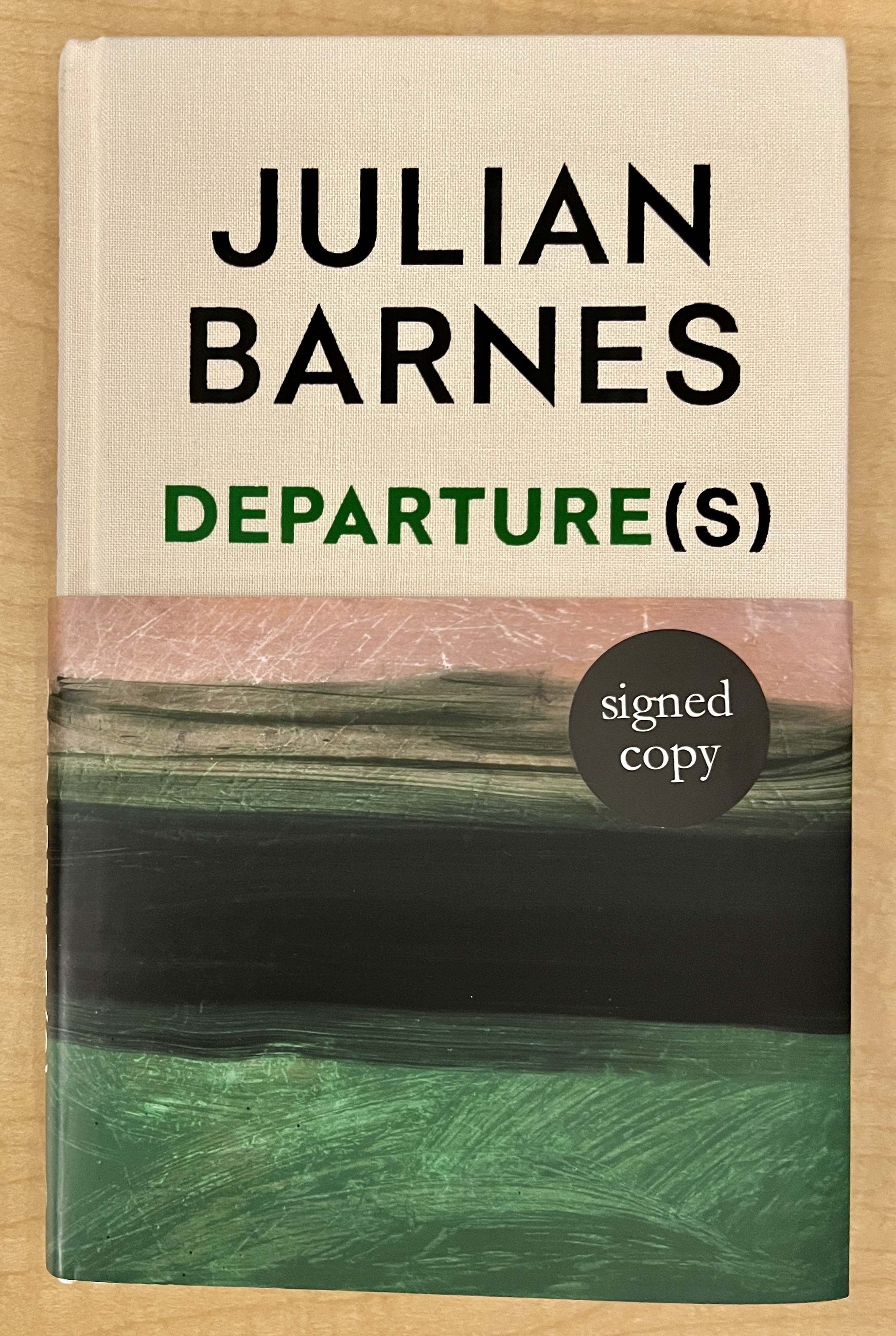
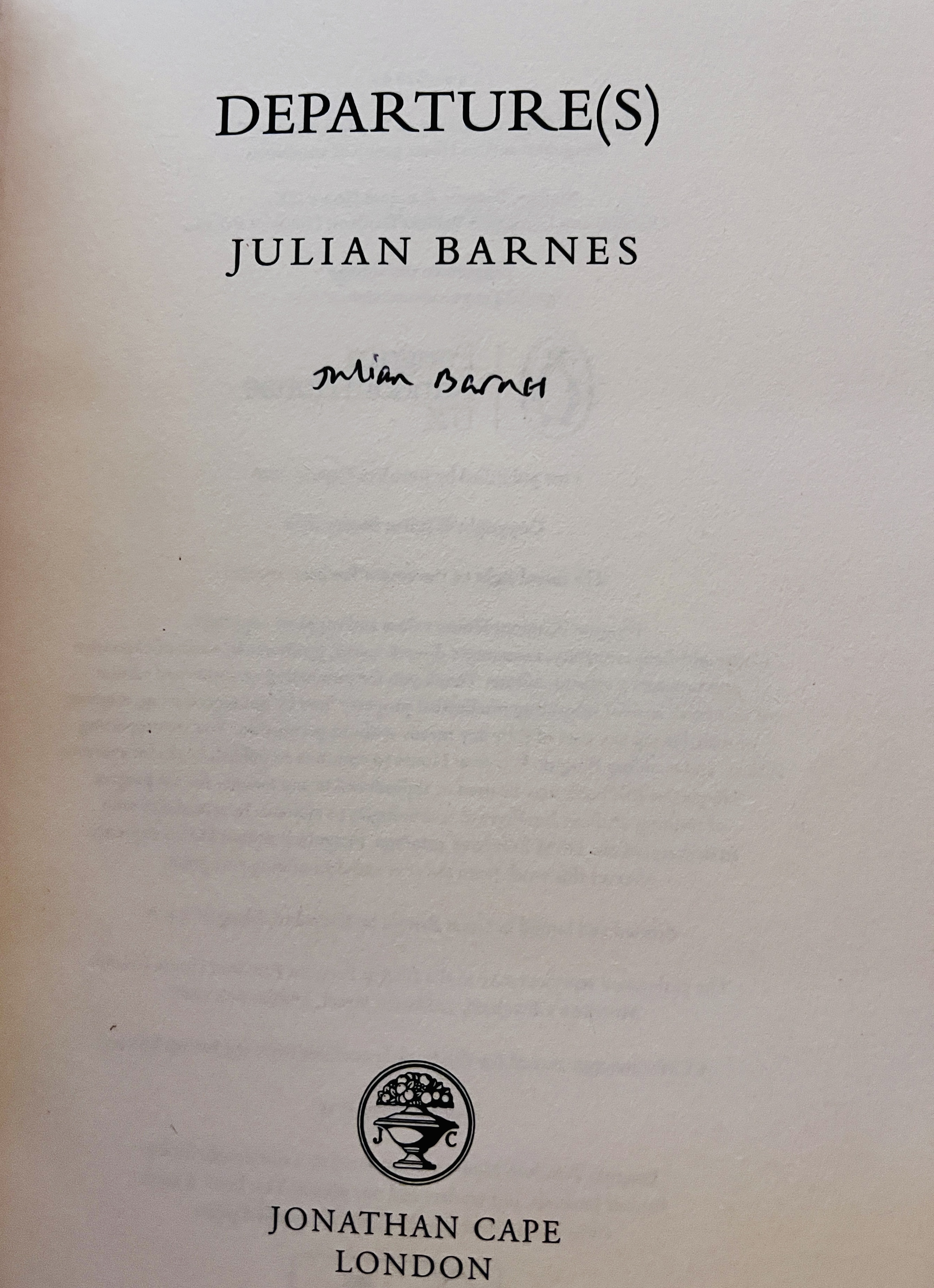
 First off, I’m pleased to say this book did not disappoint me (like the previous one did). I was delighted to get the UK edition, and a signed copy at that (although the signature was disappointing, such a small scribble). The physical book is a delight, with substantial paper, a cloth binding that invites holding (so much better than an e-reader), and the delightful old-book smell missing from more mass-produced things.
The “novel” is very difficult to describe or characterize. There is a fictional story interwoven with more autobiographical and philosophical elements, all around Barnes’ common themes of love, memory, and death and dying. Several of the reviews I’ve read following my own reading of the book characterize this as autofiction, which seems a reasonable designation. The novel portion (which also may or may not be based on a true story) concerns two friends of the narrator (which may or may not be Barnes himself). Stephen, Jean, and Julian are at Oxford together in the mid-60s. Stephen and Jean become a couple for a few years, but at graduation decide to part ways, as their only other option is to get married, a state which suits neither of them. Forty years later, Stephen approaches Julian to arrange a re-introduction, which he does. The rekindled romance burns bright and hot but ultimately fizzles; the couple part ways again and, after each has died, Julian feels free to tell their story. Within and around and because of this rekindled romance story, Barnes presents his own story, musings, and philosophies.
As always, the writing is delicious. Even when the story is a bit rambling and disconnected, it pulls you along because of the well written, almost intimate, language and tone. Of note is the dialogue he creates/recounts with the old friends. The reader is drawn in to the story by the compelling and realistic conversations and then is brought up sharply when the author steps in to remind us he’s “recollecting” rather than relating a complete story. These shifts in perspective, along with the ruminations on the fallibility of memory and the effect of aging on memories and imagination, are classic Barnes.
Barnes has said this will be his last book (not his last writing, so there remains hope for some additional stories and essays to come); indeed, in the final pages, he breaks the literary fourth-wall, bidding farewell directly to the reader, encouraging us to keep reading (“don’t stop looking”) as he slips silently away. Barnes himself is not ancient (just turned 80) nor more decrepit than most (yes, he has a manageable blood cancer and is deaf, but is otherwise mostly sound). He is just anticipating the inevitable, and wanting to bookend his literary output, at least in novel form, deliberately rather than accidentally.
This is a fine finish to a stellar career. I don’t think this book would appeal to a new-to-Barnes reader at all, not least for the many self- and cross-references throughout to his earlier writing (in that way, the book is also a quasi-memoir). For Barnes-ophiles like me, it is a wonderful reminder of his excellent earlier work, a strong motivator to revisit those in the coming months and years, as well as a fitting and fond farewell. As John Irving wrote, in The World According to Garp after Garp dies, “Read the work, forget the life.”
Fate: capping off my Barnes collection.
4 – published in 2026
19 – based on true and/or 23 – memoir
20 – a one-word title
28 – old favourite author
 rclr
rclr 
Leave a comment