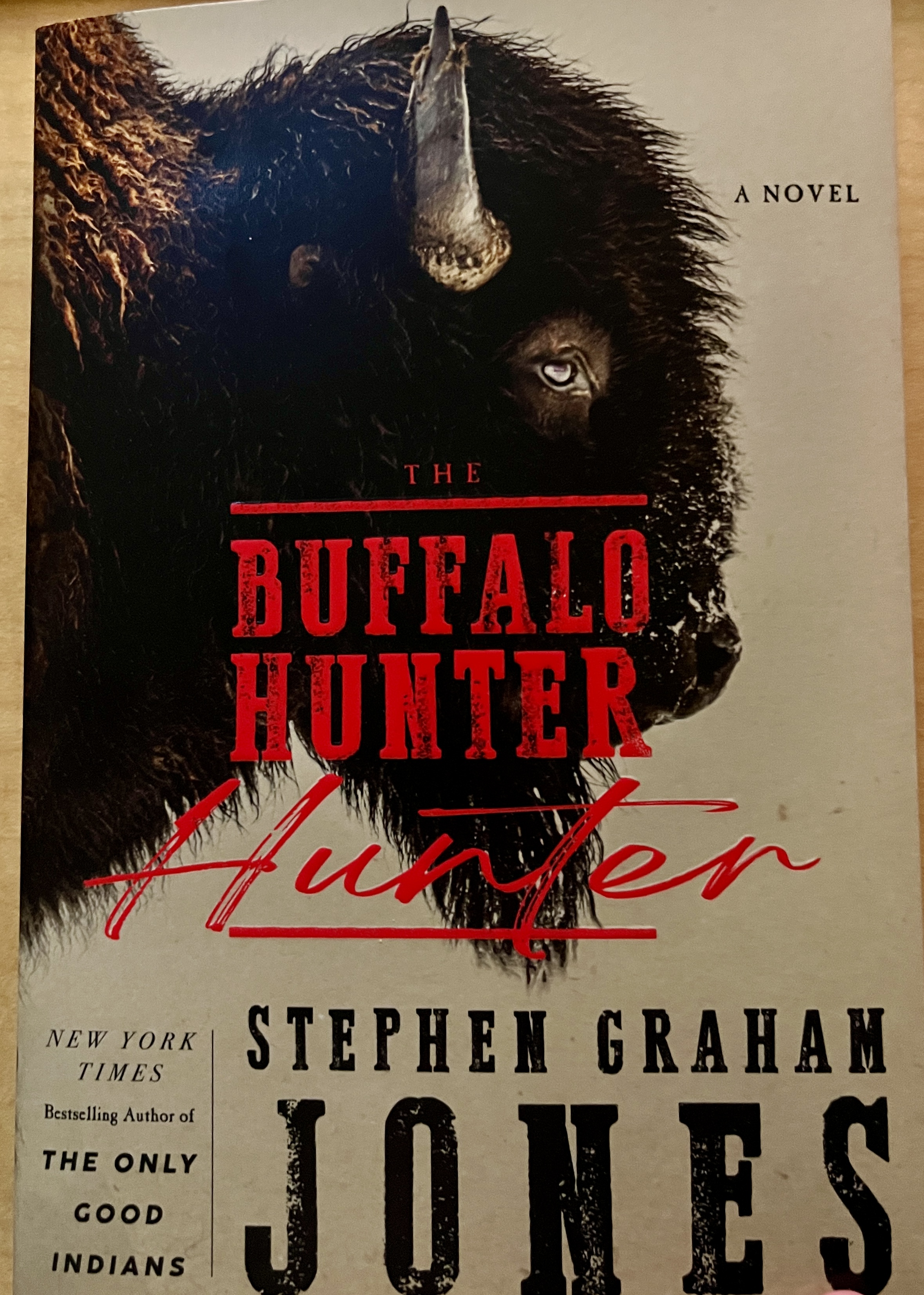
 This had been lauded by the New York Times on a year-end book review, in a breathless but brief summary, but turned out to be about something much different than I expected. In the last few years, I’ve been trying to include some writing by Indigenous North Americans (not always Canadian) in my book choices, and so I impulsively added this to my pile. I should have read up a bit more beforehand, as the main plot was a surprise, and not my usual type of thing.
In this well written and engaging tale we get the story of Arthur Beaucarne, a Lutheran pastor in Miles City, Montana, in 1912, as recounted in a recently-unearthed journal. He recounts the tale told to him in a quasi-confessional way by Good Stab, a Pikuni warrior who is now also known as Takes-No-Scalps or The Fullbood. Good Stab arrives in the town at the same time a series of grisly murders begins, and through his confessions reveals he is a kind of vampire – feeding on blood, super strong, can’t die, etc.; I say “a kind of” as there are important differences, including a reflection in a mirror and being able (although painfully) to be in the sunlight. (This is the digression from my usual thing – I rarely intentionally read horror stories.) After his accidental turning by another vampiric being, he uses his new strength and violence to avenge those who persecute his people, with some emphasis on the buffalo hunters who decimate the species his tribes depend on for their very lives. His arrival in Miles City is not accidental: he’s seeking the man responsible for a specific incident, the Marais Massacre, who turns out to be none other than the pastor. More violence and horror ensue. The entire story is presented as the research project of Beaucarne’s great-great-great granddaughter, Etsy, a communications professor in Wyoming in 2012. Etsy introduces the discovery of the journal and tells the story as her transcription of it. The novel closes with a modern day continuation and conclusion of the vampire’s revenge.
I was surprised to find I enjoyed the vampire story, comprising the majority of the middle of the book. Macabre details aside, there were stories and elements of now-forgotten times that actually weren’t so long ago. The tragedies of the Blackfeet peoples, especially the loss of their stories and way of life as their people disappeared, alongside the relentless expansion of modern society and the brutal consequences for everyone, made an interesting backdrop for the horror story. One of Good Stab’s laments is his ongoing grief at having to witness the destruction of his people while being powerless to stop it – for all his strength and violence, the outcome remained inevitable. This story is very well written and creative, with several gasp-out-loud moments when it moves in surprising but believable (for a vampire story) directions. The characters are colourful and deep, and the fear, rage, and anguish they experience are tangible.
Less engaging were the beginning and end bits with Etsy. While an entree to the historical section was necessary, this felt very contrived and convoluted, and Etsy is the least believable or sympathetic character in the story. These sections are presented as her own writing, in a journal or blog-type style; when combined with her shallow construction and immature voice, the result is disingenuous and somewhat annoying. And the ending is ridiculous, undermining the excellence of the historical portions of the story.
The book’s title is highly compelling, but not well supported in the story. Yes, Good Stab kills many a buffalo hunter, but that is hardly his mission, especially as, by the time he becomes what he is much of the buffalo population is already gone. No one in the story or history of that time refers to a buffalo hunter hunter, and any effort he makes to highlight his purpose as avenging the buffalo are misunderstood or lost amidst all the other carnage. Even the serial murders in Miles City are misaligned – while he poses them as being in revenge of the buffalo, none of the victims were in fact buffalo hunters. His attempted rescue and shelter of a small buffalo herd is one of the hallmarks of his sustained humanity, but like many of his other attempts at heroic rescue, it is misguided, poorly considered, and ultimately doomed. So the moniker of buffalo hunter hunter feels cheap, like a clever title looking for a home rather than a reflection of the story (see also Mrs. Death Misses Death).
This was an interesting read, and I was engaged with much of the story, but ultimately it felt closer to a grocery-store pulp fiction. Any sophistication comes from the historical background, which is impressive in both scale and detail, and the unusual style of the monster.
Fate: little book library.
1 – murder
4 – published 2025
13 – set somewhere I’ve never been (Montana and Wyoming)
25 – new author to me.
 rclr
rclr 
Leave a comment