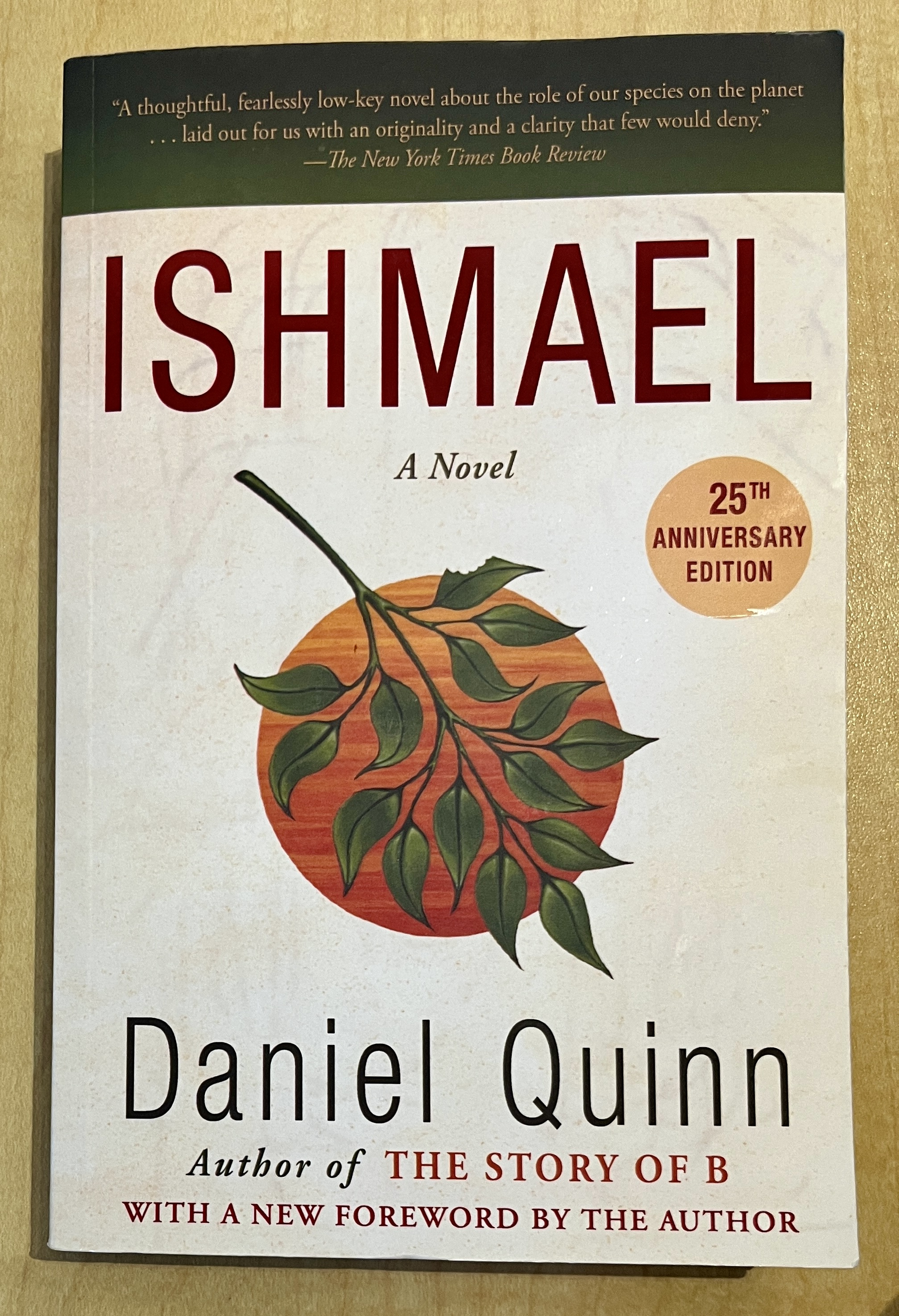
 This book was a gift from someone who suggested I read it while or after I finished the bible. It was certainly an interesting counterpoint. While not great literature, its ideas are highly original and thought-provoking.
There is not much of a story in the novel, as it consists almost entirely of a conversation between Ishmael (a highly intelligent and literate gorilla) and an unnamed man. Ishmael has had numerous previous pupils, as he tries to get his message – his warning, his exhortation – across: mankind since the agricultural revolution is devastating the world, but this can be reversed if the Mother Culture is recognized and rejected. He purports that mankind consists of Takers (societies that, since agriculture emerged, are bent on dominance of the World, including overtaking the role of Mother Nature) and Leavers (the vanishingly-small remaining hunter-gatherer tribes who live the way man lived prior to agriculture). If Takers can be convinced that their culture of acquisition and innovation is actually the root cause of the destruction of the Earth rather than the salvation of civilization, that life as Leavers is actually an acceptable alternative, then perhaps the Earth can be saved. As part of his thesis, Ishmael offers alternative interpretations of the Genesis stories of Adam and the tree of knowledge, the Fall, and of Cain and Abel (Cain’s murder of Abel represents the superiority of agriculture over pastoralism, reflecting the Mother Culture message that man should dominate and occupy the entire Earth). Ultimately, the pupil has his epiphany and Ishmael dies, leaving the student to wonder about his next steps. The theses and reinterpretations of the bible stories are intriguing, but ultimately flawed IMHO. Ishmael failed to convince me.
The novel’s style of dialogue-only (or primarily) is less engaging than intended, as the lengthy conversations are unrealistic (leaving aside that one part is a gorilla) and the revelations by the pupil are at times far-fetched. As described in the foreword of this edition, the author tried several different approaches to tell his philosophies to the world, with this version being the most effective and well-received (winning the only ever Turner Tomorrow prize, with plaudits from Ray Bradbury). This novel, along with its sequels and related books, has developed a strong following, including in the environmental and social justice movements. For me, the dialogue did not make the ideas more engaging or palatable, just a very long way of presenting a set of ideas, only some of which were convincing.
Regarding Civilization (with a capital C), an interesting thought emerged from the book around the question, “at what cost?” While modern advances and innovations have been and are positive (including agriculture but also medicine, sanitation, literacy, communication, travel, trade, and democracy), society often fails to consider or reckon with the negative consequences of these positive things. Agriculture allows humans to settle, but is it only a good or are there some downsides, and is it objectively better than the alternative? Along with the positives of safety, comfort, surplus through hard times, leisure, and the accompanying innovations come the negatives of environmental destruction, war and fighting over those surpluses, stratification of society (the comforts and the work are not evenly distributed), the vulnerability of entrenched settlements, and the loss of resiliency. We do not have to reject it because of the negatives, but we can acknowledge there are always costs and trade-offs, both for our humility and for anticipating future problems, and while it may be better than pastoral life in many respects, the alternative still has merit. In other words, there is no such thing as an absolute good (or bad), but only things that are good on balance or at least better than the alternative. For each boon of Civilization, we might benefit from dialling down the hubris and considering the downsides prospectively rather than once all the damage has been done.
I won’t say I liked the book, and I wouldn’t recommend it (you can read a synopsis online and get gist). As the novel’s conversation considered the many instances of ruin of “primitive” societies by civilized ones on the basis that modern life is better, I was reminded of two other pieces with the same but pithier message: the story of the Mexican fisherman, and the song “Civilization (Bongo, Bongo, Bongo)“.
Fate: I’ll eventually return it to the owner, if they want it, or it will go to charity.
14 – a name in the title
20 – one word title
25 – new author to me
27 – a gift
30 – philosophy/religion
34 – prize winner (Turner Tomorrow prize)
36 – part of a series
 rclr
rclr 
Leave a comment