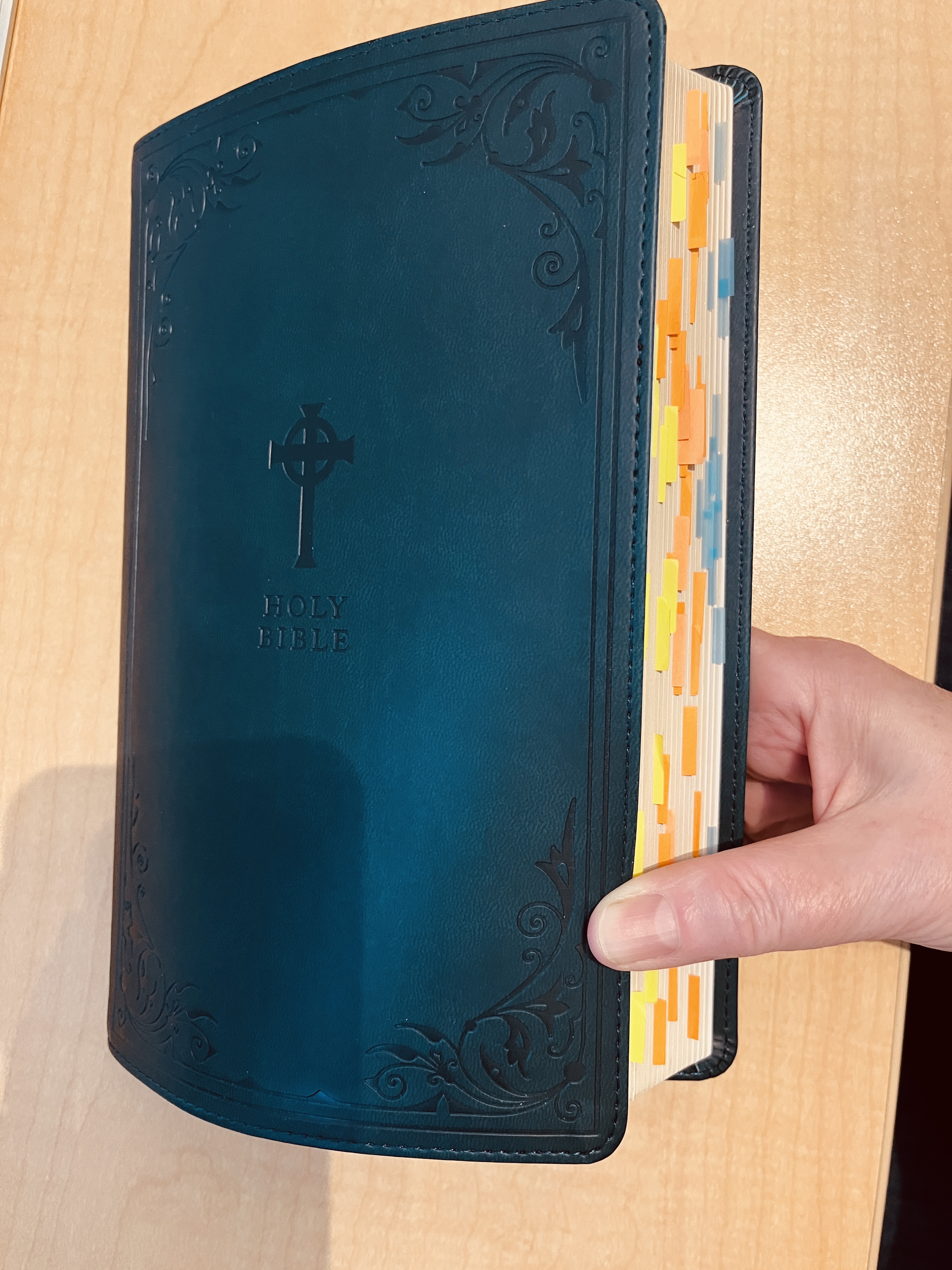
My pop used to say that a hallmark of a smart person is that they’ve read the bible. In the spring, when going through some of his things with my sister, we found his bible – a Jerusalem bible, from 1966. I decided to take on reading it this year, but didn’t want to risk damaging his copy (nor tote it around nor wade through its many footnotes), so I found a more portable version, along with a year-long reading guide. I started in late April, just after Easter, and finished the weekend before Christmas. These 1,300+ pages are why my other reading fell short this year.
As it is supposed to, it provided many moments of question and reflection. In the “what the heck” category were the many stories I thought I knew that were quite different, and often quite a bit shorter than legend would have me believe. For example, the story of Samson and Delilah is barely a chapter in Judges, and is far from a love story, and yet the couple occupy a place in the romantic pantheon alongside Romeo and Juliet. Similarly, the story of Noah is barely 2 pages long and yet is the stuff of many much longer stories and films, all extreme interpretations of this very hazy story.
Overall, this is a fairly easy read, except for the lengthy (and boring) sections delineating in excruciating and repetitive detail the various family lines of the kings and the now-irrelevant laws (“You shall not plow with an ox and a donkey yoked together.”), customs for sacrifice (“…you shall choose your offering from turtle-doves or pigeons.”), and the various numbers of people moving from one place to another.
Most striking to me was the differences in tone and language from the old to new testament, most likely due to the immediacy of the recording – the old testament being the post hoc writing-down of ancient oral histories versus the new testament’s more authentic(ish) first-person writings. A bit like biography/history versus memoir. But I did learn some interesting things. For instance, why don’t Christians keep kosher? Because Jesus said (essentially), “don’t bother.” This and other over-rulings of canon and custom, culminating in his abbreviation of the 10 commandments into his own 2 (which actually encapsulate the 10), was the root of the Jewish leaders’ disapproval (to put it mildly).
Like the old testament, the common understanding of the new is rife with fabulations, despite the comparative narratives in the gospels, starting with the nativity story. For example, there was no inn nor innkeeper to turn the family away. The three-ish wise-ish men did not arrive at the manger for the baby shower, but quite a while later. However, other elements of the story and of the lives of the apostles are part of non-biblical historical record, and so the witness accounts of the apostles are historically true; the more mystical elements of healing and miracles are, of course, matters of faith. The “scary” book of Revelation is just plain weird, more like a drug-induced fever dream and hallucination than anything clearly suggesting what the end of days will be like.
I’m glad I took the time to read this, checking off a lifelong ambition. I don’t know that it has made me smarter, but certainly more familiar with a text so important to so many. In the end, it is a story written by men (almost entirely by men) history and custom, belief and faith; the evidence of tinkering through the centuries is clear, and the political motivations and ambitions of some of the writers is obvious. But, given the bible’s centrality in so many other stories and settings, I hope I’m now better able to better recognize its influence in literature and elsewhere, and be more considerate and contemplative as I explore my own faith and beliefs.
Fate: back on the shelf, with all my notes, next to pop’s bible and all of its notes.
1 – a book with a murder
3 – before 1939
12 – should read
13 – never been
19 – based on true
21 – a translation
30 – philosophy/religion
31 – history/politics
35 – banned
 rclr
rclr 