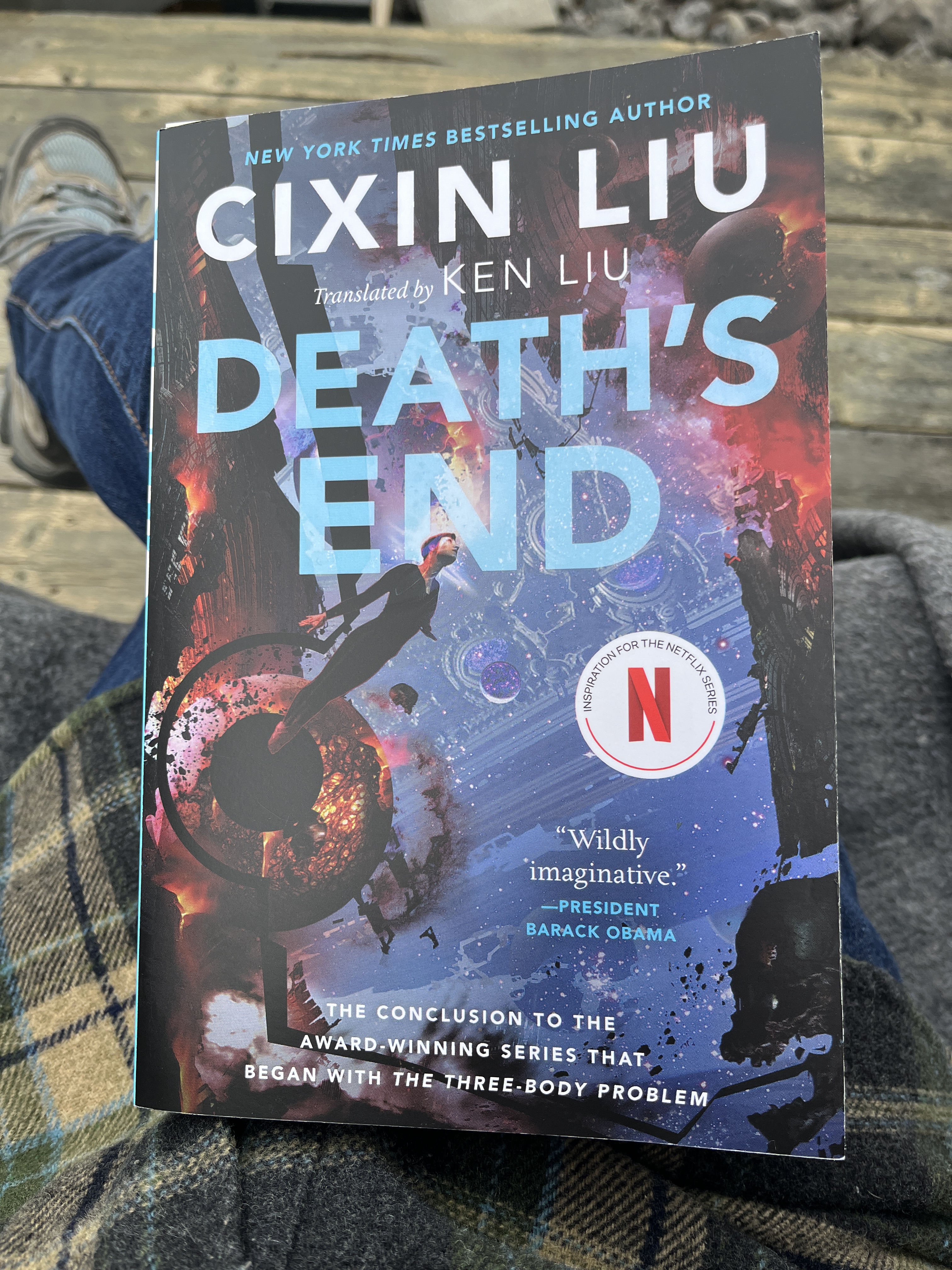
 This is the third and final book of the Remembrance of Earth Past series that began with The Three-Body Problem. Book 2, The Dark Forest, could easily have been the conclusion to the story, so I was curious to see if and how Liu could expand on the story.
The novel begins several years back from the previous one, introducing a host of new characters, situations, and technologies. Cheng Xin is a physicist from approximately our current time, and so her story overlaps with the previous ones (so understanding this book depends on understanding the previous two) and extends well beyond those. Making liberal and frequent use of the hibernation technology and becoming subject to what is essentially time travel through lightspeed technology, she plays a critical and often central role in all the human eras that make up this epic story. Equally important but much more ephemeral is Yun Tianming, a contemporary of Cheng’s at the start of the novel. Yun’s infatuation with Cheng provides the central thread to the story, thus enabling a human element to persist even through the heaviest of the science elements, including multidimensionality and lightspeed travel.
The story fulfills the prediction of the dark forest theory. An extension of the Fermi paradox, the hypothesis is: since the intentions of any newly contacted civilisation can never be known with certainty, it is best to assume they are hostile and work to eliminate them before they eliminate you. In the stories, Earth uses the threat of this to deter the Trisolaran invasion – come any closer and we’ll tell the rest of the universe where you are. This is mutually assured destruction, as revealing the Trisolaran location simultaneously reveals the location of Earth. Sadly, Trisolariis senses a weakness – the human condition – and calls the bluff. Destruction is mutually assured.
While the influence of extra-solar beings remains, most of the technical advancements and profound changes (both good and bad) in society are the result of humans. Both individually and collectively, humans make drastic errors of judgment and action, leading to the destruction of this solar system and most of the human race, thus fulfilling the original Trisolaran characterization of humans as nothing more than “bugs”.
Like the previous books, the story’s emphasis is on the people and their relationships, but given the time span of this novel, the credulity required to follow a handful of people across centuries and millennia lessens the engagement with those stories. While the failure of dark forest deterrence was inevitable, I would have preferred for the story to end with the previous book. Still, I’m glad I persisted to the end of this series as the wild technological leaps blended with the terrific storytelling made it an enjoyable journey.
Fate: I won’t read these again, so to the little book library they go.
1 – a murder
9 – made into a film
13 – set somewhere I’ve never been
21 – a translation
36 – part of a series
 rclr
rclr 
Leave a comment