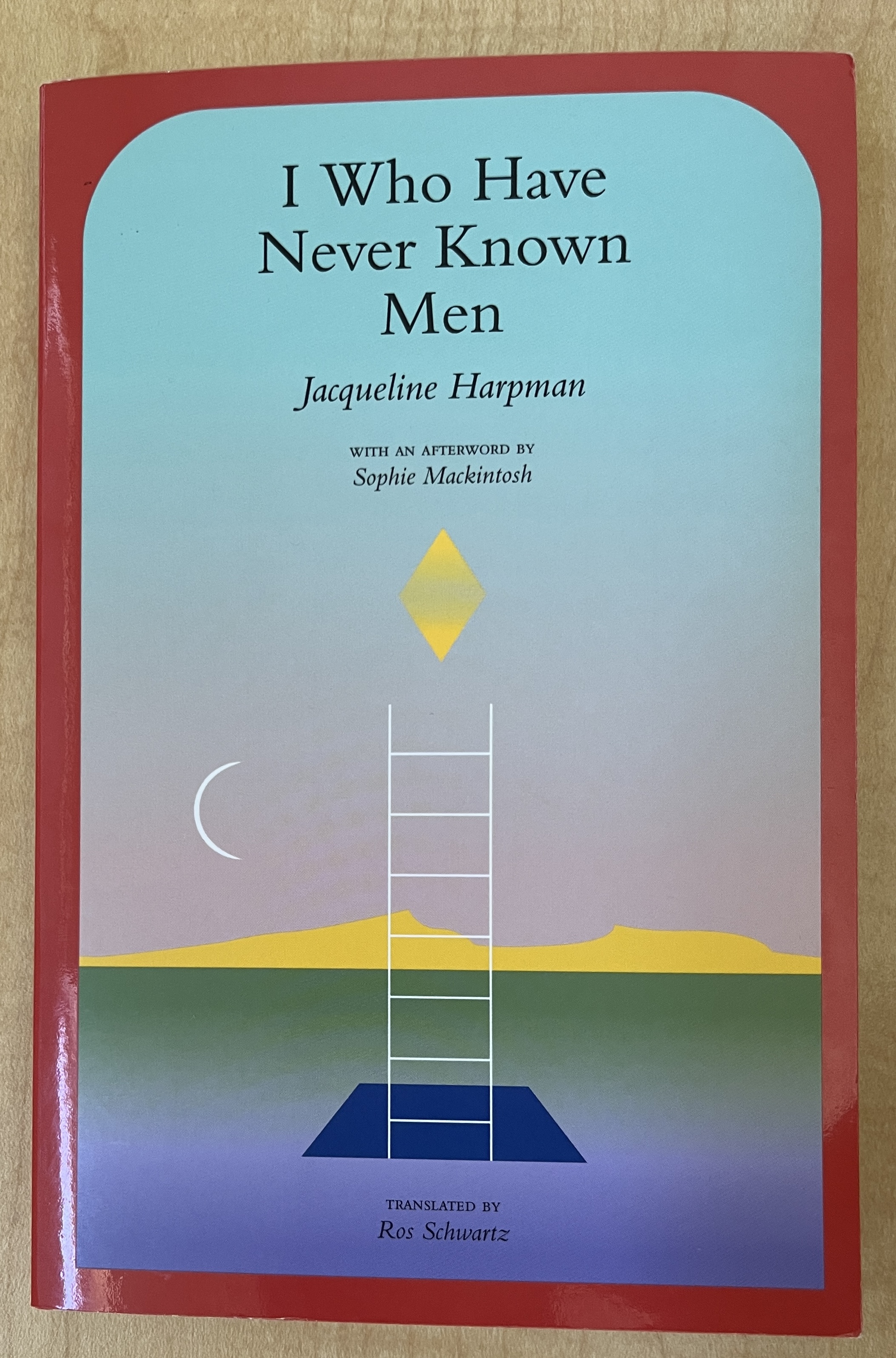
 Despite this book being on display at the local bookshop and its (unknown to me) TikTok fame, I had never heard of this book, so I consider it to be non-mainstream.
Spoiler alert (trying to not give much away): when we meet the unnamed narrator (called by the others, “the child”), she is an adolescent living in captivity with 39 women. She understands that, at some earlier time when she was a small child, they were all captured and brought to live in a cage. No one knows why – why they were selected (they have nothing in common), why they are being held, why they are being guarded (there are always guards present), why they are so restricted (they cannot touch each other, yell or cry, or try to kill themselves), why time is so random (there is no schedule for their meals or sleeping). One day, a loud alarm goes off, and the guards leave them, at the moment of opening the food hatch for the cage. The child slips out the hatch, grabs the keys, and releases the women. Gradually, they make their way through the facility and up a long set of stairs to the outside. They never see the guards again.
In their new life on the outside, the women eventually overcome their fear of recapture and begin to explore this new-to-them world. It looks like Earth but also not. After wandering and exploring for a while, they come to see they are the only survivors. The guards are gone, and no other prisoners escaped as they did. As they build a settlement for themselves, living off the provisions within their former prison, they recognize they are still captives – they cannot survive without the prison, and there is nowhere else for them to go.
The child becomes the last survivor of the group, and the novel is her biography, written for a posterity she doesn’t believe it but hopes for anyway, in answer to her own question: “…what does having lived mean once you are no longer alive?”. In the end, most of the questions – who, why, where, when – and other mysteries remain unanswered. End spoiler.
Described in some sources as proto-feminist speculative fiction (or even science fiction), the feminist element is derived from the characters – all female (except for the unnamed and mostly anonymous guards). However, I found it interesting how the title defines the main character by what she lacks: the company or even knowledge of men; she is aware of them, barely knowing what life with them involves and that, without them, life is somehow less. This suggests a woman is incomplete or incapable of survival without man, not just from the procreation perspective but in the social and spiritual sense as well. True, other than perhaps some physical strength or height requirements, there is nothing these women can’t do on their own, but even as they settle down to their community together, there is a pervasive sense of resignation and sadness, almost a collective sigh, that they have only each other for company and support.
The early parts of the story, when the location and situation is more unknown, put me in mind of the situation for the Isreali hostages from October 7th – underground, in locations unknown to them, with minimal food and comfort and silent keepers that are at best apathetic and at worst cruel. I can’t imagine the hostages’ conditions are much better than those described in the novel.
The author’s training in psychoanalysis suggests that the entire story is a dream, and indeed it does resemble one. From the somewhat faceless guards to the mysterious locations and unending wandering, it has the dreamlike quality of unanswered questions that remain somewhere near the tip of your tongue when you try to recall them. Having the narrator write the entire story down, as one would upon waking when trying to capture a vivid dream, reflects the analyst’s way of considering such a story while also providing a narrative device for how the story comes to be told.
I enjoyed this book a lot. While it could have been dark and morose (and it has its moments) or cloying with hopeful optimism (there is little of that), it stays even and intriguing without providing clever or pat (or any) answers, leaving the reader with many questions to contemplate.
This novel loosely compares with The End of Men, in imagining a society of (almost) exclusively women; however, that novel places its society within the modern world rather than a fantasy location, and the segregation of the sexes is by accident rather than design.
Fate: keeping for a while
8 – a female author
11 – referral/chosen
21 – translation
25 – new author
37 – non-mainstream
 rclr
rclr 
Leave a comment