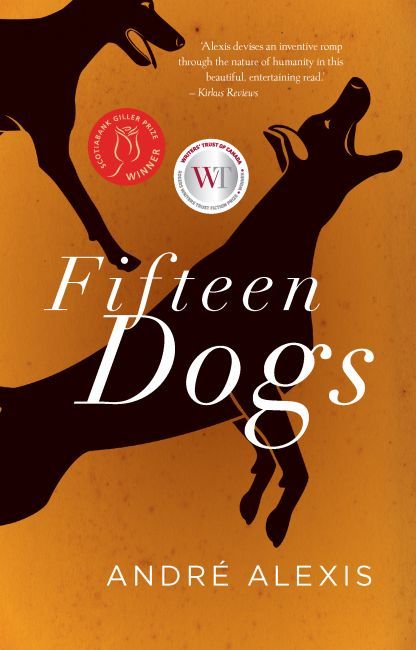
 A friend suggested this to me, not really as a recommendation but just something she happened to be reading (which surprised me, as she’s previously said she’s not a fan of anthropomorphizing animals in stories). This turned out to be an enjoyable light-ish and short read, just the thing to truly cleanse the reading palate.
In Fifteen Dogs, the Greek gods Apollo and Hermes make a bet: that animals, if given human intellect, will be just as miserable as humans. Apollo asserts that no human dies happy, because their intellect and their self-awareness ultimately tends to misery. Hermes contends that self-awareness and intelligence elevates the species, especially as compared to the immortals, who long for something they can never attain: death. To test this, the give human intelligence to fifteen dogs at a veterinary clinic in Toronto. The book then follows the lives of the dogs. Even with human intelligence, dogs must be dogs. They want to live in a pack, they have a clear hierarchy in their relationships, and remain primarily motivated by the essentials of food and shelter. They do become problem-solvers, figuring out how to open doors and escape the clinic and then to navigate the wider world. They are aware that a profound change in them has occurred, and much of the story is about their exploration of these new “powers” and assessment as to whether these are a blessing or a curse. This latter is the purpose of the story – showing how human nature cuts many ways.
The book has the subheading, “an Apologue“, which I had to look up; it’s a hybrid of a parable and a fable, with an intended moral lesson embedded within a story that uses animals as the main players, even if the lesson is for people (think Animal Farm or The Lion King). Like those stories, there is plenty of misuse of the new-found powers, and several moral lessons about kindness, nature, love, guilt, shame, and death. While thought-provoking, the story is light enough overall to be enjoyed as is, with the opportunity but not the requirement to delve deeper. The lovely little poems throughout the books (“written” by one of the dogs) are a delightful literary device.
I was reminded of a previous read, Wild Dogs by Helen Humphreys. In that story, five dogs that have been released by their owners, form a pack in a nearby woods. Their owners return to the woods each night, trying to reestablish contact with their lost dogs, but the animals have become too feral to return. In Fifteen Dogs, none of the previous owners come looking for their lost dogs, and none of the dogs attempt a return to their old homes. But, the need for humans is clear; even as a pack living in the wild (albeit in a city park), the dogs live on the refuse and scraps of humans, and do eventually seek a return to living with humans to survive. The tension between their instincts to run free and their dependance on humans reflects the beauty and tragedy of domestication; they can no longer live without humans, even as they will always be dogs at heart.
I enjoyed this book, and will seek out others by Alexis in the future (especially others from this Quincunx, exploring old novel formats). For now, this was just the book I needed to shake of the previous drivel.
Fate: I might read it again, so it will stay for a while.
1 – a murder
15 – a number
25 – new author to me
33 – Canadian
34 – prize winner (Giller 2015)
 rclr
rclr 
Leave a comment