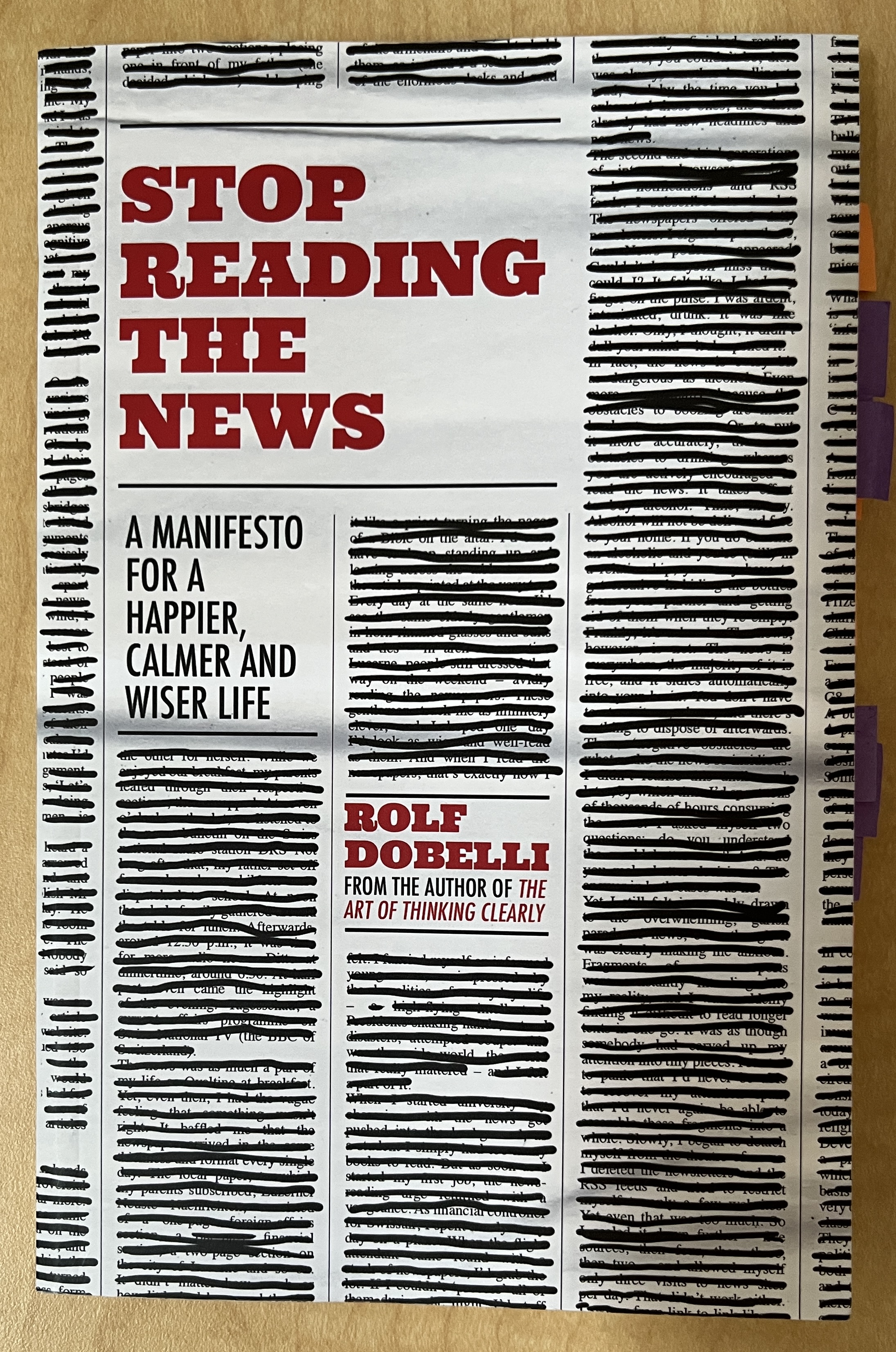
 The title of this book spoke to me, in light of many conversations this year about the depressing imposition the news represents, and the goal of reclaiming my attention from the whirlpool of online sites. According to Dobelli, the only way is cold turkey – as the title says, stop reading the news – and through the 35 easy-to-read, short chapters, he presents many provocative points and examples on why and how to do just that. The writing style is somewhat uninspired (perhaps a feature of the translation rather than the original), but the message is still engaging.
“Information these days is no longer a scarce resource – attention, on the other hand, is in short supply. So why are we so irresponsible with it?”
Dobelli covers the history of news media, from the early printing press to the modern era, as well as the many risible facets of modern news, including the emphasis on celebrity newsmakers, various biases (availability, confirmation, emphasis, negativity), and the emergence (and now reality) of AI driving the narratives to create fake news indistinguishable from the truth (we’re already there – nearly 50% of internet traffic is from “bots”, meaning less than half is humans interacting with anything, including other humans).
By “reading the news”, Dobelli is referring to our modern habit of doomscrolling – the activity of scrolling endlessly on news and social media sites. And he makes many compelling arguments for quitting this habit, including:
- Time – consider how much time is spent on screens of some kind on news. For most people, this works out to hours and days and weeks of time with little return. If we consider our own 4,000 weeks, this is a significant chunk. How productive might one be if this time were spent on other things?
- Being “first to know” – given everyone is reading the headlines, you’ll never be the first to know. Anything worth knowing (and so much that isn’t), someone else is going to tell you anyway. And you’re not obligated to know and opine about everything. Better to be well-informed about a few things that matter than ill-informed about many things that don’t.
- Consider the effect – does what you’re going to do tomorrow or next week really change by knowing the outcome of an election half-way around the world or the aftermath of an earthquake in a country you’ll never go to? By this he doesn’t mean the information is not important, just that it is not urgent and so immediate consumption of it is unnecessary.
- Biology – “News is to the mind what sugar is to the body.” In other words, addictive and destructive. Its relentless focus on the negative over the positive, on the hot take over nuance, and on celebrity rather than substance creates an assault on our emotions and making us more passive than active, capturing our attention and making us duller rather than smarter.
Much of “the news” Dobelli refers to is the internet, but also most mainstream media (most of which is viewed online and so captured in our doomscrolling). In addition to considering the time and the relevance of what one sees online, he asks two main questions: do you understand the world better now? And: do you make better decisions? Most people being honest with themselves, would say no, or at least rarely.
I know I can point to a few instances where the state of the nation or the world at large has had a specific and significant impact on my life, and I know several people who would say the same. However, can I say that constantly reading the news made dealing with those situations better, or that my ongoing news reading is saving me from others? Given the trade-off with the time spent on and the emotional impact of ongoing news consumption versus any preparation for impact on my life, it seems to be a fruitless, and possibly damaging, use of time.
Dobelli leans heavily and rightly on the stoics, who perhaps saw this kind of thing coming:
Marcus Aurelius: You are at liberty not to form opinions about all and sundry, thereby sparing your soul unrest. For the things themselves demand no judgement from you.
Epictetus: You become what you give your attention to…If you don’t choose what thoughts and images you expose yourself to, someone else will.
Dobelli is not advocating hermitism, rather a withdrawal from the consumption of mainstream and social media. He recommends being selective about when and where to give one’s attention, suggesting that longer form articles and interviews, along with books and documentaries, from reliable sources are better suited to actually inform. By being selective about these sources and taking deeper dives into topics or stories of interest or meaning, one is better informed and able to add critical and nuanced argument to the social conversation.
So, will I give up the news? Can I? It is worth a try, as immersion in the bile and violence of the current environment is not doing me any good. And I have the past experiences of time spent off-grid (with the added benefits of fresh air and nature) to reinforce the feeling and cleansing effect of a news fast.
Fate: while I’m unlikely to read the book again, I am likely to dip into it for a factoid or reminder of a key point for when I fall off the news wagon.
21 – translation
25 – new author to me
30 – philosophy/religion
 rclr
rclr 
Leave a comment