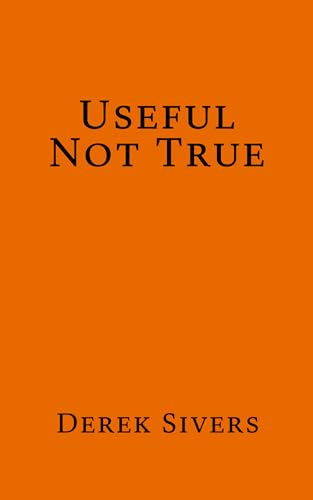
 I had read Sivers’ Anything You Want a few years ago, and found it to be a good inspiration and guide to being true to oneself when starting a business. The main takeaway from AYW is an important touchstone for me:
“You can’t live someone else’s expectation of a traditional business. You have to just do whatever you love the most, or you’ll lose interest in the whole thing.”
Last year, I heard Sivers interviewed on the Modern Wisdom podcast, and he mentioned his latest book. I liked the concept – it’s important to separate your beliefs from facts; what you believe can guide you but that doesn’t mean your beliefs are true or even correct.
Like the earlier book, this one is brief and to the point. Sivers stays on topic throughout, distilling his premise into six chapters, breaking down the difference between useful and true, distinguishing a fact from a belief, and reframing your own thinking to guide your decisions and actions. Some points I found useful:
- “When asked for an explanation, the brain invents a reason and completely believes it.” Sivers explains that anyone’s motivation for action is essentially unknowable, not least because even that person’s own brain will make something up. Ultimately, the motivation is less important than the action, but we tend to get distracted with addressing the why behind even the smallest action. (Sidebar: I found this interesting in the context of AI tools like ChatGPT, which tend to hallucinate and provide “information” that looks real, even when it doesn’t actually have the answer. Perhaps this is a near-human feature?)
- “Even science isn’t true.” This was especially validating considering the past few years and the morphing of science from theory to dogma, and the personification of science in “experts”. The scientific process requires that any “conclusion” be open to question and re-examination. Our failures to do that in recent years reflects a dangerous hubris.
- “Judge the contents, not the box.” I especially liked this one in the context of modern political discourse, where good ideas are rejected simply or primarily because of who came up with them.
- “Diamonds in the trash.” While I thought this was presented a bit clunkily, I like the message: when things look or get messy, try to find the why in order to move on to the how. Push past the first pessimistic thought, to get to the root of what’s happening. I like to think of this as applying the “5 whys” approach to challenges.
- “You can do anything. But you can’t do everything. You have to decide.” A very powerful little section on taking responsibility for one’s choices. And a reminder that inaction is a choice.
In addition to a thought-provoking collection of thoughts, the books is a lovely part of a collection of five books by Sivers. He self-publishes these and has created an attractive packaging for his volumes. I’m happy to have all of them on my shelf and will work my way through each one over the next while.
Fate: will stay in my Sivers collection.
4 – published in 2024
30 – philosophy
 rclr
rclr 
Leave a comment