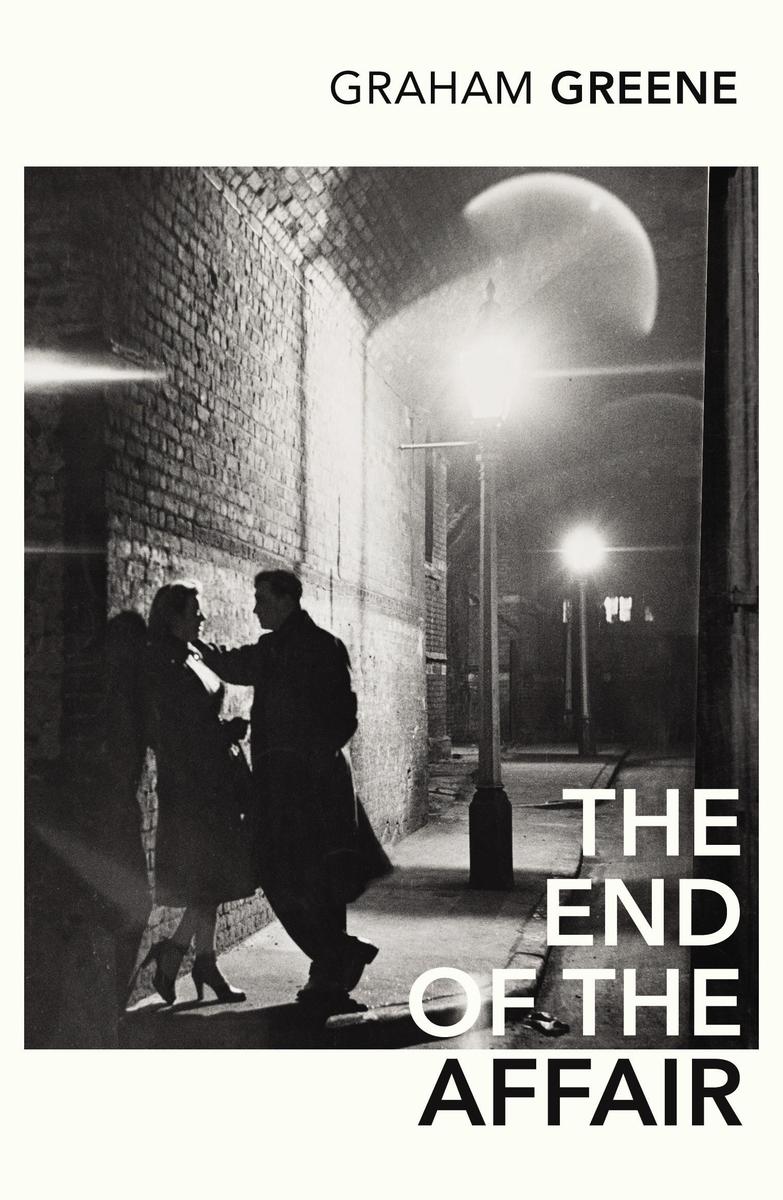
 This book was part of my September binge of favourite bookstores in Victoria (specifically, Russell Books and their terrific selection of used and remaindered). I’ve enjoyed my previous Greene novels, and since this one is well known for its film versions (neither of which I’ve seen) and for being Greene’s best (indeed one of the 100 best of the 20th c.), I gave it a go. I was surprised to find it is less of a tragic love story and more an exploration of the power of faith, especially Catholicism.
SPOILER ALERT. The narrator is Bendrix, a writer in WWII London who begins an affair with Sarah, wife of Henry (a government wonk). Sarah conveniently lives across the Common (a large park area in London), so the logistics of their affair are facilitated by this proximity and by Henry’s dedication to work during the war, his frequent absences giving Sarah much freedom. Bendrix’s “love” for Sarah is better characterized as an obsession, a possessiveness smothering to them both. After a bomb nearly destroys Bendrix’s house, Sarah suddenly and inexplicably breaks off the affair. A few years later, after the war, Bendrix’s interest in Sarah is reignited after he encounters Henry, who is worrying about Sarah’s frequent sojourns at odd hours – could she be having an affair? The naïve Henry takes the guilty Bendrix into his confidence; Bendrix engages a private investigator to follow Sarah, and then misinterprets much of what is discovered, restoking his jealously and hatred. When Sarah dies of a pneumonia contracted through her odd-hour wanderings in the rain, Henry and Bendrix become sort-of mates, connected by their individual loves of Sarah and their wonder at her mysteries.
The first half of the novel focuses on the tortured love affair between Bendrix and Sarah, while the latter half on Sarah’s tortuous exploration of love of God. It turns out her termination of the affair was the result of a religious conversion of sorts, an answered prayer leading her to question her previous atheism, eventually swinging right through agnosticism into Catholicism. While there is little suggestion her conversion is motivated by guilt (her affair with Bendrix is not her first, so she is a serial adulteress, in addition to her other minor sins), there are hints she is seeking absolution for herself and those she has brought into the sinful mix with her, especially Bendrix.
Bendrix is a dubious narrator, with an obsessive perspective colouring and twisting the story; his version of events certainly doesn’t cast him in any positive light (and his ego allows him juicy rationalizations and self-absolution of guilt and responsibility), and his pursuit of making the outcome satisfactory primarily or almost exclusively to himself is odious. The basis of Sarah’s love is unfathomable, seemingly based primarily in a mutual lust and longing for physical satisfaction, or on the need for mortification to validate her self-loathing. Bendrix’s ongoing desire to possess Sarah, and to take her away from Henry, may be rooted in class (stealing the wife of a prestigious rival) blended with his own sense of general inadequacy; he is not a very famous or successful writer, barely making ends meet, and a previous injury has kept him out of the war, a status which would have incurred some derision in wartime society.
The pivot point of the novel is the revelations learned from Sarah’s diary, the only time in the story we hear from her directly rather than as remembered by Bendrix. The PI has secured the diary for Bendrix, and in reading it we learn many of the whys of Sarah’s behaviour, including her recent mysterious outings: she is exploring religion and considering her renewed faith. Sarah is enduring a true crisis of belief, and all Bendrix wants is to get her away from Henry and back in his bed. That Bendrix would choose to use this information to both undermine her faith and disrupt her marriage makes him even more loathsome.
In the end, it is Bendrix whose faith is shaken, as he learns of several instances perhaps suggestive of miracles attributable to Sarah. He reflects on her exhortation to God in her diary: “When I ask You for pain, You give me peace. Give it him too. Give him my peace — he needs it more.” Her actual experiences reflect and reinforce the influence of God on her life and state of mind: as she takes on pain, including separating herself from Bendrix, those around her experience more peace. Her ultimate demise could be seen as an extension of this – in dying, she ends the suffering on her account of Bendrix and of Henry, although for Bendrix this introduces a different kind of pain in the form of his own crisis of belief. I was reminded here of the story in the film Breaking the Waves, where the wife of an injured man finds she can reduce his suffering and increase his healing by debasing herself further and further until she dies so he can live. The parallels with the story of Christ are also clear.
Strangely, this book about the conversion of a sinner to Catholicism was banned for a time in Ireland for being “lewd”. Since no one in the book ends up happy in their depravity and the overall message is to encourage faith and belief, especially in Catholicism, the Irish missed the boat on this one. Also, the “lewdness” is incredibly tame and pedestrian, even for the 1950s. Perhaps their objections were more rooted in chauvinism based on the female Christ-like figure.
This was a hard book to say I enjoyed, as I found it a slog at times, perhaps because it wasn’t about what I was expecting. I didn’t really like any of the main characters – Sarah is a strange blend of piety and passivity, Henry is a milquetoast, and Bendrix is beyond distasteful – but I’m finding the story of the exploration of faith strangely sticky, raising all kinds of questions about the role and place of belief in my own life. Again, I’m reminded of a film, this time Serenity, the off-shoot of the Firefly tv series. In the film, the lead character is encouraged to explore and affirm his own belief in going up against someone who is a true believer; the shepherd says belief does not necessarily have to be religious but something bigger than oneself to hold onto during adversity (“I don’t care what you believe in, just believe in it.”).
A last movie-related note: I can totally see Ralph Fiennes as Bendrix, as the sadly obsessive lover in a doomed affair is right up his street, not dissimilar to his role in The English Patient (a younger Jeremy Irons would have been a good alternative for the same reason – typecasting). Ditto for Julianne Moore as Sarah, with her penchant for roles as the beautiful but neglected wife and sad/confused lover.
These days, many adversarial situations are built on or exacerbated by belief systems focused on the proclaimed (if not proven) virtues of one’s own side and the demonization of others; this includes those without a religious or faith-based way of thinking, but still a dogma about their beliefs and principles, a “gainsay who dare” approach to discourse. Any belief system – religious or otherwise – comprising self-reflection, generosity, understanding, and forgiveness, may offer many some comfort, guidance or peace, and so are somewhat encouraging and worthy of consideration.
Fate: While this book didn’t wow me, it certainly has grown on me in the contemplation of it post-reading. Like Greene’s other novels, I’ll hang on to this one for a possible reread in the future.
9 – made into a film
30 – philosophy/religion
35 – banned
 rclr
rclr 
Leave a comment