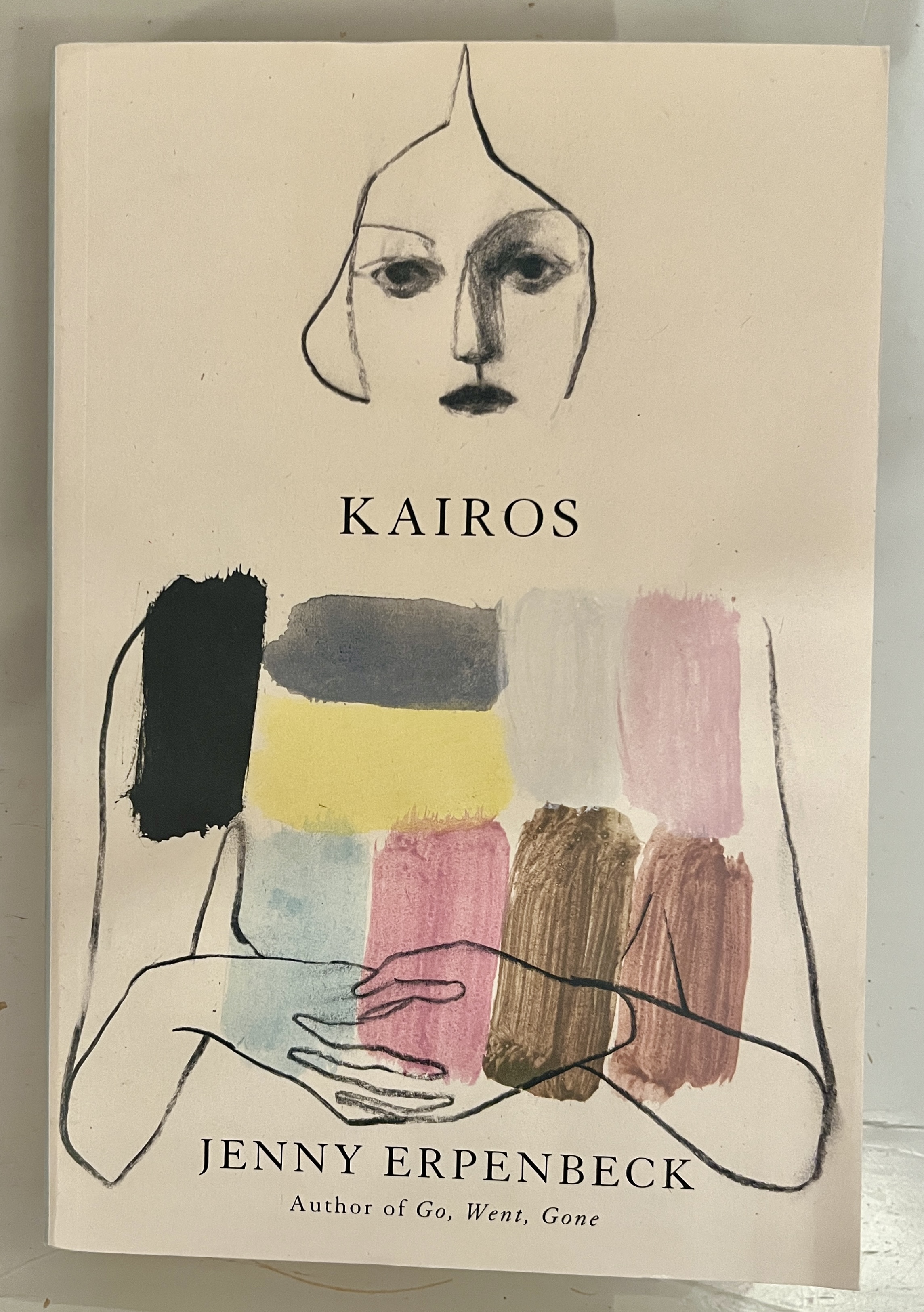
 I went for this book specifically because it won the 2024 International Booker prize, and so knew it would fulfill a booklist category. Otherwise, I knew nothing about this book, other than its original language was German.
The title Kairos refers to the Greek god or characteristic of a chance encounter. This is how the characters meet in the story, a chance encounter involving a bus, a rainstorm, and a closed office. Katharina is 19, a trainee and student in the arts. Hans is 53, a writer and presenter on the national radio arts program; he’s also married, with a teenage son, and has a longish history of affairs. They fall deeply and almost instantly in love, and begin a torrid affair lasting a few years, ultimately dissolving as she grows up and he grows old.
It is the late 1980s and they live in East Berlin, where the presence of the tragedies and constraints of past and present are tangible and oppressive. They can see the Berlin Wall as they walk through their neighbourhoods, as well as many remnants of the Nazi regime embedded within the Soviet infrastructure. At the beginning of their relationship, we see how this environment is familiar and, if not always comfortable, something they have learned to adapt to. They move freely around the city. There are coffee shops and restaurants and libraries and art. While some of the conditions sound decrepit and squalid, Katharina and Hans pursue their individual hopes and dreams, and pursue their relationship, relatively unencumbered by their surroundings.
But their carefree life and relationship is fleeting. After the initial passion their affair becomes one of abuse, obsession, and mistrust, mirroring the reality of their lives in East Berlin. There is casual mention of needing permission to travel, which might be denied for any of a number of capricious or insidious reasons, especially the risk of flight: they might not return from the decadent West. The descent of their relationship in to a kind of madness and its ultimate dissolution come to represent the life of East Germany in miniature, including its end with the fall of the Soviets.
Katharina’s obsession with continuing the relationship – with putting on a happy face throughout – reflects a citizen who has not known a non-Soviet life, one who has been conditioned to treat Western life as suspect. Hans is old enough to have experienced pre-Soviet Germany in the form of the Nazis; while he, too, is wary of the West, he likely considers the Soviets better than what came before. Both have learned how to navigate and live, if not thrive, in their world. But like the Soviet world, their relationship is toxic. The happiness and love Katharina says she feels for Hans masks her desperation, depression, and shame of their relationship, a divided feeling reflecting her relationship to her country: she puts on a smile and is patriotic, but inside she is miserable, resentful, and ashamed.
As the Wall comes down, we see a citizenry blinded by the light of freedoms and ultimately overwhelmed by the flow of Western society. For many, the economy of their lives collapses, their employment ends, and the benefits of those freedoms are fleeting. Sure, they can move freely about the world, but they cannot afford to live in it. For some, their homes are taken from them, returned to long ago owners or dismantled to make way for new and “better” ones far beyond their means.
I found the characters’ observations within this time to be provocative. There is an assumption in the West that “freeing” people is a virtuous pursuit, that everyone not living in a capitalist quasi-democracy is part of the “huddled masses yearning to breathe free.” While freeing others from oppression is certainly laudable, perhaps it needs to be considered what alternative the oppressed are seeking; it may not be exactly what the West is offering, with its alternative form of oppression through choice. Regardless of the comforts the West is offering, for the newly freed this is a major change and loss of the familiar, however uncomfortable it was. Ingrid, Hans’ wife says, “Is this what freedom feels like? Not having an enemy you can put a name to?” Hans replies, “…maybe the aims that set such a rebellion in motion are often quite different from the ones that are achieved.”
After the Fall, Hans loses his job and then his home. Katharina, wandering the newly opened West Berlin, says she “…feels like a bad copy of the people who live there…she sees how every conceivable need is catered for by some product or other.” The newfound freedom of choice is really a, “…freedom to consume…separating people from any yearnings that might transcend their personal and momentary wishes” and “demystifying by familiarity” things once precious and special. The Fall of the Wall is also the end of their relationship, as Katharina is now free to seek true happiness and no longer requires the dark side she had with Hans.
We don’t learn what happens in the following years to either of them. At the start of the novel we learn Katharina is married and presumably still in Berlin. Hans has recently died and his letters and writing from their relationship are delivered to her, an event leading Katharina to read through all her own old letters and diaries, sifting through the dusty mementoes to reconstruct and retell the story of their relationship. She is able to present and consider both sides of their story through the shared paperwork. Sometime later, she also gets access to other more official papers about Hans, learning he had quite a different life and persona prior to her, before she was even born, which reinforces the otherworldliness of their pasts and the imbalance and perversion of their relationship.
The parallel stories – the rise and fall of the toxic relationship and the fall of the Berlin Wall – was very interesting, a disarming way of telling the political story in human form. I would have liked to read more about the impact on the East Berlin citizens of their “release” into the Western world, as the disruption was most intriguing.
I enjoyed this book and story, and found the language (and presumably the translation) to be fluid and captivating. I’ll likely read more of Erpenbeck in the future, either The End of Days, (which was also a prize winner) and/or Go, Went, Gone (recommended by a fellow reader). The character Katharina could be seen as semi-autobiographical: Erpenbeck was born in East Berlin in 1967, and so is the same age as her protagonist; she is also an opera director and so presumably draws on her own experience to portray Katharina’s theatre internships and work.
Fate: I’m not likely to read this again, so to the little book library it goes.
8 – female author
13 – set somewhere I’ve never been (Germany)
14 – a name in the title
20 – one word title
21 – a translation
25 – new author to me
27 – a gift
34 – won a prize (International Booker 2024)
 rclr
rclr 
Leave a comment