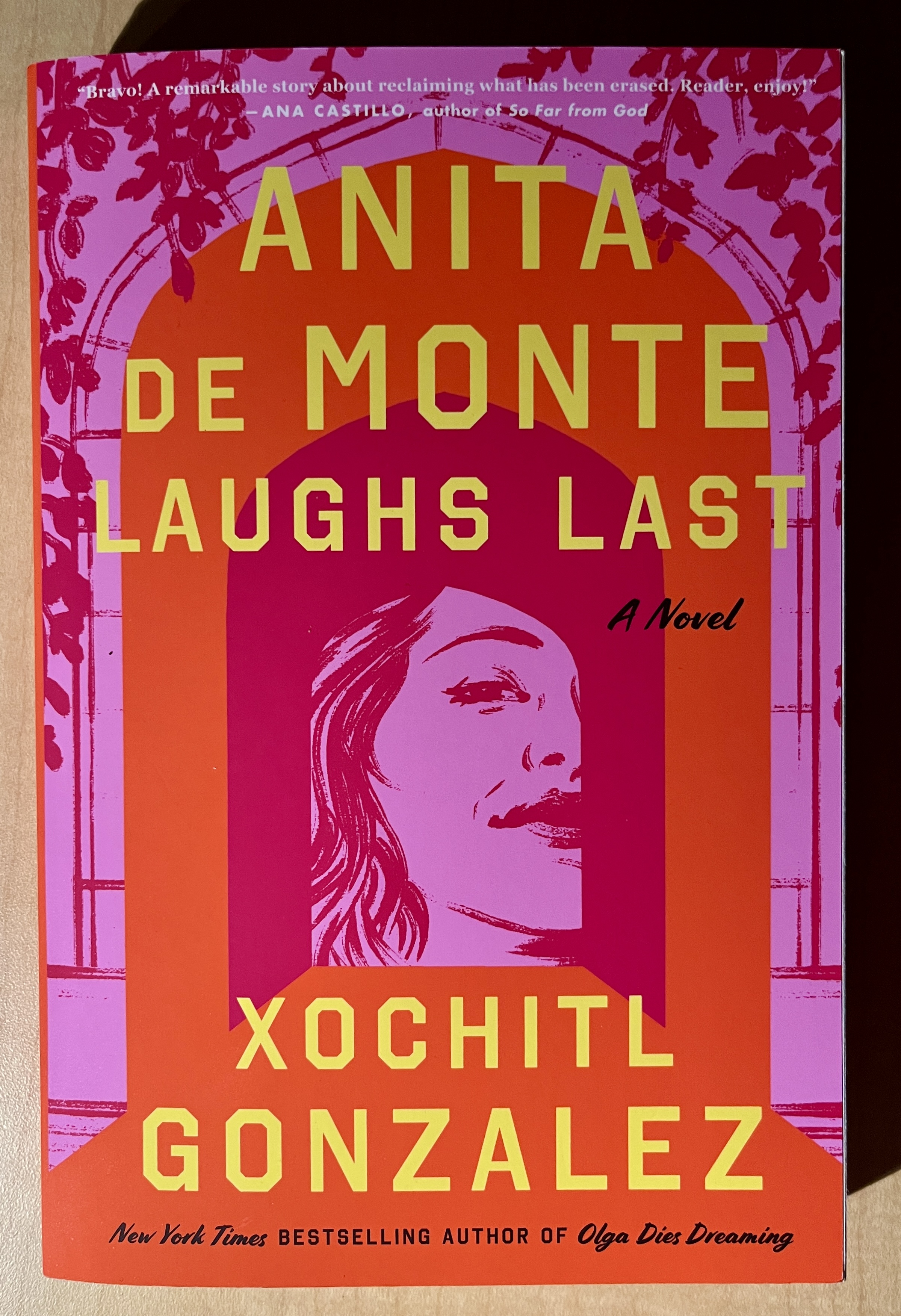
 My reading of this book is a three-part saga.
Before: I previously read Gonzalez’ first novel, Olga Dies Dreaming, a recommendation from another reader. I thought it was okay, with some interesting characters and a story based in a culture unfamiliar to me (Latin American/Caribbean Americans in New York). When the author’s next novel came out last year, it was on my Christmas wish list, delightfully granted by my sister.
During: I enjoyed the subject matter (art) and some of the characters, and enjoyed how the story was told, with multiple timelines and voices eventually merging at the end. There was also a ghost-story element which was an interesting (if wholly unbelievable) touch; without the ghostly intervention, much of the story would not have moved along, taking agency away from the characters (could the student really have discovered the story if the ghost hadn’t flipped the page of the book?). Several of the storylines are predictable, and the ending, telegraphed in the novel’s title, was good but nothing surprising.
Like in the first novel, the language and some of the characters’ behaviours were juvenile, and some bits could have used better editing. The main character – 20-year-old Raquel – is young, but her actions and thoughts were more of a teenager than college junior, and her bad decision-making makes her silly and unsympathetic. There were a few times when I found her quite exasperating, and looked ahead to see how much more of it I needed to endure before the story would move on.
The time setting of the novel was also odd. Running from the early 80s through the 90s, there was little rationale for this and, other than the music reflected in the more modern sections (conveniently, Raquel works on a hip-hop music radio show) and the associated slang of the era (things being “dope” or “mad cute”), this riddle is not answered in the novel.
Overall, I liked but didn’t love this novel. Several elements felt preconceived and therefore forced. Some characters (the rich art people, the college professor) were boring caricatures. While I like the back-and-forth in time and stories, it didn’t create the suspense I think was intended. The supernatural stuff was an interesting angle, but as above, was not believable and felt like a real stretch.
After: While reading, I thought perhaps this story was based on a real person, especially as the author is a journalist as well as a fiction writer. I had no idea how right I was until I did some follow-up reading after the book. The novel is – there’s no other way to say it – a rip-off of the life of Ana Mendieta, a Cuban-American artist of the late 70s/early 80s. A performance artist trained at the University of Iowa, her art often used elements of nature (flowers, mud, water, blood) and her own body as her medium. In 1985, Mendieta “fell” from the window of her apartment and died; she fell from the 34th floor through the roof of a deli next door. Her husband, an artist specializing in minimalist sculpture and known for his workman-like approach (wearing coveralls all the time, doing his own manual installations), was charged with her murder but found not guilty by a judge. Since then, Mendieta’s art has remained obscure, though her family continues to champion her work. Change some of the names (but not much else) and you have the story of Anita de Monte.
Other than a vague dedication (“In memory of Ana”) and the naming of a character (Mendieta’s niece, Raquel, works on her aunt’s legacy – perhaps this was a lame/perverse homage?), there is no acknowledgement in the book of the source material, despite the very specific “similarities”. Anita is a Cuban-American performance artist, trained in Iowa, who uses her own body within nature (mud, blood, flowers) as her medium. Anita dies in 1985, “falling” from the window of her apartment; she fell from the 30-somethingth floor through the roof of a deli next door. Anita’s husband is a famous minimalist sculptor, and known for his workman-like approach (wearing coveralls all the time, doing his own manual installations); he was charged with her murder but found not guilty by a judge. For many years, Anita’s art remains obscure until rescued by Raquel. The names are changed, but the story is virtually identical.
While an author is not obligated to get permission or approval to “base” something on a real-life person, the decent thing to do would be to at least acknowledge it. The main storyline in the novel – the life, death, and legacy of Anita de Monte, as well as her relationship with her husband – are the entire premise of the story. All the rest are convenient but ultimately unnecessary mechanisms for telling Anita’s story. The supernatural elements feel even more contrived, as if Anita’s story couldn’t be remembered without ghostly interference.
Out of respect for the reader and – more importantly, Ana Mendieta – there should have been some indication somewhere the novel was inspired by her real story. Without this, it feels like – once again – Mendieta is pushed aside, obscured by the tragedy of her death, overshadowed by her husband’s career, and forgotten. That the author is a journalist makes this duplicity distasteful and disappointing. That the author ropes in the reader to this – making the reader complicit in the further erasing of the artist – felt unsavoury.
Fate: like a few others from this year, this will go to the little book library with a warning about the faux-novelty of the story.
1 – a murder
4 – published 2024
8 – female author
14 – a name in the title
19 – based on a true story (even though that’s not acknowledged)
32 – art
 rclr
rclr 
Leave a comment