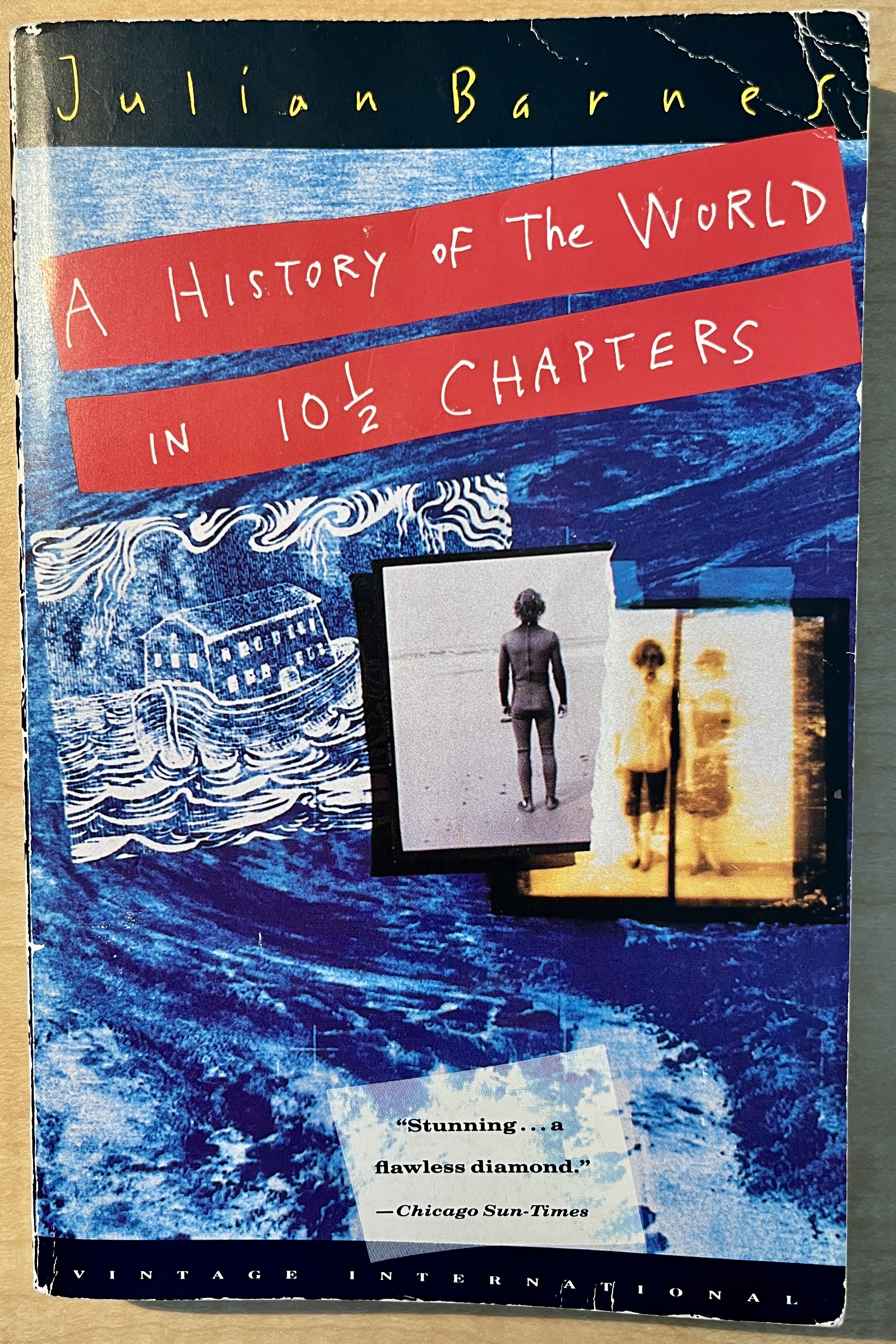
 After recently re-reading Not Wanted on the Voyage and The Preservationist, I wanted to revisit this book for its themes and images from the Noah’s Ark story. These appear in every chapter as either the topic of the chapter, a metaphor, or a mention by a character. Four chapters have a direct connection, while others are more subtle or slight.
The first chapter, “The Stowaways”, is the most direct, being a story told by a group of stowaways on the Ark – a family of woodworm of the common furniture beetle. Excluded from the list of those wanted on the voyage, the woodworm sneak on (and then off) the Ark and are thus preserved. Their story is presented as a counterfactual to the more traditional story of Noah and family, and of the voyage of the Ark. Some important revelations in the woodworm version: the Ark was actually a flotilla of ships rather than a single one; Noah actually had four sons, but one is lost with his ship, thus only three remain in the story (also, some interesting species were lost with him, including those we only see now in fable and fossils); the flood and its recession took years, not months; Noah and family were not nice people and generally poor custodians of the animal kingdom.
The first chapter touches on several of the classic story’s themes that then reappear in the remaining chapters: beings moving two by two; separating the clean from the unclean; the divergence of myth from reality; wiping the slate and starting again.
“The Stowaways” is the closest kin to the other books read recently. Interesting overlaps and divergences with the other books:
- “Stowaways” does not give names to the wives, while the other two did, and does not address the actual construction of the Ark, a big focus of the other two. Also, it is the only one where the story is told from the animals’ perspective, and as a retrospective rather than a narrative about the actual events.
- In both “Stowaways” and Not Wanted, Noah is not a nice man. Both the animals and the reader are left to wonder at God’s selection of who to save from the flood. Also, in these stories, the animals are actual characters and communicate with one another.
- “Stowaways” inclusion of the flotilla idea gets at the practicality of collecting the entirety of the animal kingdom, but glosses over the other implications – how did the ships communicate, share supplies, stay together without propulsion or steering?
- Not Wanted is the only incomplete story, ending before the landing and disembarkation. While “Stowaways” gets through disembarkation, Preservationist tells the most complete story about the Noah family.
Because I was reading this specifically to see the Noah connections, I was alert to those references throughout. While some are direct – in “The Survivor”, the main character is escaping an end-of-the-world event in a boat and takes a pair of cats with her, who then go forth and multiply – others are almost in passing – in “Upstream!”, Charlie proposes starting a family and describes how he’ll make a Noah’s Ark toy set for the children, complete with pairs of animals.
As in my previous readings, my favourite chapters were “Shipwreck” (about the wreck of The Medusa and its associated painting) and “The Dream” (a delightful version of heaven). While both reference Noah’s Ark at some point, only “Shipwreck” includes it more directly, in contemplating the story in art, pondering why the subject of Noah and the flood is comparatively unrepresented in classical paintings.
As with the Adam-and-Eve story, there are some essential licences needed to make it work. The collection and then dispersion of the animals from and then to the entire world seems unlikely, both due to the geography to be considered and the ultimate necessity of other animals to enable the gene pool. It’s also interesting to see the Noah reset taking place so soon after the initial start. In Voyage, it’s suggested there are just 1,000 years since the Fall before God despairs of humans and wants a do-over (this is comparable to the canonical timeline). Given the impetus – mankind’s descent into wickedness – it is surprising there haven’t been more obvious additional reset attempts. Or perhaps there have been, just in more human species-specific forms (plagues, anyone?).
This remains a favourite book, although I enjoyed this reading a bit less due to the vigilance needed to see and note the Ark references. I’m sure I’ll enjoy it properly again in the future.
Fate: This is my original copy from 1994, so I’ll be hanging on to it and hoping it doesn’t fall apart next time I read it.
1 – a book with a murder
13 – set somewhere I’ve never been
15 – a number in the title
28 – an old favourite
 rclr
rclr 
Leave a comment