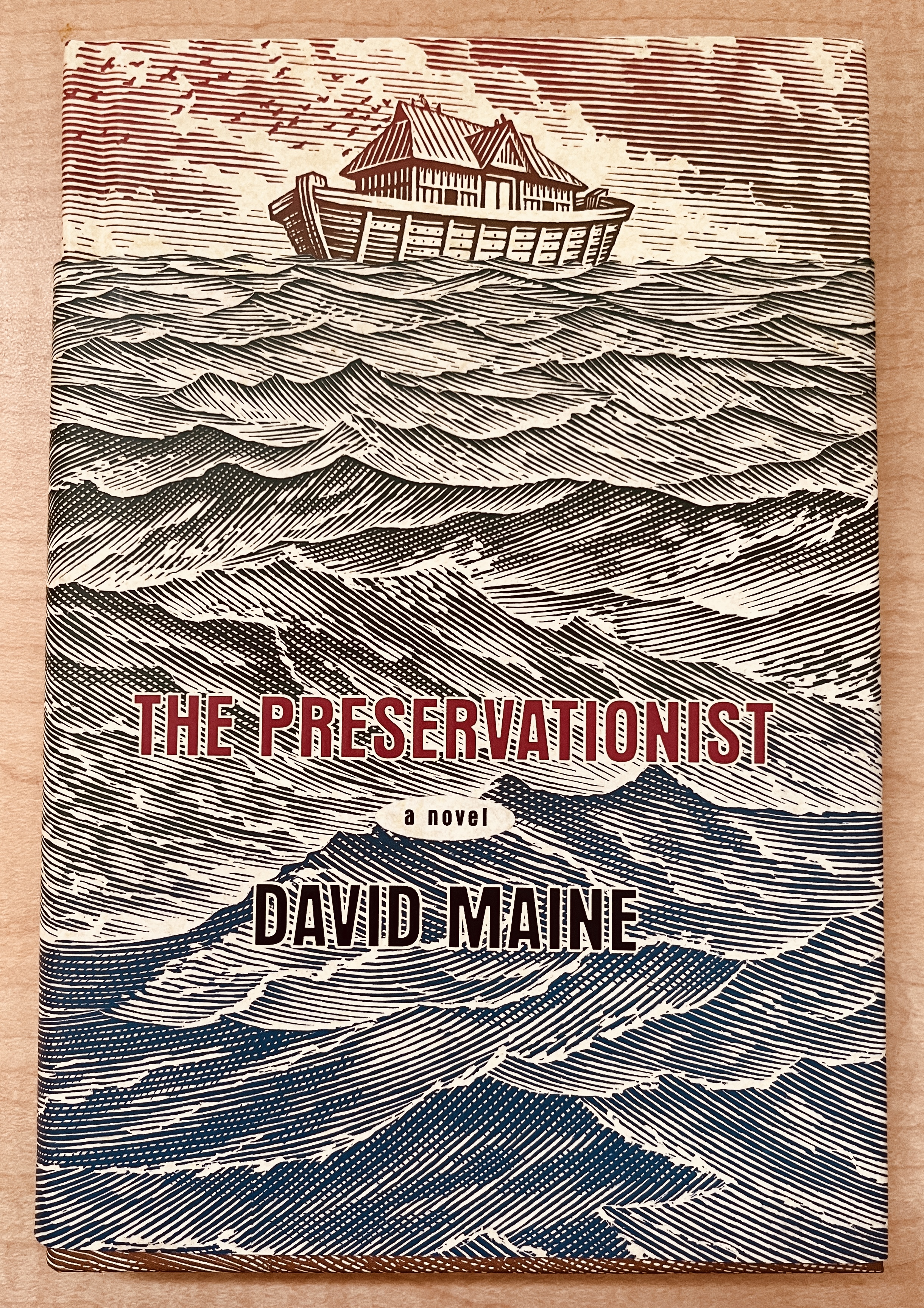
 After recently finishing Not Wanted On the Voyage, I wanted to revisit another novel I have about the same story. I first read The Preservationist not long after it was published and enjoyed it enough to seek out David Maine’s other novels (the best of which is Fallen). My current version was recovered from a little book library, a first edition replacement for my old trade paperback. Like Findlay’s, Maine’s version of the ark-and-flood story takes license with the characters, filling in the gaps of the “official” record, but with less of the dark and sinister nature of Findlay. Maine refers to a specific version and translation of the story from the Douay Bible, to give himself and the story a clear foundation and some guardrails. He follows the timeline and naming conventions of that bible, and then fills in around that.
While still having a certain level of dysfunction, the family here is mostly average. Noe and his wife (who is never named) have lived together for roughly 40 years, with a significant age gap in their relationship; Noe is 600 while his wife is less than 50 years old. The “gift” of long life seems unique to Noe’s generation, something unusual but unremarkable in their culture. The three sons – Sem, Cham, and Japheth – and their wives – Bera, Ilya, and Mirn – all seem quite content in their relationships, with the wives having considerable gratitude for being taken in by the family.
In perhaps the biggest bit of creative licence, Cham has been away from the family for a few years as a journeyman shipbuilder, thus having the necessary expertise to design and construct the ark with minimal outside help. This felt a bit too convenient, but it does address the question of how a desert-living family could construct a sea-worthy vessel all by themselves.
The most modern element of the story is the near emancipation of the women, especially the sons’ wives Bera and Ilya. Each of these is dispatched to return to their homelands to collect the representative animals from there for the ark, and each gets their own part of the story describing their journeys. It felt a bit odd for the times – women travelling alone, with their own money, giving orders and conducting such strange business. Despite the unusual and creative ideas that these segments presented, both stories were kept quite short and almost incomplete; I would have liked to hear more about these adventures, although later on we learn that even the family didn’t hear much about them. All of the women have unusual strength of character and voices in this story, which, while perhaps out of context for the time and culture, is more realistic than the subservient or even non-existent characters portrayed in other versions. These would be the kind of people worthy of saving and entrusting with the future of humankind.
As the rains begin, and the animals and the families retreat into the ark, there are a few others around trying to be saved. While Noe is enjoying his I-told-you-so moment, hectoring the drowning people as the waters rise, others in the family are troubled by survivor guilt: “…the questions that circle in my mind like vultures: Why me, and not them? Why them, and not me? There is no answer, of course. There never is.”
In the midst of Noe’s jubilation at the start of the journey, Maine gives an excellent portrait of how not-great it is:
The birds around him share no such contentment. They cluster miserably, crows and jays, larks and finches, sparrows and rollers and doves: a multidenominational carpet of plumage stretching the lengths and breadth of the deck. A sorrier bunch of living things would be difficult to conceive. They are uninvited guests at the worst party ever…
The time on the ark is as miserable in any other story – endless chores in caring for the animals; constant worry and complaints about food; boredom and torpor that never quite tips over into despair (they have, after all, been saved).
The time after the landing and disembarkation was the most interesting. As we know from many other natural disasters in modern times, nature has a way of rebounding and flourishing afterwards, and here is no exception. The new Noe homestead is fertile and abundant, including the family itself who quickly begin to have children of their own. That first year after landing is among the happiest any of them has. But it is not to last.
Yahweh’s final instruction to Noe is to send his sons away in order to populate the world. While Noe is obedient in this, it’s the one instruction that he seems to resent the most: after everything I’ve done in your name, I now have to part from my family? Indeed, this is perhaps the saddest storyline; after the sons and families disperse, Noe’s wife dies of a short but painful illness, leaving Noe to live out his remaining 300 years entirely alone.
Each of the sons and their families goes in a different direction, becoming the various tribes and peoples and cultures of the world. Cham and Ilya have a strange encounter on their journey: on a mountain pass, they find seashells among the rocks. This nod to the geological record is similar to Findlay’s acknowledgement of evolution, with a more overt recognition of the mystery:
… another explanation, I was certain, waiting only to be chanced upon…Did Yahweh pepper the world with conundrums such as these for His own amusement, I wondered, or did he do it to challenge us?
Each chapter is told either as a narrative about Noe and the family or in the voice of one of the family members. It is ultimately a kind of record of that time, some passages reading like journal entries (although there are no books here). The fragmented nature of the story, with bits untold, reflects the nature of historical records – there are always pieces missing. Near the end, Maine gives a subtle wink to his creation of this story, as Mirn considers the future for her family and the responsibility of passing on the story of the end and new beginning of the world:
Of course, people will tell something, it was the end of the world after all. A story like that won’t be forgotten. But things will get added and left out and confused, until in a little while people won’t even know what’s true and what’s made up…When the story gets told, and told again and then again things will change. They always do. Not on purpose, but just because people don’t ever really listen.
As a first novel, this was a good one. While not as intricate as Findlay’s story, The Preservationist is as creative with the source material, choosing instead to be kinder and more optimistic, as well as to tell the whole story – the idea, the action of the flood, the world after. Interestingly, both authors characterize the sons in similar ways: Sem/Shem as stolid and obedient; Cham/Ham as the happy scientist and engineer; and Japheth/Japeth as the malingering youth (although much more redeeming in Maine’s story than Findlay’s).
I had forgotten many of the details of this novel since first reading it, and I’m glad I chose to read it juxtaposed with Findlay’s as, while Findlay’s writing is more mature and cynical than Maine’s, the two versions are each compelling, interesting, and believable in their own way.
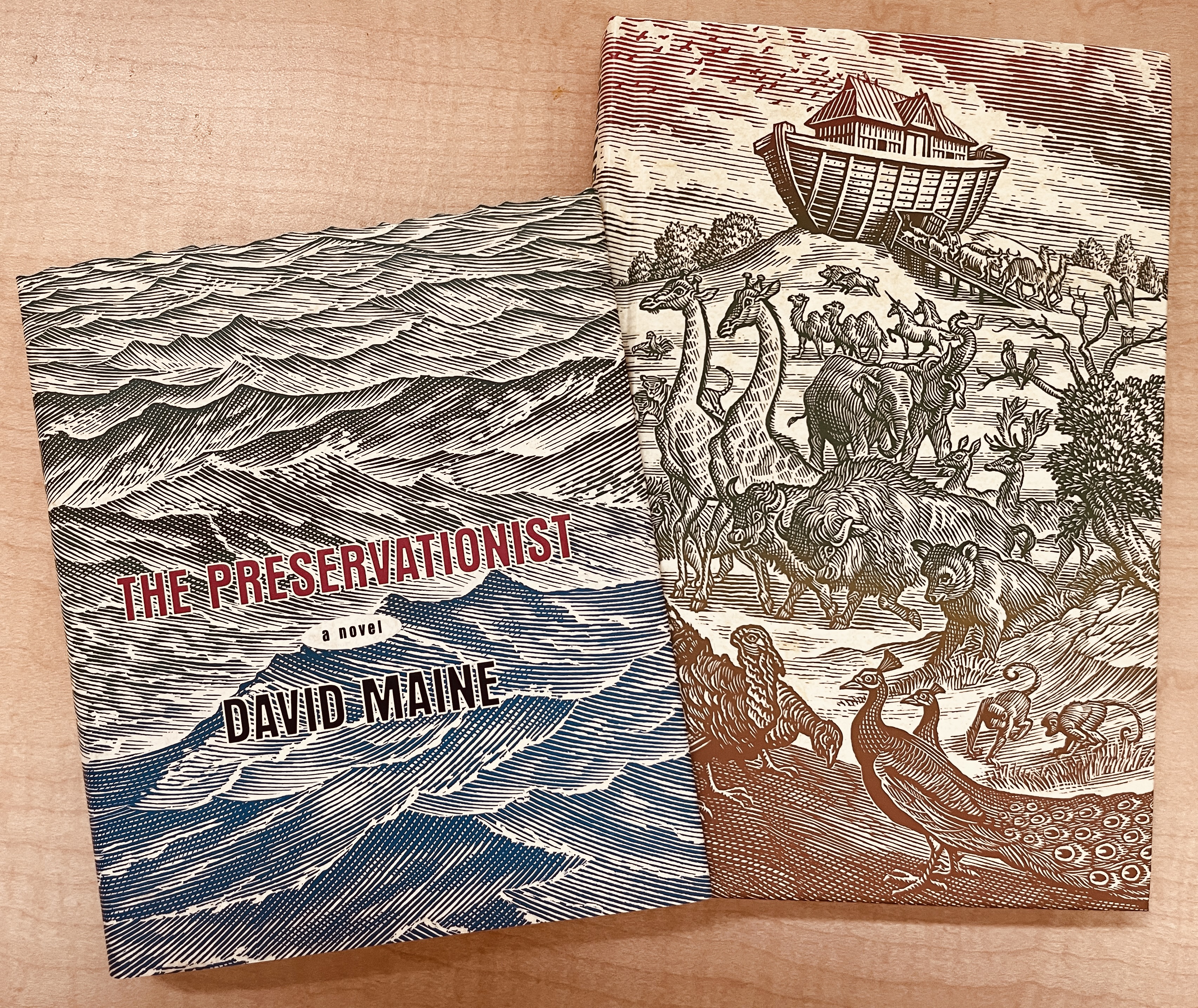 Fate: As my copy is a true first edition with this clever book jacket and cover, it will stay in my library as part of my David Maine collected works.
7 – a debut novel
13 – set somewhere I’ve never been
28 – an old favourite
 rclr
rclr 