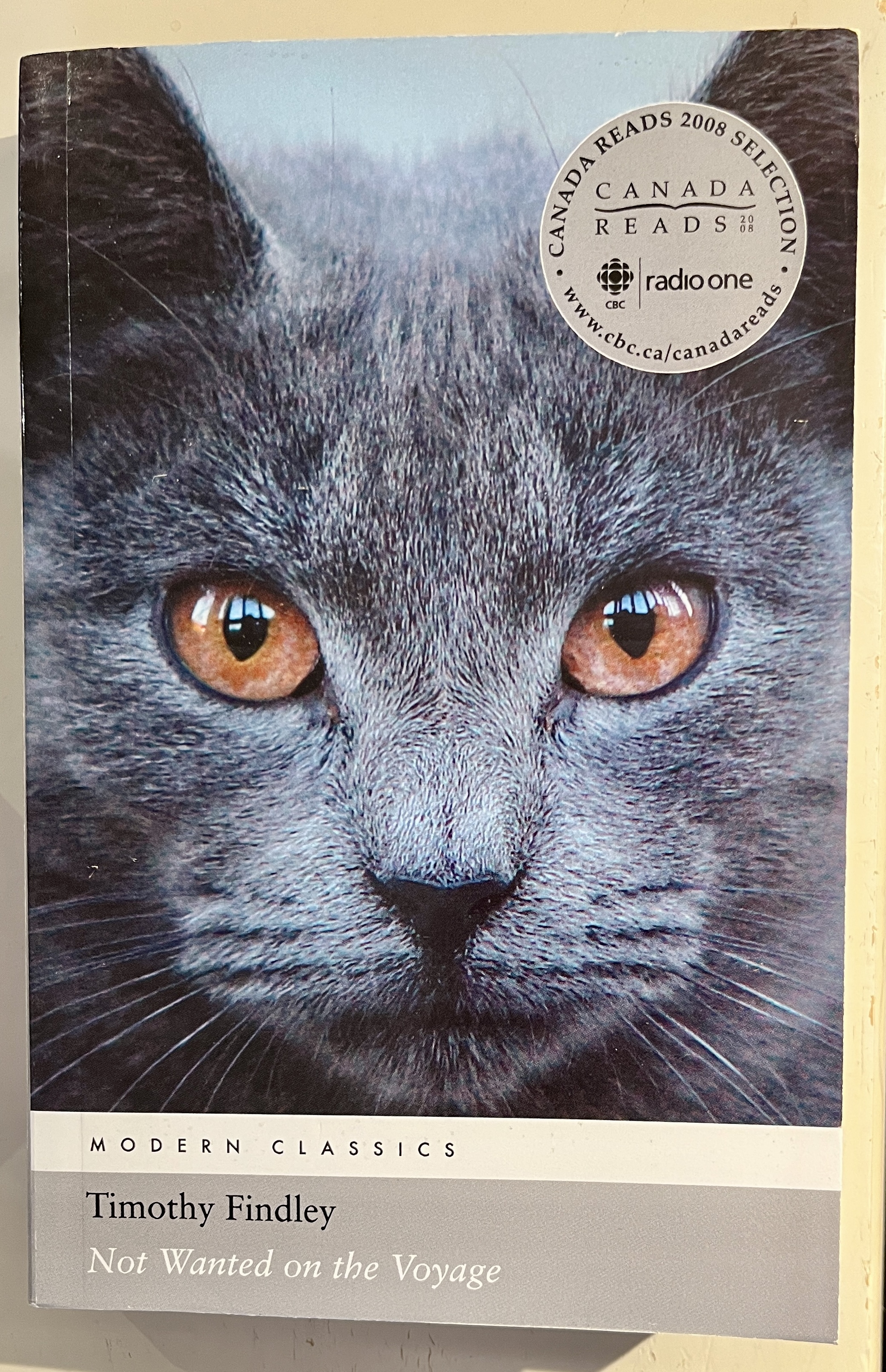
 I recall first reading this in the mid- to late 80s, and it’s been a story that has stuck in my memory as provocative and well written. I don’t think I’ve reread it since then, despite having included it on my ever-changing favourites list for many years. Reading it now, I can see how and where it grabbed my attention and imagination. While it may not be on my top-ten any more, it certainly retains its place on my bookshelf.
In the bible, Noah and the flood take up barely a page of text, but it is a story almost everyone knows at least at a high-level – the ark, the two-by-two animals, the flood. This is a retelling of the story, with Findlay making creative use of the missing details about the Noah family’s life before the ark, and especially the characters of the wives; these women are not even named in the bible, so there is plenty of space to create them, and Findlay runs with it. He also elaborates on the male characters, ascribing little in the way of gentleness or honesty in Noah and two of his sons.
In this version, we have Mr. (variously titled Doctor and Reverend) Noah Noyes, his wife Mrs. Noyes, and their family: son Shem (the Ox) and wife Hannah; son Ham (the scientist) and his “wife” Lucy; son Japeth and his child-bride Emma (just 11 years old). Like some kind of comical soap opera, Hannah is clearly fooling around with her in-laws Noah and Japeth, Lucy is a fallen angel (and so not a woman), and Japeth has had the misfortune of nearly been eaten by cannibals (he was marinated for so long he is now permanently blue-skinned).
While there are many familiar elements from the bible story, Findlay plays fast and loose with many details, creating a separate world and time for the story. It is a time of magic, fairies, unicorns, dragons; of talking animals and singing sheep; of cities of decadence and vice, with an us-vs-them relationship between city and country; of angels and demons. There are also some more modern elements like glass, furniture, books, and music that make determining the timeframe difficult; some of these books include histories of naval campaigns and piracy, suggesting strange warping of time. Here, God is more than personified – He is a person, a very old man. At 600 years old, Noah is a relative youth.
As in most Noah’s ark stories, there’s a certain amount of disbelief to suspend for the story to work. Questions like: how could all of those animals have fit on to the boat, or lived side by side without carnage, or where did the food come from for them. These practicalities must be put aside for the fable to work. Regardless, the assemblage of the ark and its passengers, and then their life on the flooded world are grim enough without considering those other details.
This story involves lots of violence – from God towards people, certainly, but also nature against nature, man against nature, man against man (or woman), and man versus the supernatural. Of these, the violence in nature seems the tamest and most understandable. The rest is awful, gruesome, with a level of cruelty the executors seem to relish. In a rare moment of peace on the ark, Mrs. Noyes tries to understand it:
“What is this cruelty, then, she wondered; that battens those doors up there and locks us in, as if we were dragons – and fearsome?
The thought of Noah’s rages and of Japeth armed gave her the answer.
Cruelty was fear in disguise and nothing more.”
There is an interesting and subtle exploration of the concept of evolution. The character of Lotte, twin sister of Emma, is kept hidden and secret by her family, and when we meet her in the story, she has been abandoned by them as the flood develops. Mrs. Noyes finds Lotte and sees in her a child of her own, a twin of Japeth. While Mrs. Noyes had killed that child, as was the expectation of the times and of her husband, Lotte’s parents had not. Although never fully described, Lotte is clearly ape-like – hairy, ungainly, with big eyes and teeth. Noah sees these children – for there will be one more – as inconvenient indicators of the fallibility of God’s plan, requiring their dispatch to keep things in order. After Japeth kills Lotte:
“But he did think it strange that so much fuss was being made. After all – he’d only killed an ape. And an ape was really only an animal. Nothing human.”
I saw these unfortunate children as reflecting either the cusp of evolution – where humans and apes were still adjacent rather than separate – or as a reversing of evolution, a part of God’s determination of mankind’s irredeemability, sliding backwards down the phylogenetic tree.
Findlay is a master of vivid imagery, environments and people that stick with the reader long after the book is done. Even though it’s been many years since I last read this, I recall very clearly several moments through his evocative descriptions. For example, after visiting with the Noyes family, as Yaweh is leaving, we read of the strange sound emanating from his carriage, a sound the attendees recognize with dawning horror: the cacophony of flies awaiting the dying God; the memory of that sound sticks with me, and the miracle of Findlay creating the feeling of dread in sound through words is remarkable.
This is a difficult book to enjoy, but definitely a story worth reading for the creative approach to fleshing out this familiar story. I was reminded of other novels I’ve read with a similar trope, so I’ll be digging those out to re-read for some comparative assessments.
Fate: Will stay in my library as I’ll be curious to read it again after a while.
1 – book with a murder
9 – made into a film/play
13 – set somewhere I’ve never been
28 – an old favourite
33 – Canadian author
 rclr
rclr 