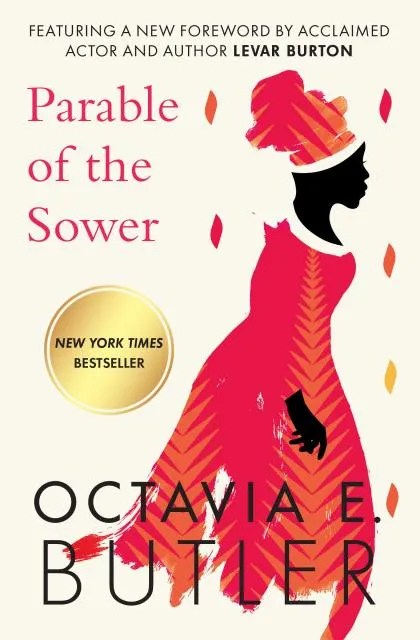
 I don’t recall where I heard about this book or what prompted me to get it, as I was completely unprepared for the story I encountered. Midway through, I did some online poking around to try to remind myself of why I picked this one, and while I found plenty of plaudits and effusive praise, nothing aligned with the experience I was having. While it was engaging enough to finish (although I did almost give up in the early stages), I found it to be just okay as a novel and story.
Published in 1993 as the first of a planned series of Parable novels (Butler died in 2006, leaving most of the series unwritten), here we meet Lauren Olamina, a mature and precocious teenager in the dystopic world of 2024, where society is plagued by incoherence, privation, and violence, driven by a combination of climate change and totalitarianism. Lauren’s small community lives in a walled-off area near Los Angeles and struggles daily to secure necessities like food and water and to provide security and any sense of normalcy. People with jobs often work from home, as venturing outside is fraught with innumerable dangers from gangs and starving scavengers, as well as the agents of civil order – the police and other agencies are corrupt and just as dangerous as the criminals. The community is eventually overrun, resulting in death and worse for most of the inhabitants. Lauren and two others manage to escape, and thus begin their journey North, away from the violence they have known towards an unknown location and future.
Lauren is the Sower of the book’s title, which itself comes from a well-known bible passage. She has developed her own religion she calls Earthseed, wherein God is not personified but is exemplified by the concept of change. Since change is omnipresent in life and impacts everyone, God is change; at the same time, since humans have agency, they can direct, influence, and shape change. A blend of Buddhism and existentialism, with pinches of science and the rapture, Earthseed’s central tenet is that humanity on Earth is but a precursor to life among the stars – the purpose of mankind’s development and suffering on Earth is to prepare a group of people to be transplanted to another home in the galaxy to start the human experiment again (since we messed it up so badly here). Lauren inculcates her small band of survivors with Earthseed and leads them toward a promised land.
While I was never truly convinced of Lauren’s charisma, the concepts and setting are interesting enough. The novel does an excellent job of creating a believably terrifying world and is remarkably prescient about the impacts of climate change and the breakdowns of civil society, including the far-reaching effects of addictive drugs on a new world order. The devaluation of human life, including through almost casual murder, institutional slavery, random sexual violence, and the near-normalization of cannibalism, are powerful elements in this dystopian society. From the 1993 perspective, Butler foretells several 2024 realities, including remote work, virtual reality, space exploration, political polarization, and social division and violence.
What is not believable is the considerable maturity and clear-sightedness of a young woman from an isolated home and community becoming the smart, worldly leader of a disparate group of people mostly older than herself. Lauren is too well read and well spoken for someone who grew up in a world where books are an extreme luxury and without access to the internet. For most of her own lifetime, her parents’ roles as college professors are distant memories, and while such backgrounds may have contributed to a family culture of learning and development, the realities of their lives make it inconceivable for the children to have either the access to or the time for copious amounts of diverse reading; such a gentle and effective learning environment is certainly not reflected in the story of the family or community. To me, this undermines the impact of Lauren’s development of the Earthseed religion and makes both the ease and impact of her proselytization unbelievable. The one mature character who treats her philosophy with bemused indulgence seems to go along with it primarily because he loves her (overall, this is the most unrealistic relationship and storyline in the novel, further straining the reader’s credulity).
The language of the book felt somewhat juvenile. I checked a few times whether the book was considered as young adult fiction (it’s not), as the parallels in both style and substance with The Hunger Games stories was to me very clear and obvious. While there are certainly adult elements to the story, especially the extreme violence, the adolescent way of calling any non-violent sexual intercourse “making love” and the spare details of almost all physical encounters felt almost charming, as if sparing innocent readers such adult themes. Also, the amount of time the travellers devote to ensuring they can all have sex freely and frequently undermines the sense of danger they are in at every moment. This felt like an adolescent view of the world, and did not enhance the credibility of the story.
Most of the additional reading I did about this book emphasized the racial divisions and elements of world presented. In reading the afterword (which included some significant spoilers about the second novel in the series, thus ruining any interest I had in reading it), I was surprised by the emphasis on race focused on by others (this novel is considered an essential piece of the Afrofuturism genre). I found this surprising as, although it is occasionally mentioned in the story, race doesn’t seem to be a factor in many of the situations. Indeed, it was surprising to me every time it was brought up in the story, as if I was being forced to look at the race element of a relationship or situation but not shown why it mattered. From the beginning, I assumed the communities, families, and relationships were interracial, without any notion that race mattered to the story. There are moments where the characters refer to social racism, such as suggestions that interracial couples might be harassed, but I didn’t see anyone experiencing it. No characters are restricted from locations, jobs, or privilege based on their race, and as the violence is mostly random and broadly delivered, there is no link to race as a driving factor. It is only the characters themselves referring to or anticipating social racism as something to watch out for, something driving a few of their decisions, and not any explicit actions or encounters in the story. To me, this seems like a classic “tell rather than show” fail; if this was intended as a driving message, to me it didn’t work.
All of that to say: I did not enjoy this book very much. It was okay, but I didn’t see what the big deal was, and as mentioned previously, I was tempted to stop reading early on as the story did not feel new nor the characters likeable or empathetic. It felt like a somewhat standard dystopian youth novel and a good start to such a series, but not a world I found interesting or engaging enough to continue, and not a novel that makes me want to read more from this author.
Fate: little book library/charity shop.
1 – a murder
8 – female author
13 – somewhere I’ve never been
25 – new author to me
36 – part of a series
 rclr
rclr 
Leave a comment