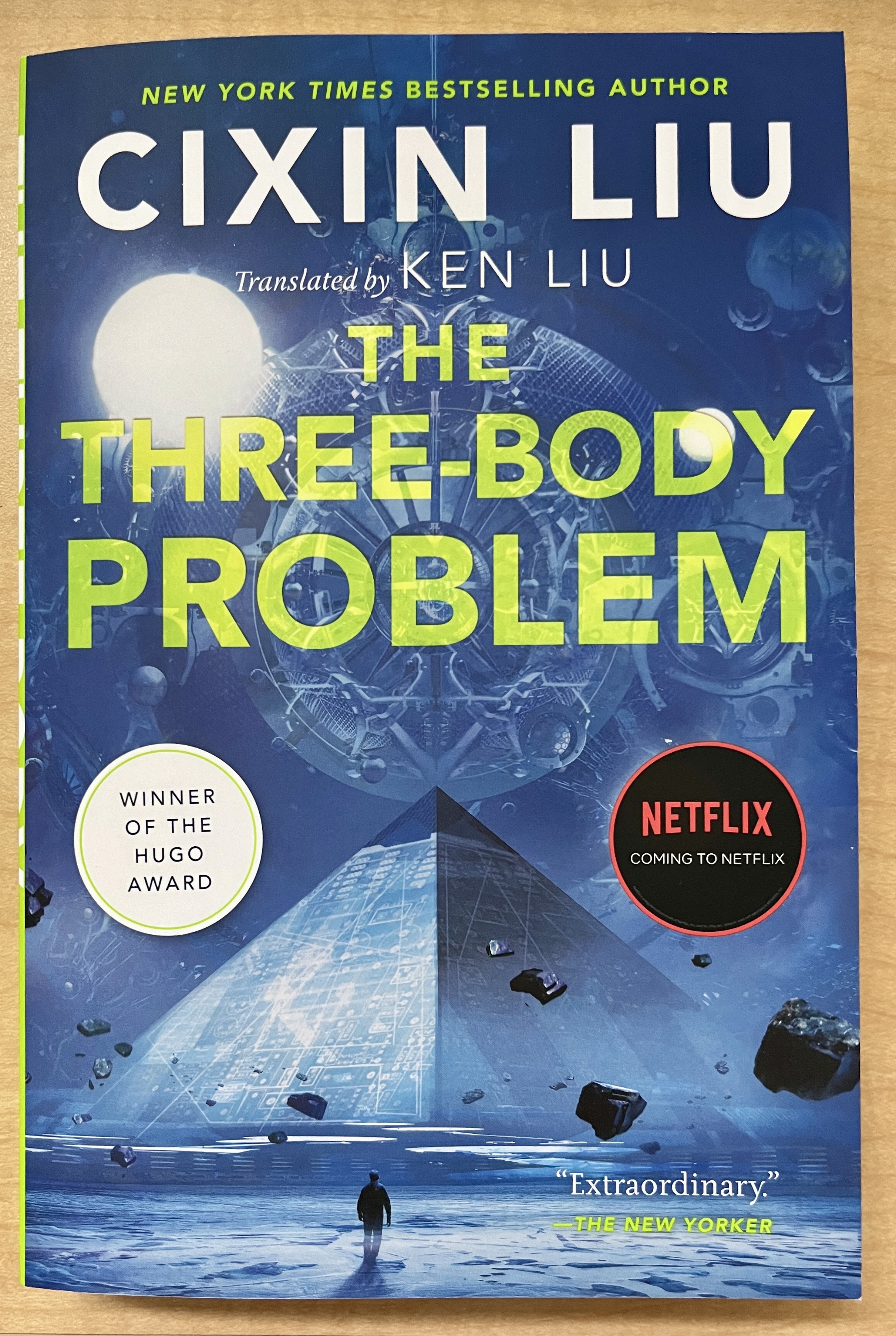
 My sci-fi book buddy recommended this a few years back, but also warned that it was “hard sci-fi” so I had avoided it. Then I watched the first season of 3 Body Problem on Netflix, and decided to give this a try.
To summarize this book is challenge, but here’s my attempt. An astrophysicist named Ye, exiled to a remote and secret listening station, finds an opportunity to broadcast a message across the universe, which is answered by a civilization that is relatively nearby. Despite a clear warning, she sends a second message inviting the others to come to Earth. As people of Earth learn of the existence of the aliens, disruptive and rebellious groups attempt to lead further contact and create a welcome for the newcomers. The aliens, hoping for a smooth first contact, attempt to stifle further technology development on Earth to ensure that humanity remains at its current state, which is behind their own development, until they arrive. Along the way, we meet several scientists, military and police officers, and rebel leaders, who argue, battle, and clash over who should be in charge and how to make decisions.
The titular three-body problem is a real physics problem with no known solution. It considers trying to develop a formula to predict the positions of three separate objects (celestial bodies) that orbit around each other. Such a system is chaotic due to the influence of the gravity of each body on the others – as one is affected by the gravity of another, its path of movement will change and so its future position and velocity are unpredictable.
This problem is relevant for the aliens – their world continues to be devastated by three nearby suns. Because they cannot predict their movements, their development progress continues to be interrupted. They see a relocation of their civilization to the more stable Earth as a solution to the uncertainty in their own system.
While there is a lot of science in the book, there is also a lot of history and politics, as well as some great characters, dialogue, and action. I think it did help that I had watched the tv show first, if only to make me less fearful of the science; the show moves much of the action to global settings (which I don’t think was necessary for anything other than casting), while the novel sticks almost entirely to Chinese characters and locations.
At the heart of the story is the (mis)conception of astrophysicist Ye of the moral superiority of the aliens. In her early despair, she says: “Is it possible that the relationship between humanity and evil is similar to the relationship between the ocean and an iceberg floating on its surface? Both the ocean and the iceberg are made of the same material. That the iceberg seems separate is only because it is in a different form. In reality, it is but a part of the vast ocean…” Her life experiences make distinction between evil and humanity near impossible, thus she seeks rescue from beyond the stars: “To achieve moral awakening required a force outside the human race.”
Later, when explaining her invitation to them, she says: “If they can cross the distance between the stars to come to our world, their science must have developed to a very advanced stage. A society with such advanced science must also have more advanced moral standards.” Her naïve faith in the inherent goodness of science to be always for the good of humanity is sadly poignant, and scarily prescient of current times and recent history. Spoiler: she is really wrong on this point.
I enjoyed this book a lot, and so will persist with the full series, adding the next two novels to my upcoming reading list.
Fate: I’ll hang onto it for a while, for reference when I read the other books.
1 – a book with a murder
9 – been made into a film
13 – set somewhere I’ve never been
15 – a number in the title
21 – a translation
25 – a new author to me
36 – part of a series
 rclr
rclr 