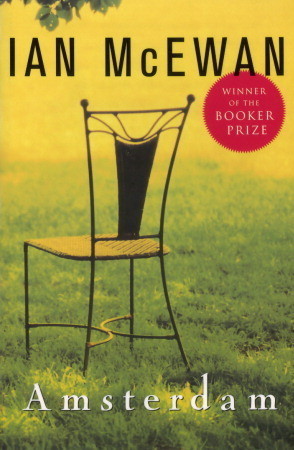
 This is one of those that’s been sitting on the bookshelf for ages, with the occasional false start over the years. I decided to start again and finish it off, if for no other reason than to satisfy the “place name in the title” category. Also, I enjoyed my last dip into McEwan’s work, which came highly recommended by a fellow reader and Barnes lover.
At the start, we meet two long-time friends – Clive and Vernon – who are both former lovers of the recently deceased Molly. Clive is a composer of some modest fame, and Vernon is a newspaper publisher. Their common connection with Molly seems to be the basis for their friendship, which is otherwise tenuous, based on the duration of their acquaintance rather than its meaning or quality. In a bout of hypochondriasis, Clive thinks he’s contracted the same disease that took Molly (the suggestion is CJD), and he extracts a commitment from Vernon to “take care of him” in the event he succumbs; Vernon agrees only if the promise is mutual. “Taking care of” means euthanasia in The Netherlands. Once this is established, the story moves through the various lives and tribulations of Clive and Vernon, touching on several other people who had relationships with Molly.
While I enjoyed this story, there were many elements that felt incomplete or shallow, not the least being the fulcrum of all the stories – Molly. We meet her at her funeral, and while we get glimpses of her from the others, these are all biased, fuzzy, and incomplete. Of the characters we do get to know more intimately – Clive and Vernon, as well as Molly’s husband, George, and another former lover now Foreign Secretary, Julian – none are either likeable or sympathetic. You want them all to get a comeuppance of some kind, but alas, only a few do.
The ending is quite clever in a Poirot kind of way, but I felt afterwards that the author came up with the ending first, and then tried to derive a story that would lead to that. There was also a convoluted and highly unbelievable section about Clive going for a ramble and witnessing a crime, which felt contrived solely to move another point of the plot forward. There were also missed opportunities to explore more deeply the creative process, the fields of journalism and publishing, and euthanasia, each of which is glimpsed but barely.
I was surprised that this book was a Booker prize winner, but perhaps there was something in the reflection of the cusp of the Millennium that was appealing to the prize judges. I was also surprised at the persistence of some of the issues touched on in story. One character, known for espousing family values and morality alongside racism, is found out to be a transvestite (the word appropriate to the time, what is now known as cross-dressing). There is an argument between Clive and Vernon about the virtues and journalistic essentialness of publishing the photos. Vernon believes that there is a moral imperative (as well as benefit for his paper) to publishing the photos as scandalous and unmasking a hypocrite. Clive sees this for the rationalization that it is, saying, “If it’s OK to be a transvestite, than it’s OK for a racist to be one. What’s not OK is to be a racist.” I found this to be an interesting and sound way of looking at modern culture, with the cancellations of complex people based on a single dimension of their beliefs or experience. We haven’t come far since the last century.
I liked the book enough to finish it, but not to recommend it highly. It doesn’t turn me off McEwan, as the writing was engaging enough and the clever ending quite interesting. I will try something else sometime.
Fate: Little book library
1 – a book with a murder
17 – a place name in the title
20 – a one word title
29 – leftover
34 – prize-winner (Booker)
March 2025 post-script: in re-reading this, I remembered that I have also read McEwan’s 2007 novel, On Chesil Beach, and that it felt like a similar structure – the author envisaged the ending, and then worked backwards on a story to get there. I felt the same discomfort with that story, that it was somewhat clumsy in how it got to the ending.
 rclr
rclr 