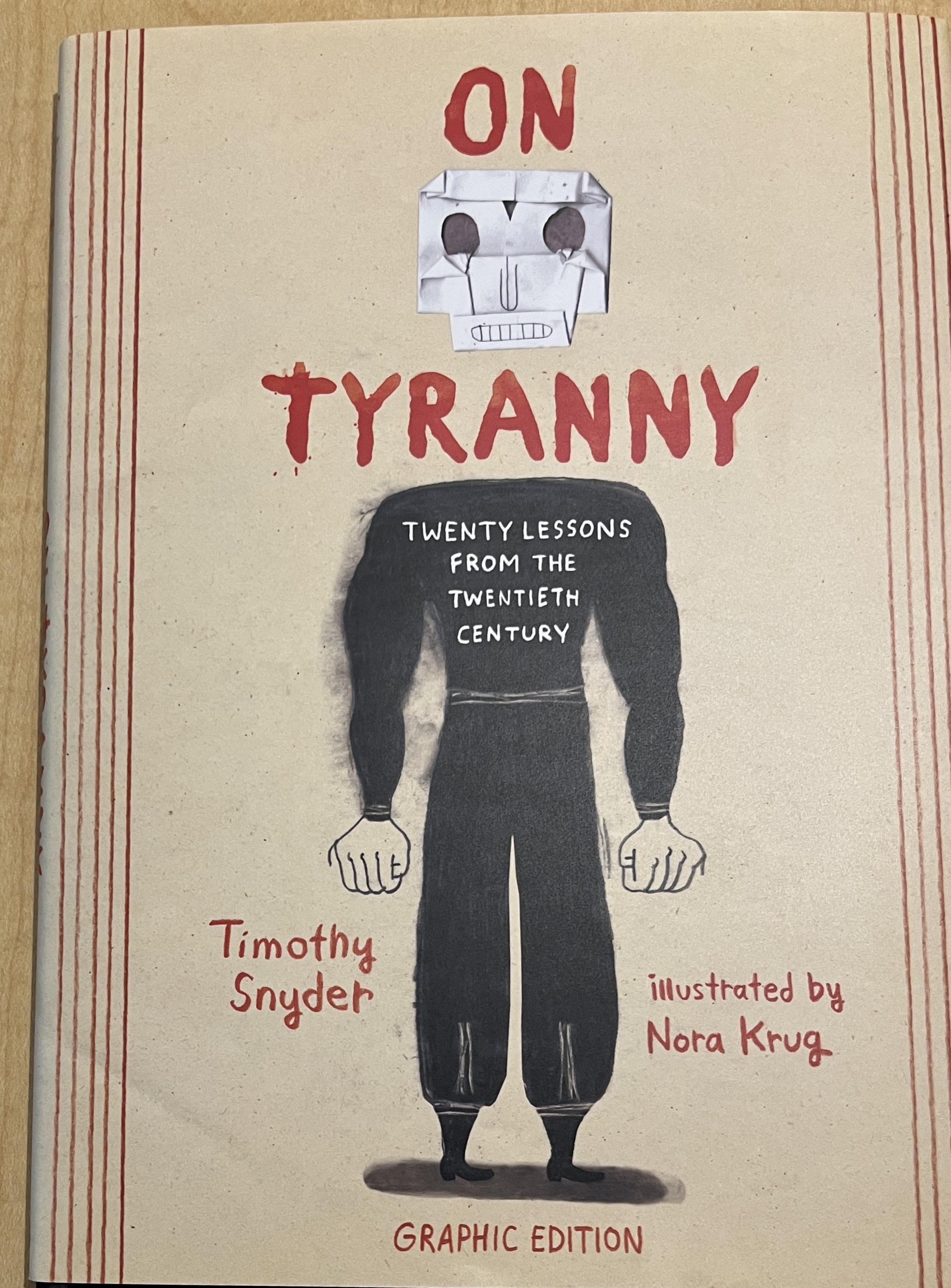
 This book has popped up on reading lists and various sites over the past few years. I expected it to be a weighty slog (turns out, it’s quite short), but the graphic edition makes for an easier, if just as sobering, read.
Snyder is a professor of history and human sciences. Krug is an award-winning illustrator and graphic artist. Together, their messages are evocative and insightful, provoking the reader to consider times past and present and to contemplate the immediate future by looking around and listening carefully.
Snyder presents 20 lessons from the 20th century about the emergence, rise, domination, and downfall of the two extreme ends of the political spectrum – Nazism and communism. Lessons such as, “don’t obey in advance” and “beware the one-party state” – these all seem especially relevant these days and over the past few years. However, while Snyder is clearly offering many of these warnings against the rise of conservative (i.e., Republican) politics in the US, zooming out one can see how these can apply across the spectrum.
The lessons are for citizens, not for politicians (although they could learn some things, too), and are reminders of the need for everyone to remain vigilant and informed, with a persistent and healthy skepticism of anyone claiming to speak for everyone, to provide a fix for everything, or to be trusted with more and more control of the public and private spaces in society.
Under, “take responsibility for the face of the world,” Snyder is warning against the emergence of seemingly innocuous and inclusive symbols. While these are often advanced as ways to show commitment and demonstrate loyalty, signalling to the world one’s support for and belief in causes, they often and quickly become sources of exclusion. In today’s social media world, such signalling includes adding flags or other messages of solidarity to profiles, posting pictures or videos with hashtags of current events, and resharing “news” that quickly becomes stale. When combined with other lessons, such as “investigate” and “be kind to language”, Snyder reminds readers and citizens of their own power and responsibility for truth and compassion, and to be wary of both the bandwagon and the mainstream.
Under, “listen for dangerous words”, Snyder says, “Be alert to the use of the words extremism and terrorism. Be alive to the fatal notions of emergency and exception. Be angry about the treacherous use of patriotic vocabulary.” From recent days and events, I suggest that existential threat, genocide, and any of the many -isms in common use today are good additions to this collection. Such extreme language, especially when used repeatedly as part of a slogan or platform, both exaggerate situations and diminish the power of language to convey things clearly. If everything is an existential threat, from the climate to an individual, then how will we recognize and describe something even more serious?
When someone points at and demonizes the other person, says, “vote for me because the other side is bad for the country”, perhaps we can recognize that they are not saying that they are good for the country, just that the other side is potentially so much worse. When people advance to power through emergency and exception, circumventing processes and relying on changes to long-standard rules, in the name of saving the nation, how does that represent a free and democratic system?
To me, the important lessons here are that ALL sides are suspect and as individuals we have the opportunity and obligation to pay attention, ask questions, and either affirm or deny power to others. When politics morphs into dogma – when questioning is surpressed – that’s when there is a danger of tyranny emerging. We must be alert and circumspect of any side that says, “we know what’s good for you,” when someone offers slavery as a form of freedom, promises peace through war, and tells us that we are strong and united while keeping us ignorant of the truth.
Fate: this is a slim enough book to keep, as I’ll likely revisit it over the coming months in the tempestuous political realm, and may loan it to others who are interested.
5 – a book about language
12 – a book I should read
25 – a new author to me
31 – history/politics
 rclr
rclr 
Thank you
<
div>Sorting out our political choices