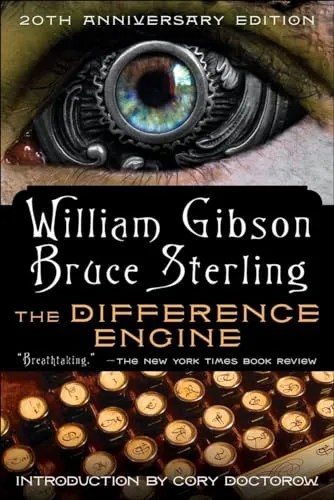
 I chose this book after recently completing Burning Chrome by Gibson. The premise of this intrigued me, and I wanted another sci-fi book for my other book club project.
The titular difference engine is a reference to an early computing machine created by Charles Babbage. He subsequently merged the difference engine with the Jacquard machine (which used punch cards to program looms for weaving) to create the analytical engine in 1837, which was the precursor to the modern computer.
In the novel, the authors imagine that this engine and its future development advances rapidly, becoming by 1855 as ubiquitous as the internet is today, albeit powered by steam engines. So, we have a world in which people still get around by horse and carriage (although steam-driven vehicles are emerging), but a computing system is at the heart of modern life. Welcome to the cyber-steam-punk world of Gibson and Sterling.
The story involves three main characters, each of whom encounters a set of mysterious punch cards for a difference engine. Each is entreated to keep the cards safe, but why and from whom is unclear to each of them. Along the way, we meet versions of famous people from that time who are now on alternate trajectories due to the engine’s influence on the world. For example, John Keats becomes the equivalent of a filmmaker rather than a poet, and Lord Byron survives and becomes Prime Minister of Great Britain. In this world, scientists are treated as heroes (known as “savants”) and given a high status in society.
The novel is redolent with Gibsonian foreshadowing of technology. Two characters begin a scheme use the engine idle time for alternative studies or analysis, something that modern computer systems now do routinely. While the initial purpose is for scientific analysis, the darker anticipated use of this computing time is for social monitoring of everyone in London – where they are at any moment, what they’re doing, who they’re with (in the novel, a similar system in France is used entirely for that purpose). Remember, this novel was written in 1990, well before much of the social networking we take for granted today.
There are other instances of foresight about the manipulation of mass media (“There is a wicked pretence that one has been informed. But no such thing has truly occurred!”), the failures of scientific modelling at predicting real-world events, and the development of military camouflage. Perhaps the greatest is the revelation that emerges about the set of punch cards – they are a version of a computer virus, so when fed into a difference engine cause considerable disruption and chaos.
While I enjoyed this novel, it was certainly the case that the stories – the mysteries of the people and their interactions with the mysterious set of punch cards – get somewhat lost in all the steam-tech, especially the long section in the middle about the single night of revolution in London (the Luddites try to take over. They lose.) The characters are great, believable, and engaging, as is much of the mystery story, but they felt lost often in the sea of background and situation that make up the mise-en-scene of the novel. The pathway to resolution is perhaps unnecessarily complicated. In fact, the “resolution” doesn’t really happen, and the story peters out in a way that is intended to reveal…that the entire story was written by computer (it wasn’t really, they just wanted it to look that way). But to me, that part is not believable, because the intricacies of the story and (especially) the character development is all too human.
Of considerable interest in this edition is the afterword, a conversation between the authors 20 years after publication, where they talk about their collaborative method. In addition to the writing process they followed, we learn about how they shared files – in the days before the internet and email and file sharing sites, they had to ship floppy discs back and forth between them and use a fax machine for more immediate sharing of text – and were embracing for the first time the effectiveness of the word processor over the typewriter. Technologies that were mind-blowing at the time, now seem as quaint as the difference engine itself.
Overall, this is a fascinating read with a good story. Not likely something I’ll read again but definitely something I will think about.
Fate: I’ll hang on to this for a while, for my other book-club project, and then likely pass it along to another reader.
1 – a murder
33 – Canadian
 rclr
rclr 
Leave a comment