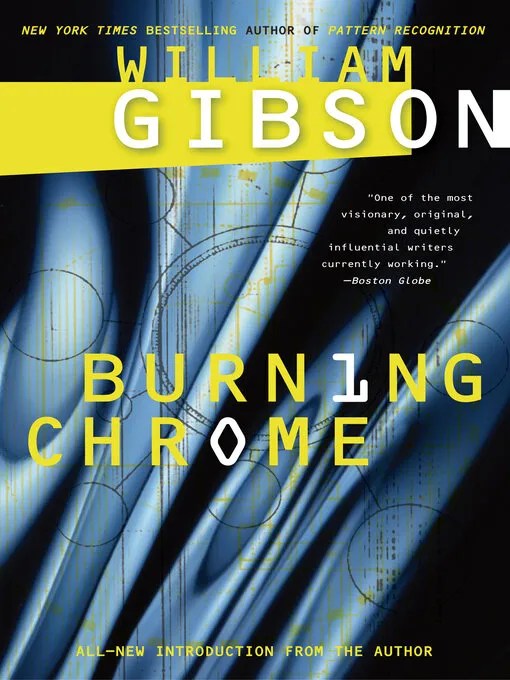
 I first read this book in the early 90s, a gift from a friend. I enjoyed it very much, but never returned to it as sci-fi is not my favourite genre. However, I’ve read a few good sci-fi books lately and enjoyed them, so I returned to this one to see if it stood the test of time, which it most assuredly has.
William Gibson is an OG of sci-fi, one of the GOATs of the genre, known for his detail in his stories and his prescience. Indeed, it was in one of the stories in this book (his only book of short stories to date) that the term “cyberspace” was coined, but here we also see the first glimpses of bizarre forms of human enhancement and transplantations, brain-chip implants and augmentations, bone-conduction headphones, centralized digital currency, and the omnipresence of surveillance and the internet.
There are 10 stories in total, each written at different time, and sometimes with collaborating writers, giving each story a unique theme and world. I liked all of them, but my favourites are:
- Johnny Mnemonic, for its intensity and then-futuristic take on brain implants as data storage, merging technology and human in a way that, in 1981, was truly futuristic.
- Hinterlands, one of the few of Gibson’s stories to involve the traditional space-travel element of sci-fi. Here, we have space travellers returning from galaxies far, far away with advanced technology and psychoses that render them mostly incapable of sharing their discoveries, and the people who greet them upon their return, trying to ease them back into the world.
- The Winter Market was the story that I read first, from my friend’s recommendation. Set in a sort-of Vancouver, complete with Granville Island and Fourth Avenue, the “singer” is someone able to communicate their dreams to others, in a world where listening involves actually plugging the “music” into your brain. Here, the singer actually gets absorbed into the internet, being able to “live” forever in the system.
The far-reaching influence of Gibson’s cyberpunk worlds is evident in many more mainstream technology and art. For technology, the emergence of AI, Neuralink, CBDC, and bone-conduction headphones have clear connections, if not origins, in these stories. Movies such as Strange Days, The Matrix, and Minority Report, as well as the direct adaptation Johnny Mnemonic, owe a great deal to the worlds and technologies created by Gibson.
This set of stories was especially interesting for the geopolitical contexts they all rely on – the evil presence of the Soviet Union and the emerging technological and economic dominance of Japan, neither of which has persisted in exactly the way they were in the early 80s when these stories were written. In that sense, they present what-ifs that are intriguing – what if the USSR became the predominant power over the US? What if the technologies and shady criminal underworld of Japan became a controlling element in the world order?
Gibson is known for both the cyberpunk and the human elements of the stories, with characters that have real emotions and regular needs like food and sleep rather than super-hero-like abilities. The stories include explanations of the technologies, but without any awe, as the characters and worlds see these fantastic elements as normal for them. All of which makes these very accessible and understandable to the reader in ways that harder sci-fi doesn’t.
Fate: definitely keeping this one, as talisman of my youth.
1 – a book with a murder
9 – made into a film (Johnny Mnemonic)
18 – short stories
28 – old favourites
33 – Canadian
 rclr
rclr 