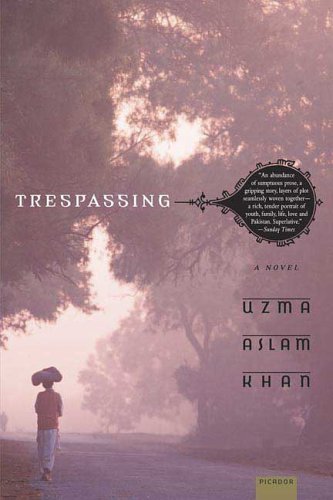
 I’ve had this book on my shelves for a long time. I bought it after reading Fallen by David Maine (and a few of his other books), and reading in the author notes that his wife was also an author. For whatever reason, I never got around to reading this one until now.
Trespassing is set primarily in Karachi, Pakistan, and mostly in the late 1980s and early 1990s. The historical backdrops then are the Afghan Mujahideen, based in Pakistan, and the USA’s Gulf War in Kuwait and Iraq. The story is both a family drama and love story, set within these turbulent times. Each of characters is given space and a voice to tell their story, and these are interwoven nicely, switching from one to another as mysteries and family histories are told. By the end, the three families and seven characters from disparate backgrounds and experiences are shown as complexly interconnected in extraordinary ways. The writing is beautiful and evocative, and the pace of the story is balanced and tantalizing, with the revelations unfolding in what feels like real-time but with always just a bit more mystery to follow.
In several places throughout the novel, Khan comments through her characters on the duplicity of politicians and states, the coopting and corruption of the media, and the tensions in all societies between races and between men and women. One character (Daanish) is studying journalism at an American college. He tries to write about what he sees, especially the hypocrisies of the US foreign policy around the Gulf War, but is discouraged by his mentor; in response to a piece that asked about the American motivations and objectives in Kuwait, he’s given a failing grade with the comment, “you’re going to get nowhere by siding with Saddam.” Daanish becomes a stand-in then for anyone who sees past the veil of the mainstream media, but cannot pierce it, Cassandra-like in their futile attempts at discourse or revelation.
Khan explores through her characters the many faces of racism. In America, Daanish is surprised to experience it in the country that he’s always been told is the great egalitarian melting pot. Within Pakistan, a person’s regional background (which province in Pakistan they are from) and the shade of their skin play an outsized role in their social standing; native Pakistanis are discriminated against and decried as “taking our jobs” by business owners and workers who are recent immigrants from neighbouring countries. The political turmoil in Pakistan in this period, with the inexorable rampant violence and corruption that presents near daily violence and peril to the ordinary citizen, is fuelled by these social and interracial divides, and Khan makes these quotidian trials vivid and real.
I was greatly impressed by Khan’s ability to make social commentary through her characters without getting in their way with her own editorializing or speechifying. At one point, Daanish berates an American friend about their privilege; he calls out their claim that Americans know about persecution because that’s how America was founded by saying, “That may be true. But whatever it was your parents or grandparents had to put up with, the fact is that you never did. Now, you’re not the persecuted anymore…” Written in 2003, this is Khan speaking to the America that launched the wars in Afghanistan and Iraq, created the Patriot Act, and denied or ignored its own role in creating the very forces they were fighting – the Mujahideen, Al Qaeda, and the Taliban, to name a few.
I really enjoyed this book. There are well-developed characters, a complex and compelling story, layered love stories, and a well-told historical setting for it all. I look forward to exploring more of Khan’s writing (although like David Maine, she doesn’t have many books).
Fate: I’ll look to pass this on to someone who I think might enjoy it. Otherwise, little book library.
1 – a murder
8 – female author
13 – set somewhere I’ve never been (Pakistan)
20 – a one-word title
25 – a new author to me
37 – non-mainstream
 rclr
rclr 