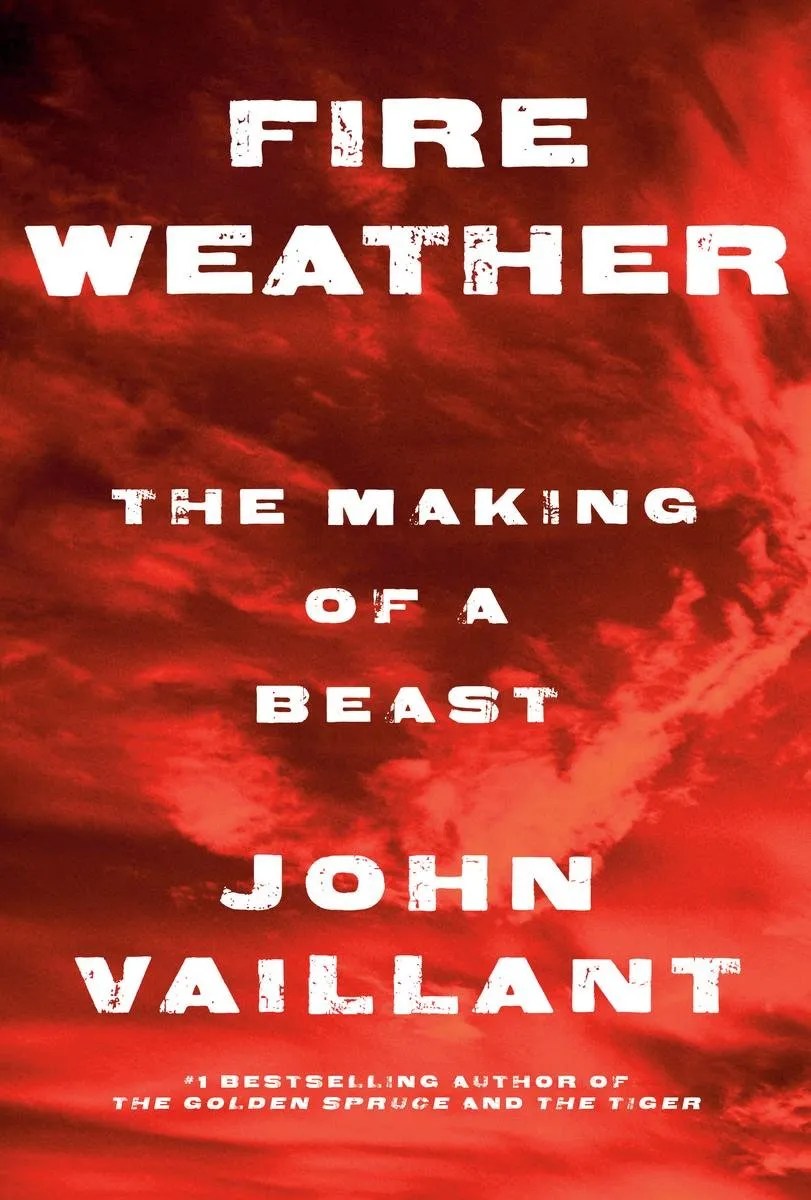
 This was an impulse purchase when visiting a friend with whom I’m working on a nascent book review podcast project. In that “club” we have to read the same book, and then have a discussion about it over Zoom, with the recording (with some editing) becoming a podcast episode. So far, we’ve only made two, so we’re a long way from going mainstream.
We were together in Cafe Books in Canmore AB, and I saw this one. As my friend works in the Fort McMurray area regularly, this seemed like one she should read, so we each bought a copy.
John Vaillant has written two previous books that I’ve read – The Golden Spruce, which was terrific, and The Tiger, which also good but not as good as the former. In Fire Weather, he turns his journalist attention to detail and excellent storytelling on the 2016 Fort McMurray Fire. In that May, a fire erupted near to the Canadian town most closely associated with fossil fuels – particularly, “tar sands” or bituman – and ultimately became the most devastating and costly “natural” disaster in Canadian history. Within 48 hours of first being noticed, the fire had overtaken the town and the region around it, forcing the complete evacuation of the 100,000 people who lived there, as well as the unprecedented shut-down and evacuation of the oil sands and mining sites nearby. It would take over a year for the fire to be finally declared as out.
Vaillant covers several contributing factors in meticulous and clear detail, including the histories of the petroleum industry and previous exploitative resource extraction industries in Canada such as the trades in beaver and otter, as well as climate science. He moves back and forth between the moment-by-moment replay of the fire to various historical and scientific lessons, introducing us to several real-life characters from Fort McMurray and sharing their experiences and memories of that time. It is through these people and their stories that the events truly unfold, as we hear of the decisions each had to make in those days and the reckonings in the aftermath. These personal stories, the step-by-step timeline of the events, and the detailed historical context are where Vaillant excels, both engaging and educating the reader with accessible and compelling writing.
It is in the final parts of the book where I found things to be less compelling, which is unfortunate as it seems that this is where the author wanted to be the most powerful. There are several chapters of righteous lecturing about all the failings of governments, industries, and science to address the climate crisis, with little in the way of suggestions or solutions. The reader is left with a sense of hopelessness about the situation because a) it is so dire, prolific, and unrecoverable, and b) the fault lies entirely with these large and amorphous entities. Moreover, the emphasis in these sections is about the search for the guilty – who is to blame, who failed to do what when – and a lauding of those who provided Cassandra-like warnings in the past 200 years. While perhaps cathartic for author and reader alike to shout out statistics and call out critically terrible decisions of the past, the only solution offered here is litigation – individuals or groups of citizens launching lengthy and costly lawsuits to drain the vast profits of the evil corporations into the noble bank accounts of the environmentalists. This time- and attention-consuming path hardly seems to meet the exigencies of the situation, and all the money in the world won’t bring back those ruined landscapes and lives. As climate change and its outcomes are now inevitable and with plenty of precedent, how to prepare the world for more Fort McMurray fires would be more efficacious than repeatedly pointing out what to be afraid of and who is to blame (hint: we all are).
I was reminded in these latter sections of something that, in a previous working life, a patient advocate once said when speaking at a cancer research fundraising event: stories trump data. You can present all the facts and data and charts you like, and these may all be accurate, but without stories to make them real and accessible, you risk overwhelming and/or boring your audience. Vaillant tries to use the Fort McMurray story to make that link, but perhaps because there is so much data to present, the book lags in the later sections where the data predominates and the story gets lost. Already overlong and dense, the book does return to the stories in the end, but with less interest from the exasperated writer and exhausted reader. At the same time, the end of the book feels rushed and incomplete, as some of the people’s stories are left unresolved.
I was also reminded of my previous read, Beneath the Surface of Things by Wade Davis, which includes an essay on climate change. Davis would agree with Vaillant entirely on the facts and details, but Davis has recognized that shouting at people is not going to engage them in solutions or change, nor will it prepare anyone for a changed world. And both Davis and Vaillant skirt the issue of population growth as a contributing factor: while atmospheric CO2 has nearly doubled since the pre-industrial era (283ppmv in 1800 to 421ppmv in 2020), the global population has increased by a factor of eight (1B in 1800 to 8B in 2020). Also, any modelling work needs to consider and acknowledge its gaps and assumptions, and models that do not consider factors like population growth and distribution (just like those that do not consider cloud cover, water vapour, gaps in the geological record, or large events like volcanoes) are by definition flawed as prognosticators, which is perhaps part of the reason the general public find them less than persuasive.
None of that is to say that the climate is not changing (it is) or that people in general and industries in particular treat the environment terribly (we do). However, I think as long as society continues to value conspicuous consumption as the primary status symbol (something that’s unlikely to change – it’s evolutionary for humans to show off), the climate Cassandras are unlikely to be heeded. While Vaillant’s book explains how we got here and what the drastic consequences can be and are, it ultimately presents a future of repetitive devastation as inevitable. Perhaps then making changes to be prepared for that world would be more relevant than looking for who’s to blame or attempting to stall or reverse that inevitability.
I enjoyed learning the historical and scientific elements, and about the various fires covered (Vaillant also covers other large fires in recent years in California and Australia – which is perhaps another gap in the book: a focus entirely on the first world or “Western” regions). Perhaps his objective was not to provide solutions but to raise the alarm and provide the facts, but like most of the climate science he presents and the scientists behind that, he ultimately fails to engage beyond the outrage or towards any solution.
Fate: I’ll be hanging on to this book for a while for my other project, and then it will join the other Vaillant books on my shelves.
4 – published in 2023
12 – book I should read
13 – set somewhere I’ve never been (Fort McMurray)
26 – science (NF)
31 – history/politics
33 – Canadian
 rclr
rclr 