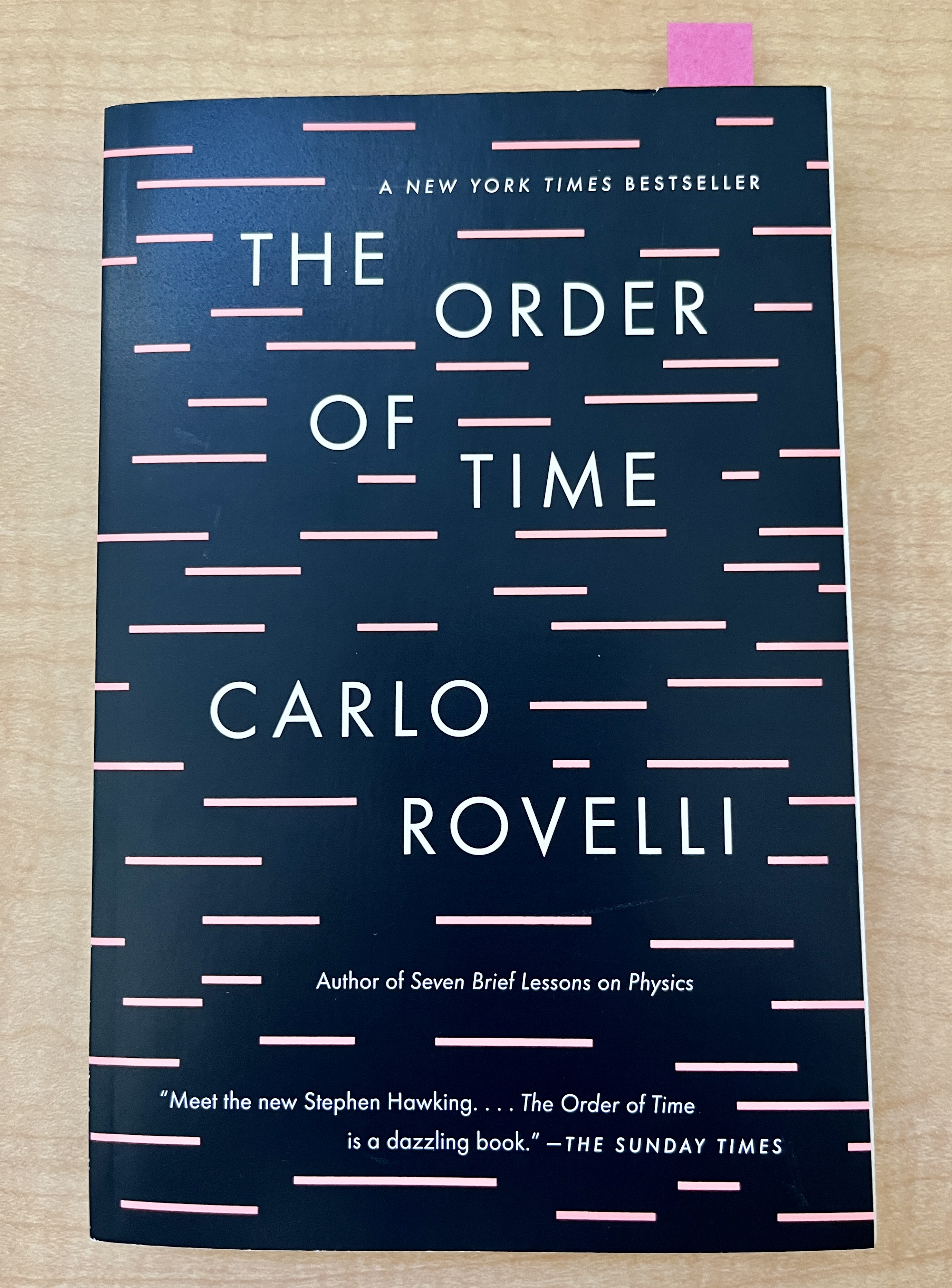
 I heard about this book on a podcast sometime in the past year. While on a bus around the same time, the person sitting next to me was reading it, and when asked how it was, said, “It’s good but some parts are tough.” I agree with that assessment, but ultimately I found the push through the hard math a good use of time.
Part physics, part philosophy, part history, Carlo Rovelli presents the story of our understanding of time, breaks down all the various and evolving physics theories where time is and is not a variable, and then reassembles time in a thought-provoking way.
In the first part of the book, he goes through how we’ve understood time over time (this kind of looping use of the word “time” and the concept “time” is part of the challenge of writing about time). For millennia, we didn’t have a sense of measuring or measurable time. There was day and night, which changed with the seasons and with location. It was only in the 1400s that the idea of there being a clock and hours emerged, and only in the 1800s that these were synchronized between places. When considered on the scale of evolution, it’s no wonder people today struggle with time management and productivity – and even with sleep – we haven’t had time to get used to hours. Rovelli also dispels our illusion of the notion of “the present”, since as time passes for any moment it immediately becomes the past, and any time beyond the present is the future; the present is the knife edge between what has been and what will be, and has no meaning beyond being that dividing line.
The middle bit is mostly about the physics, and the various theories over time about time. From Aristotle through Copernicus and Newton to Einstein and the current theories (such as string theory and loop theory), Rovelli does his best to make these comprehensible and digestible. From here, I took away a few important concepts:
- Rovelli argues that the world is made up of events rather than things, as even physical things are just instances in time of the materials that make them up. He uses music as a great example of this – music is not a thing, but an event, sounds that move through time and that we experience, but otherwise it does not exist.
- Granularity refers to the concept that there is, at an indistinguishable level, a minimum quantum of time – a duration that can no longer be subdivided. This is really more of a duration whose subdivision can no longer be measured. I was reminded here of a game I used to play with a friend – when sharing a dessert, as we would get to the end, we each had to try to take just half of what remained, dividing and dividing the crumbs of cake until finally someone had to eat the last bite.
- Perspective (which is linked to the idea of relativity) means that whatever we’re looking at, studying, or measuring, our perspective – distance, angle, even bias – plays a role in what we perceive. A moment that I perceive as fleeting might be interminable for someone else.
The last part attempts to reassemble the theories and philosophies, where he challenges the human desire to make things permanent, to want concepts and language that bring order and certainty, even to things as intangible as time. Here, he brings the human back into the equation of time, positing that our own individual timelines are comprised of our memories, which represent our past and all the lessons and feelings that shape and colour our lives, and the notion of anticipation, looking ahead to the uncertainty of the future. Both memory and anticipation are balanced on the fulcrum of the present moment, and provide perspective to how we experience it. And all of these are shaped and influenced by love, the ultimate unmeasurable.
As a kind of footnote to how uncertain and slippery the notion of time is, Rovelli talks about sleep – how our dreams can seem like hours or even days of time, but in reality last only a few minutes. This leaves the reader with the sense that there is still much to study and learn and philosophize about time.
In the first section, Rovelli wrestles with the language of time and of science more broadly, and eventually comes to: “…the best grammar for thinking about the world is that of change, not permanence. Not of being, but of becoming.” Near the end, he returns to this when describing how our attempts to bring order to time, or at least to our understanding of it, are driven by this: “The fleeting illusion of permanence that is the origin of all our suffering.” Perhaps, for some things, we should just let the mystery be.
Fate: I really enjoyed this book, and will likely return to it again, not for re-reading but for reminding of the science and philosophy.
21 – a translation
25 – new author to me
26 – science
30 – philosophy
31 – history
 rclr
rclr 