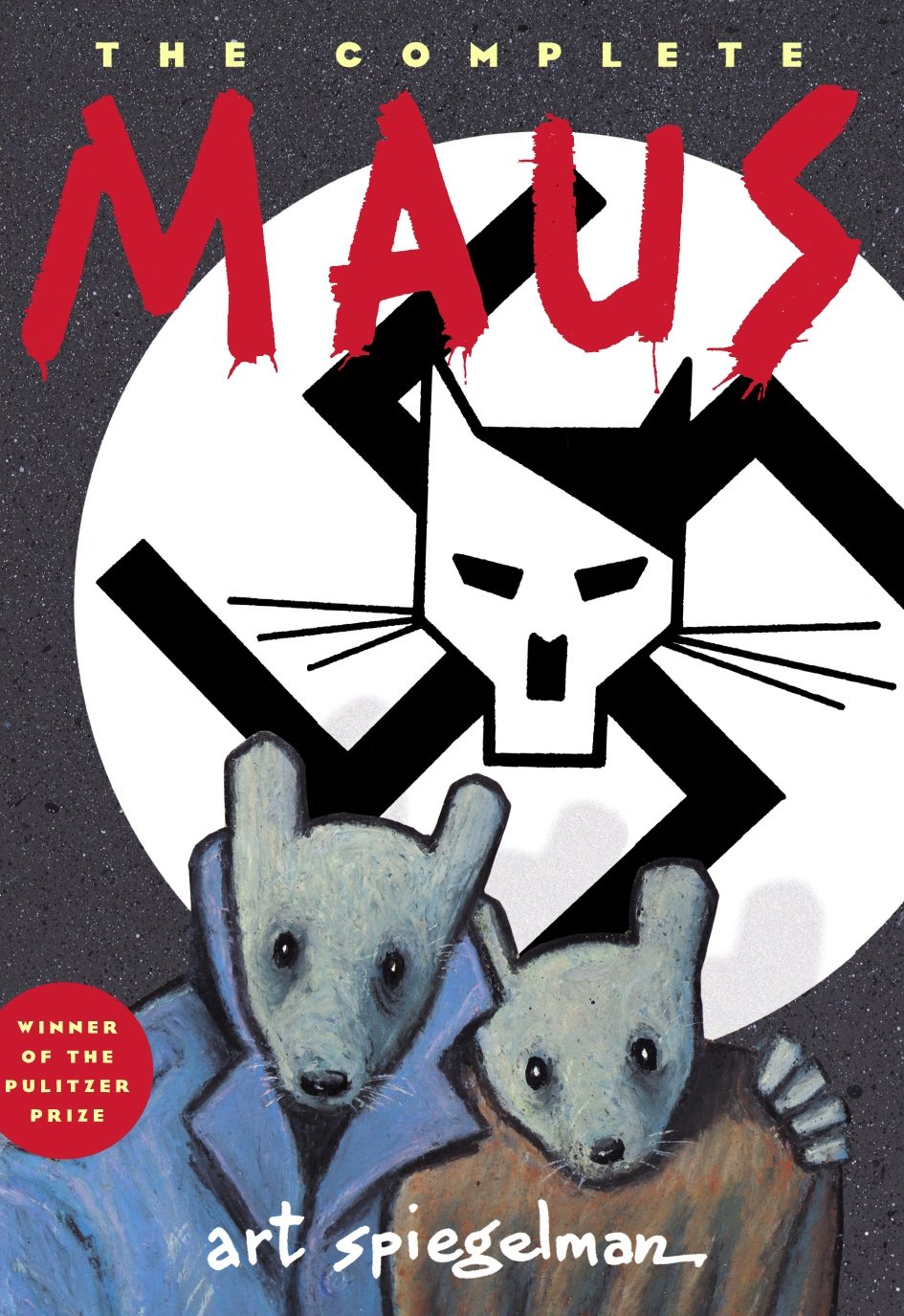
 I hadn’t had any interest in this until recently. My prior experience with graphic novels was less than engaging, and the glimpses I’d had of this one did not make it appealing – dark and violent, with animals in clothes. However, in 2022, a school board in Tennessee decided to ban the book (the day before Holocaust Memorial Day, no less) which made me want to read it. It’s been on my shelf since then and finally made it to the top of the pile.
The author is working on documenting his father’s story of his time during WWII in Poland. The novel moves back and forth from the present and the past, as Art works to extract the story and details from Vladek while also dealing with his challenging personality and his own memories of their family’s past. As Jews in the Southern region of Poland, his parents were subject to the constraints and violence of the Nazi regime, and along with their larger family and community tried to navigate and survive in this every changing and narrowing society. Eventually ending up at Auschwitz, Vladek and Anja are separated, and separately endure the hardships there for 10 months. Reunited after the war, the eventually make their way to the US, setting in Queens NY. Art is born during their journey from Poland (via Sweden).
There are many layers to the story, including the war years in Poland, Vladek’s time in Auschwitz, Art’s childhood and difficulties in adulthood, Art and Vladek’s difficult relationship, and Vladek’s difficult relationships with everyone. The book ends with the end of Art’s documenting of their war story, and with Vladek’s death, but throughout the story moves back and forth between the various threads, much like a conversation would between parent and child, filling in details and taking detours to side- and back-stories.
The reverse anthropomorphism is very interesting, and helps to distinguish between characters and situation. Jewish people, regardless of nationality, are portrayed as mice. Nazis/Germans are cats, Poles are pigs, French are frogs, and Americans are dogs. There’s a Gypsy in a brief scene, portrayed as a housefly. These are not done to be disparaging, but reflecting the Nazi characterizations of Jews and non-Germans as vermin or other, and to satirize the notion that all people of one race/religion/nationality are identical. One might have expected the animal characters to soften the horror, but not at all – if anything, they enhance the overall sense of power differences and perceptions of othering that both created and resulted from that environment and time.
During the war years, the story tells of the familiar and tragic responses of everyone – “oh, they’d never do that”, “it can’t get any worse”, “if we just do what they say, they’ll leave us in peace” – and the steady decline of conditions and the ultimate disintegration of their world. Not with a bang, but a whimper. Vladek’s hindsight is heart-rending, as he sees how decisions made at key points – to stay, to move, to separate, to comply – led inexorably to all the losses and tragedy, while at the same time reckoning with the reality that nothing could have averted much of destruction that occurred. Not only did he feel that he had no choices, but any of his choices would have ended in the same result.
I found this telling of the story gripping and moving in ways that a narrative of the same might not have worked, especially the story of the telling of the story alongside the story itself. It made the complex, not simple, but accessible, without minimizing the horror of the tale at all. While it hasn’t made me enthusiastic about the graphic novel format, I can now better understand its appeal and potential as a storytelling medium.
Fate: little book library, as I won’t read this again.
12 – should read
13 – set where I’ve never been (Germany, Poland, Queens, Catskills)
19 – based on a true story
20 – one word title
23 – memoir
25 – new author to me
31 – history/politics
34 – Pulitzer prize
35 – banned (in 2022)
 rclr
rclr 