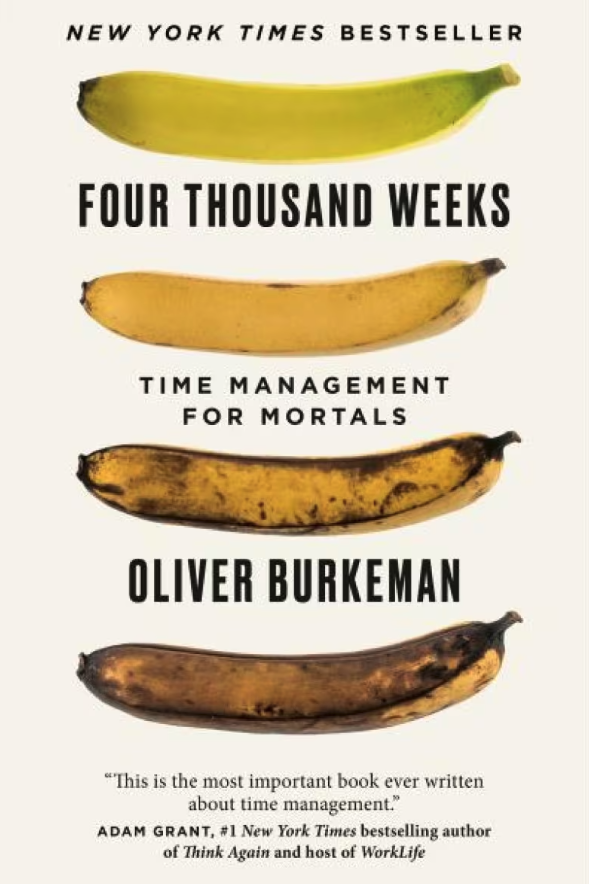
 Oliver Burkeman was, for many years, a columnist at The Guardian, wrote “This column will change your life.” I recall reading several of his columns, and then in 2020 he stopped. As he expands on in this book, he had a bit of an epiphany: that all his efforts to be more efficient/productive/happy (and the associated advice he gave about it) was responding to the wrong questions: trying to be more productive is really trying to stave off the inevitable recognition of our finite lives. The title refers to the average human lifespan in modern Western society, approximately 4,000 weeks. Through the 15 chapters, Burkeman considers two questions: how to choose how to spend the time you have, and how to accept that so much is beyond your control (including how many weeks you will have). There’s a blend through out of carpe diem, eat-drink-and-be-merry, and the serenity prayer, with lots of tidbits from philosophers old and new. He covers distraction and procrastination (these are so appealing because they give us an excuse not to do the serious and meaningful but difficult things), the efficiency trap (the more you try to get on top of things, the bigger the pile gets and the further away the top gets), the benefits of patience (which he practices by going to a museum and looking at a single painting for three hours straight), and the importance of sharing time with others (and how we lose a lot of that with working remotely).
I really enjoyed this book. It is well written and paced, and there is a lot of food for thought in thinking about how to use the finite time remaining in life. Patience and focus are important, but so is recognizing the value of the moments right in front of me, rather than trying to “save time” for the future. When it comes to productivity, while there are always tweaks to my own time management systems, they can be improved by being clearer about the goals, celebrating the accomplishments, and being gentler with myself about what is expected of me by me.
It was interesting reading this book about time management (kind of) along side the books about money. The expressions we use (save time, spend time, make the most of time) contribute to the illusion that time is something tangible that we can control. As someone said to me many years ago: you cannot save time, you can only spend it, but you can choose to spend it foolishly or spend it well.
Fate: this goes on my groaning shelf of business-type books. I can see recommending this to clients who are wrestling with how to get it all done.
15 – number in title
25 – a new author to me
30 – philosophy/religion (self-help?)
 rclr
rclr 