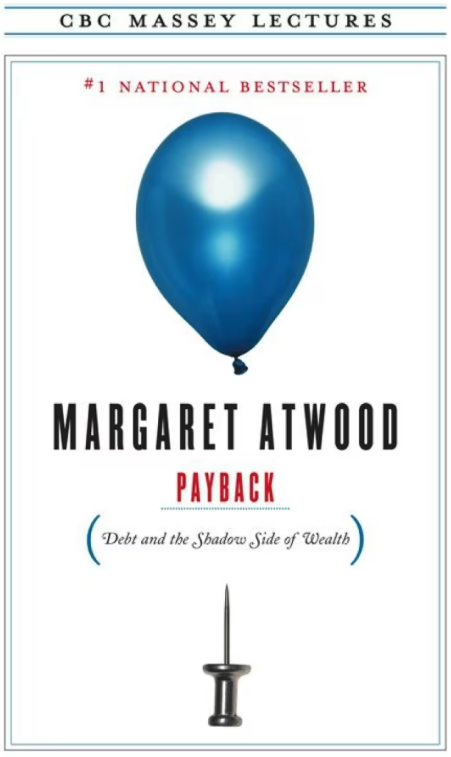
 I’ve owned this book for several years, and thought that I had previously read it. I recall (now) reading at least part of the first chapter, as I remembered the elements of the modern history of mortgages, credit cards, and government loans. However, I realized very quickly that I had stopped reading at about page 25, as the rest of the book was new to me.
I decided to read this as a follow-up to my previous read this year, The Psychology of Money. I expected it to be an interesting companion piece, and it was. However, there are fewer lessons to learn in Atwood, as her study is more about debt as a concept than specifically about money. Subtitled “debt and the shadow side of wealth”, the focus of the book is debt in all of its forms, and its influence on society, culture, and literature. Curiously, there is little about economics here, but that reflects both Atwood’s sensibilities and the general understanding by many of her readers of money and balances of power. Atwood considered debts to society, Faustian bargains, debts of honour, and the more existential balancing in life between giving and receiving, as well as good and evil. There are several literary references – Faust, Scrooge, Shylock, the Tullivers, Chaucer, and Grimms – and these provide for interesting discussion about debtors and creditors, and what is “owed” in various ways.
This is Atwood’s contribution to the CBC Massey Lectures series, and while it was interesting to read it was not enormously engaging, not least because a good proportion of it is lengthly quotes from other sources. Unlike my previous read in this series (the wonderful The Wayfarers), each essay does not stand on its own, but is more like a chapter in a treatise, requiring that you read to the end to get the full meaning. If I had paid to attend just one of these as a lecture, I would have been pretty irritated as the rambling nature of the discussion and the inconclusiveness of each bit.
That being said, I learned a lot about ancient civilizations and the emergence of credit, and it was thought-provoking in places, especially to consider other types of debts. I do think it could have been shorter and more focused, instead of rambling in places.
Fate: likely to go to charity or a little library.
8 – female author
10 – collection of essays (based on lectures)
20 – one-word title
29 – leftover
31 – history/politics
33 – Canadian
36 – part of a series
 rclr
rclr 