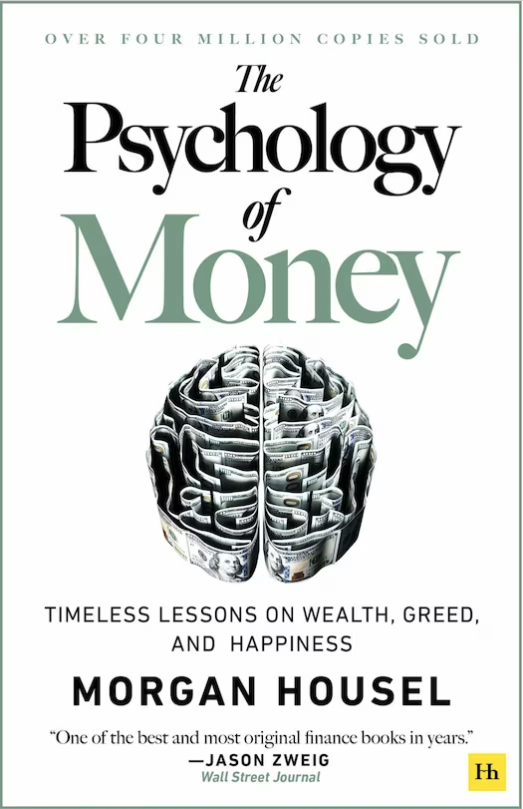
 This book was a 2021 Christmas gift from a colleague, and I read it in early 2022, but somewhat superficially, looking for the key takeaways. I recall some of the points as being adjacent to areas of management, leadership, and life besides money, so decided to read it again.
Through a series of 20 chapters, each with an exemplar story for the key lesson, Housel gets into the contradictory and universal thought processes behind how we handle and make decisions about money, and also why the lessons about money are so difficult for each of us to learn. As much as we like to think that if we track every penny, watch the market and study its past performance, and use our spreadsheets to analyse our finances every which way, we’ll be able to score big and retire rich, “financial success is not a hard science.” First, there are so many things beyond our control, something most people don’t like to admit to themselves. Next is the emotional element of financial decision making, which cannot be adequately captured in looking at history nor sufficiently predicted for in the future. Lastly, we are each of us terrible at figuring out what we need – how much is enough. As the cover promises, there are lots of timeless lessons here, but it is difficult to take them away. Instead, they can be reminders of how to check our own behaviours.
In terms of leadership, I found lessons about planning and goal-setting (and why we’re all terrible at it), that time is ultimately more valuable than money (in fact, the purpose of accumulating wealth is to allow one to have the freedom to spend their time however they wish) which is why time off is often valued more than financial rewards, and the importance of knowing what game you’re playing when making decisions (I see this as a variation of “half the answer is in reading the question”). There is also much about the psychology of comparison, dealing with uncertainty and risk, the seduction of pessimism, and the value of humility in the face of unknowns.
The book is a pretty easy read, and the short chapters and writing style make it readable in smallish bites. I wondered while reading it if it would be a good read for younger people who are experiencing their first financial challenges to a) let them know they’re not alone, and b) give them good pointers for finding a better path. Sort of a modern The Wealthy Barber (who’s guidance is very similar to that found here).
Fate: adding it to my shelf of resources for coaching and work.
7 – author’s debut book
25 – a new author to me
26 – science (I wasn’t sure whether to mark this as science, philosophy, or history, as there is much of all of those in it, so I may reclassify it later)
 rclr
rclr 