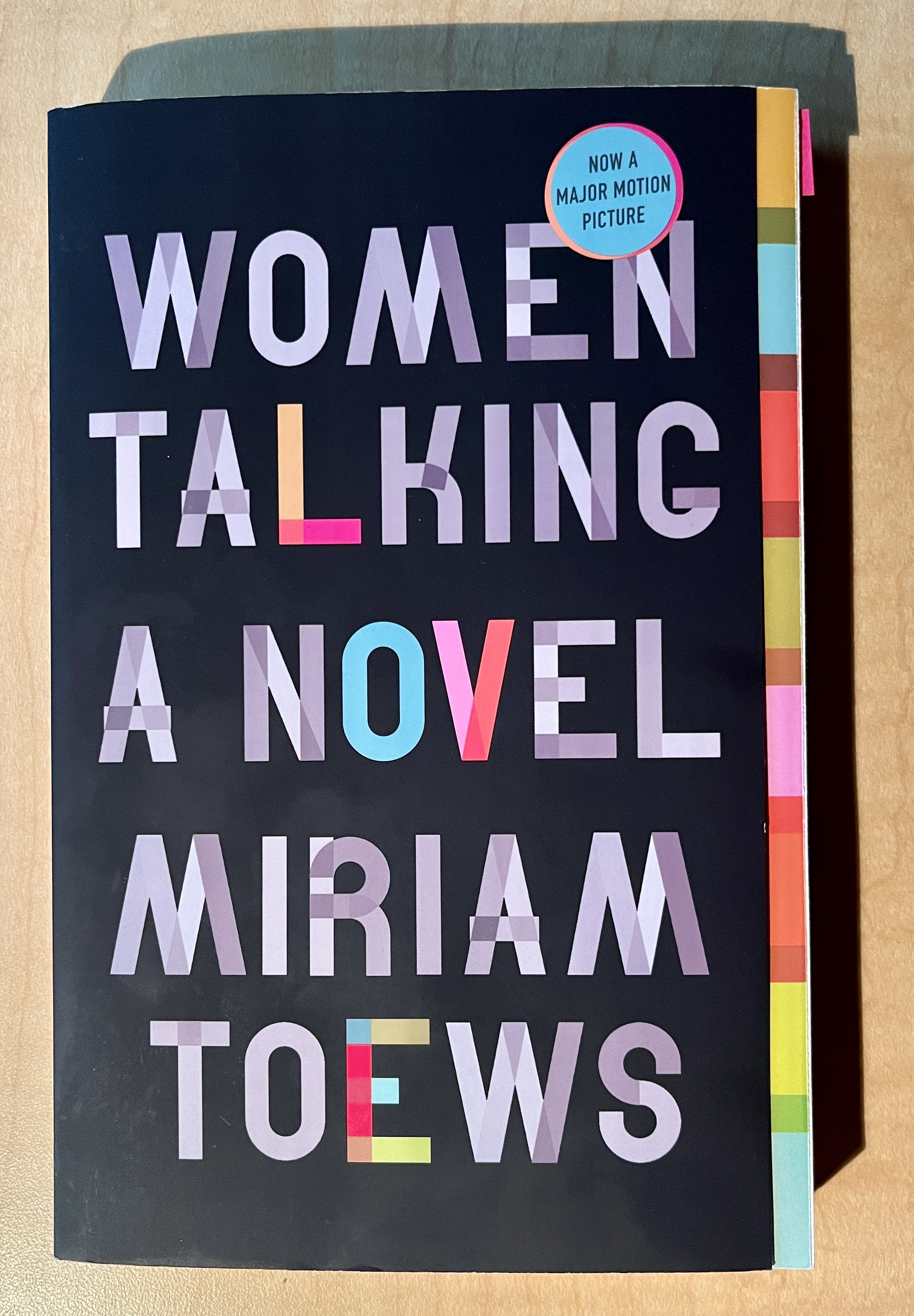
 Women Talking, by Miriam Toews. Pub 2018
I was interested in this book after learning about the movie version from 2022 that won an Oscar for best adapted screenplay. The premise I’d heard was that a group of women in a Mennonite community who are usually mostly silent have some special circumstance to gather and discuss something important. That was close, but not completely the story.
SPOILER ALERT: In the Mennonite community in Eastern Europe/Russia (likely Ukraine), near the Black Sea, the women have for several years been subjected to a campaign of nightly assaults by the men. Until the truth is discovered, the women’s complaints and reports of pain and obvious rape have been either dismissed as fantasy or declared to be some mysterious holy retribution for the women’s unknown sins. The women are either faking it or they deserved it. After four years of this, one woman catches a man in the act and the cabal is revealed. Then, while the men are away at trial, the women gather to talk and plan what they will do next: stay and do nothing, stay and fight, or leave. Their planning is complicated by the reality that none of them can read or write, so they enlist the assistance of the colony’s teacher, a man who was not involved in or aware of the actions of the other men, to help them document their discussion and make their plans.
I didn’t know what to expect from this book, certainly not the horrific assaults at the root of the story. As the women talk and share their thoughts, experiences, and ideas in deciding and then planning their next steps, they are revealed as whole and complex individuals, each with a strong sense of themselves that they’ve till now had to keep mostly hidden in this community. Once their sense of agency and possibility is awakened, there’s no putting it back. They are strong, committed, brave, and conscientious, wanting to create a safer life for their children and themselves. Throughout their deliberations are questions of faith, responsibility, and humanity.
The novel is not without humour or thoughtfulness. The grim horror that they’ve been subjected to is both omnipresent and hardly spoken of. Instead, they talk about what they want to do and who they are and want to be. Their ultimate manifesto could be a basic set of human rights: “We want our children to be safe. We want to be steadfast in our faith. We want to think.”
When it comes to faith, they explore this a bit more and recognize that their views up to now have likely been tainted, as they’ve been entirely dependent on the men’s telling and interpretation of it. If the bible says women should obey and submit to their husbands, does it really say that, or is that just the men’s interpretation? Since they can’t read it themselves, they’ve just taken it on faith that it’s so. As they talk together, they open themselves to the possibilities of other interpretations, other facts, other realities. The genie is out of the bottle, and she is angry and strong and is not going to take it anymore.
This was an excellent book – a clever story and lovely set of characters and a satisfactory resolution. I had thought that I must have read Toews before (as a friend said, “everyone” has read A Complicated Kindness). But I read some of the summaries of that book and have no recollection of it so this must be my first with this author. But not my last. I’m also even more interested in seeing the film, to see the characters brought to life.
Fate: Keeping it for a bit for another project, then off to the little book library down the street.
8 – female author
9 – made into movie
13 – set somewhere I’ve never been
19 – based on true story
25 – new author to me
33 – Canadian author
 rclr
rclr 