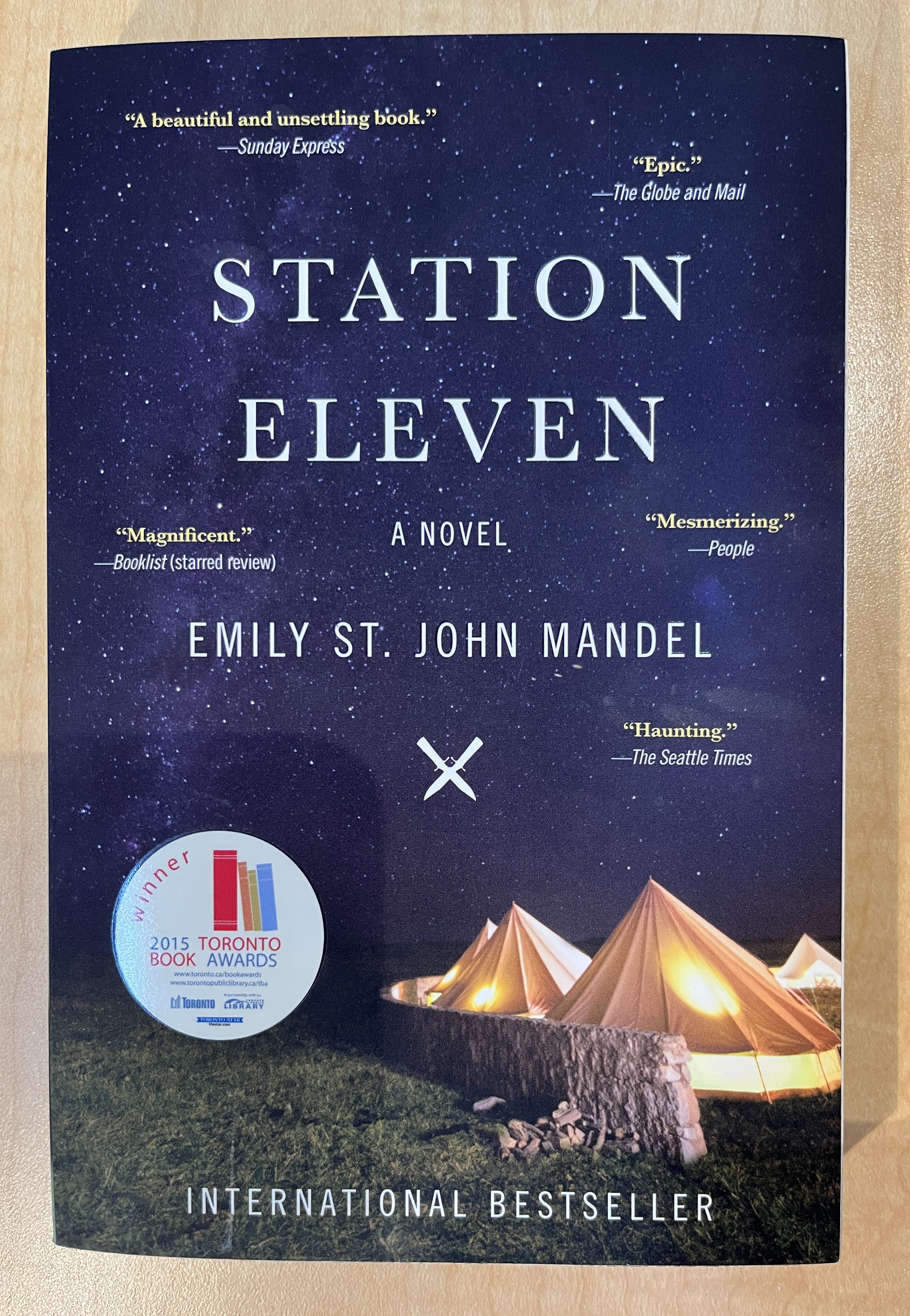
 Station Eleven, by Emily St. John Mandel. Pub 2014
I chose this book based on a recommendation in the acknowledgements of a book I read last year (The End of Men)*. It was interesting to read a second post-apocalyptic book so close after the previous one (Moon of the Turning Leaves), especially one set in approximately the same geographical area.
Spoiler alert: starting in the mid-2010s, the book looks at the lives of several interconnected people in the ~20 years following a global pandemic – one with a 48-hour incubation period, high transmissibility, and more than 99% mortality. Of the barely 1 in 100 who survive the virus, many more succumb to the ravages of a ravaged world – exposure, starvation, violence, injury, suicide, you name it. New communities – most good and some not – emerge within the wreckage of the world. As we learn about the characters and their histories, we see the connections, that were normal in a global community, re-emerge in strange and mostly delightful ways. The nexus of the novel’s characters is Arthur Leander, a middle-aged actor with three ex-wives, one child, and lifetime of regrets. From him, we meet others who were a part of his world, including a woman who is now also an actor, performing Shakespeare for this desolate world as part of a travelling theatre group. The title refers to a set of comic books/graphic novels created by one character but linking all the others and reflecting the disconnection and isolation of the post-pandemic world.
Unlike with the Moon books, here we know the cause of the collapse. But the outcome is very similar – near immediate loss of communication, information, and transportation, followed by the reality of survival in a world where there will be no new things. New orders develop as well, but many here are peaceful, perhaps reflecting the longer time since the event (and perhaps indicating that good beats out evil over the long term). There is a clear divide between people who experienced and remember the “before times” and those who don’t, with the latter seeming to fare better as they don’t know what they’re missing. There’s an interesting debate about this in one community, with a father questioning whether they should teach children (there are enough of them here to have a kind of school) about the way things were. Does exposing them to things like computers and cars inspire them or scare them?
There is a sense of hope at the end, as well as a suggestion that in some respects the world is better off without all the things, and that even though the world is harder perhaps it is more as it should be.
I really enjoyed this book, despite the bleakness of the settings and the fates of many of the characters. I found it more realistic than some others in this genre, partly due to the timeline but also for its not trying to explain everything or close-off every storyline – in a disconnected post-apocalyptic world, many times we just would never know how things worked out for people. For example, at an airport that becomes a community, a plane lands during the height of the pandemic and taxis to the far side of the field. No one emerges and there is just one radio message: quarantine. 20 years later, the plane remains where it stopped, becoming a mausoleum for everyone on board, with no further explanation required.
And now time to read something that’s not about an apocalypse…
Fate: hanging on to it for a bit as part of another book club project. Then to the little book library down the street.
* Another terrific recommendation was for World War Z by Max Brooks, which was excellent as an audiobook-cum-performance.
1 – book with a murder
8 – female author
9 – been made into a tv miniseries
15 – number in title
25 – new author to me
33 – Canadian author
 rclr
rclr 