We, by Yevgeny Zamyatin. Originally published 1924. Translation by Clarence Brown, published 1993.
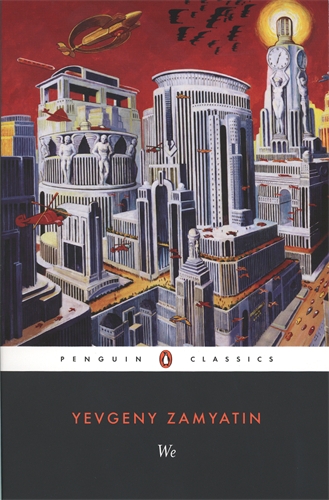 This selection was driven primarily by the need to complete the banned-book category, but also by several pieces in The Happy Reader (issue #10) which made me dig it out of my bookshelves.
Briefly, the story is set in the future – the 26th century. After a 200-year war, civilization has settled down into a civil society where people do not have names, where there are rigid timetables to follow and roles to play, and everyone is happy. There is a Benefactor who oversees all, and people live protected and sterile lives in the city, with no natural elements present. The narrator is D-503, the Master Builder of a rocket being constructed to deliver the message about the goodness of their society to presumed populations on other planets. Citizens have been encouraged to write their own missives to these distant peoples, extolling the virtues of the way of We, and that’s how D-503 begins. Through his journal writings, the reader follows the revelations he experiences that ruin his perceived happiness and contribute to his revolutionary actions.
The writing is a bit tricky to follow, being in the first person, being a translation, and being in a strange style – kind of a personal journal ranging from documentary to stream-of-consciousness. But as I read and kept reminding myself, “this was written in 1920!”, it was a remarkable story to read. Like most good science fiction, the story includes elements that would have been fantastical at the time (and still are) but were in fact predictions or prophecies of the future. In the novel’s main city setting, almost all structures are made of glass – all the sidewalks, buildings, stairwells, furniture. Everyone lives alone in their apartments with clear glass walls, so everyone can be seen by everyone else all the time; a foreshadowing of today’s “windows” into our everyday lives – the phone, tablet, or monitor you’re looking at to read this blog is the modern-day equivalent of those glass walls. In the latter part of the book, a new operation is introduced that becomes mandatory for everyone – a kind of lobotomy (which hadn’t been invented yet in 1920) to remove imagination and promote docility and contentment; in current times, that same window technology might also be seen as structured to dull or remove imagination, to placate the masses. The city in We gets its electricity from towers collecting it from the sky (these also control the weather) and from wave energy from nearby oceans, and people fly around in solar powered autonomous vehicles; none of this tech is entirely here yet, but is in its infancy and eagerly anticipated by some.
This book was a significant inspiration for both 1984 and Brave New World, and likely many others (including HP Lovecraft, Robert Heinlein, and Ray Bradbury), and was itself inspired by the social science fiction of HG Wells. While primarily a commentary on the then recently victorious communists in Soviet Russia, their restrictions on speech and their flagrant propaganda, the story uses Taylorism – the original time-and-motion theories so embraced by famous capitalists and assembly line inventors – as the true basis for the society, with everything rigidly controlled to maximize efficiency, right down to the number of times to chew one’s food. No one has anything and everyone is “happy”, mostly because they know no other way of being. No one is an individual, just a number, so there is nothing other than the collective “we”.
In a discussion between the characters that seems to initiate the breakdown of D-503’s beliefs, there’s an interesting foreshadowing of the rules of 1984 (Freedom is Slavery), in a conversation about religion and paradise:
“Those two in Paradise, they were offered a choice: happiness without freedom, or freedom without happiness, nothing else. Those idiots chose freedom. And then what? Then for centuries they were homesick for the chains.”
As the translator remarks in the introduction to the novel, in the world of We, “All the messy inconvenience of freedom has been eliminated.”
The book had a tortured and circuitous route to publication. Written in 1920/21, there was no way to publish the book in the Soviet Union, so it was smuggled out to the US, translated into English, and first published in 1924. After several re-translations into other languages, it was eventually published in the original Russian in 1952, and finally made its way back to Russia in 1988, where it was published there at the same time as 1984. This 1993 translation is based on that original Russian text. I do wonder about the fidelity of all the various versions, and how much any of them digress from the author’s original text. Zamyatin, a contemporary of similarly troubled authors Bulgakov and Pasternak, drew the considerable ire of the Soviet government after We first appeared in English; he avoided the gulag or execution, and was exiled in 1931 to Paris, where he died in 1937.
Dystopias are never “fun” reads. They are serious, complex, sad, and frightening, and rarely have a happy ending. I enjoy them for the haunting forecasts and impressively imaginative divergences of society. Good dystopias work when they are believable, when the reader can see how close we are, or could be, to the writer’s vision. In that sense, they can provide warnings about those dangerous pathways we might be on when we make or allow for even seemingly minor changes in our societies, when (to paraphrase Benjamin Franklin) we give up a little bit of freedom for a little bit of security, only to find that the security is fleeting but the loss of freedom is permanent.
Fate: this will stay in my dystopia library.
3 – published before 1939
9 – made into a film and a play
12 – something I should read
20 – a one-word title
21 – a translation (Russian)
25 – a new author to me
35 – book (and author) that was banned
 rclr
rclr 